


Safe, painless whitening in Turkey.
Let’s be honest. For many people, the aspiration of a dazzlingly white “Hollywood Smile” gets killed right the moment they take a sip of ice-cold water and feel that sharp, electric jolt running through their jaw.
If you have senIf you have sensitive teeth, the very notion of willingly applying potent bleaching agents sounds pretty close to madness. On one hand, you want the outcome, but on the other hand, you absolutely do not want to go through that process. At Lema Dental Clinic in Istanbul, we are witnesses to this panic daily. We see thousands of international patients who want a brighter smile so badly that they’re scared to death of the notorious “zingers”—those quick bursts of nerve pain during treatment.
It is not just a question of “Is it possible?” The main question is: “Can it be done safely and comfortably here in Turkey?” The answer is absolutely yes. But certainly not with the stuff you get at the drugstore.
The “Volume Knob” Analogy: Understanding the Pain
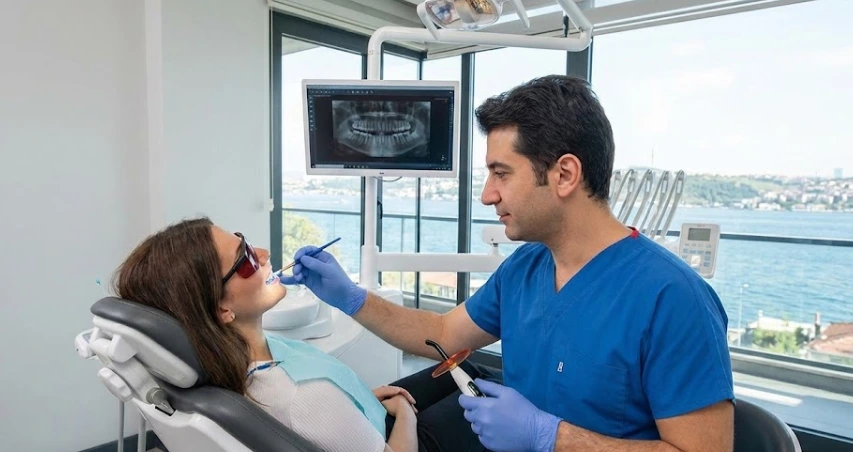
For whitening to be safe for sensitive teeth, it’s necessary first to figure out why they are hurting. The nerve inside your tooth can be compared to a radio. Generally, the enamel and dentin are like walls with soundproofing that allow only a low volume to get through.
When you have sensitivity, those walls are thin or porous. The volume knob is already turned up to an eight. Whitening gels work by temporarily opening the pores of your enamel to scrub out stains. If you use a generic, high-strength gel on an already sensitive tooth, you are cranking that volume knob straight to eleven. It’s too loud for the nerves. At Lema Dental Clinic, our approach isn’t to turn up the volume. It’s to temporarily “mute” the radio before we start cleaning the walls.
The “Clinical Hunch”: The Thin Enamel Trap
I’ve noticed a pattern in our Istanbul clinic that surprises many patients. The people who want whitening the most—those with yellowish, translucent teeth—are often the ones with the most sensitivity. Why? Because their enamel is naturally thin.
Dentist Polen Akkılıç and her team often have to manage expectations here. If your enamel is paper-thin, blasting it with high-intensity Zoom light is a recipe for disaster. It’s a bit of a dental secret, but sometimes the strongest treatment is the worst choice. We often steer sensitive patients toward laser whitening, which is more targeted and generates less overall heat than broad-spectrum lamps.
The “Turkey Safety” Question
We hear the whispers. “Is it safe to get this done in Turkey? Do they use unregulated chemicals?“
Let’s be blunt: bad dentistry exists everywhere. But at a high-level clinic like Lema, safety is an obsession. Professor Doctor Coşkun Yıldız ensures that we only use EU-certified, genuine whitening products (like Philips Zoom or Biolase lasers). The difference in Turkey isn’t lower safety standards; it’s lower operational costs allowing us to offer premium care for less.
For sensitive patients, we have a strict “Pre-Game Protocol.” We don’t just sit you in the chair and start blasting light. We prepare the teeth with specialized desensitizing agents containing potassium nitrate and fluoride days or minutes before the bleach touches your enamel.
Sensitivity Risk Breakdown by Method
| Whitening Method | Sensitivity Risk | Speed of Results | Lema Recommendation for Sensitive Teeth |
| DIY / Drugstore Strips | High (Uncontrolled gel leakage) | Slow (Weeks) | Avoid. Risk of burning gums and nerves. |
| Standard In-Clinic Zoom | Moderate to High (Intense heat/light) | Very Fast (1 Hour) | Only with aggressive pre-desensitizing. |
| Laser Whitening | Low to Moderate (Targeted, less heat) | Fast (1+ Hour) | Preferred Choice. Highly controllable. |
| Custom Take-Home Trays | Low (Lower concentration gel) | Slow (2 Weeks) | Good alternative, but requires patience. |
FAQ: Straight Answers on Pain and Safety
If we do our job right, no,” says Dentist Polen Akkılıç. “You might feel a ‘tingling’ or slight warmth. If you feel a sharp ‘zing,’ you tell us immediately, and we stop and reapply desensitizer. You are in control of the session.
Zoom is like a floodlight; it heats the whole mouth. A laser is like a surgical pen; we target only the tooth structure, keeping heat away from the nerve. It’s slower, but much gentler.
Then we don’t whiten them,” says Professor Doctor Coşkun Yıldız. “Safety first. If your enamel is compromised (eroded), whitening could damage the pulp. In those severe cases, we might discuss ultra-thin porcelain veneers instead.
Usually 24 to 48 hours. We give our patients in Turkey a special post-care kit with high-fluoride paste to “rehydrate” the teeth quickly. Avoid very cold or very hot drinks for two days, and you’ll be fine.
No. We use the same professional concentrations (usually 25% to 40% hydrogen peroxide) used in top clinics in London or New York. The key isn’t the strength of the bleach; it’s the protection of the gums and nerves.
- Markowitz, K. (2010). Pretty painful: Why does tooth bleaching hurt? Medical Hypotheses, 74(5), 835-840.
- Joiner, A. (2006). The bleaching of teeth: A review of the literature. Journal of Dentistry, 34(7), 412-419.
- Browning, W. D., et al. (2008). Comparison of the effectiveness of an in-office bleaching system combined with different desensitizing agents. Operative Dentistry.
- Kihn, P. W. (2007). Vital tooth whitening. Dental Clinics of North America, 51(2), 319-331.
- Haywood, V. B. (2005). Treating sensitivity during tooth whitening. Compendium of Continuing Education in Dentistry.

