


Save Your Bone For Implants
That moment when you lose a tooth can be really quite traumatic; however, the choices you make immediately after that, say within an hour, contribute almost all of the critical decisions in the entire restorative branch of dentistry. Unfortunately, many patients have this misconception that once their tooth is extracted, their “problem” is over and done with.
In fact, the truth is that your jawbone like any other part of your body, is one of those “use it or lose it” organs. At Lema Dental Clinic in Turkey, one of the things we frequently tell our patients is that the bone around their teeth is there for only one reason: to support those teeth. Subsequently, when you lose a tooth, the bone is somewhat like an employee who has lost their job. Due to the absence of the usual stimulation of the bone through the action of biting and chewing, the body shortly thereafter reabsorbs that mineral density.
The ‘Scaffolding’ Metaphor: Why Bone Grafts Matter
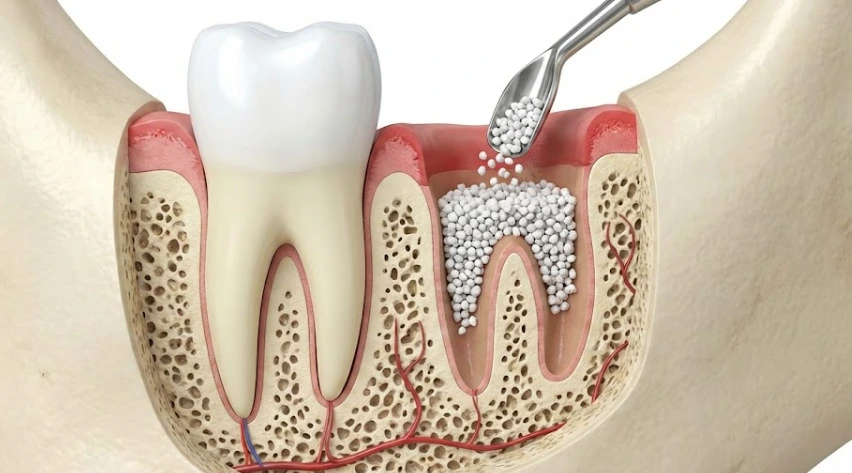
Picture your jaw as being the footing of a house by the sea. The first thing to come out is the ‘piling’ (tooth root), therefore, the adjacent sand (bone) gets washed away and falls in. Professor Doctor Coşkun Yıldız remarks that research has shown that in the first period of six months after an extraction, the affected area of the bone can be reduced by up to 40-60% of its original width.
The clinical procedure of socket preservation entails placing a bone graft in the freshly emptied tooth socket. It is not just a hole that we are filling here; instead, we are providing a ‘scaffolding’. In addition to maintaining the place and preventing it from collapsing, this material also communicates with your body letting it know to regenerate healthy bone tissue.
The Role of Precision in Turkey
According to our clinical experience at Lema Dental Clinic, if this is carried out at the time of tooth extraction, the surgery is really minimally invasive, in contrast to when the next step is delayed. Dentist Polen Akkılıç and her team employ state-of-the-art biomaterials that have a similar structure to human bone, and hence the treated site is ensured to remain “plump” and robust for the subsequent implant.
Why Wait? The High Cost of Delay
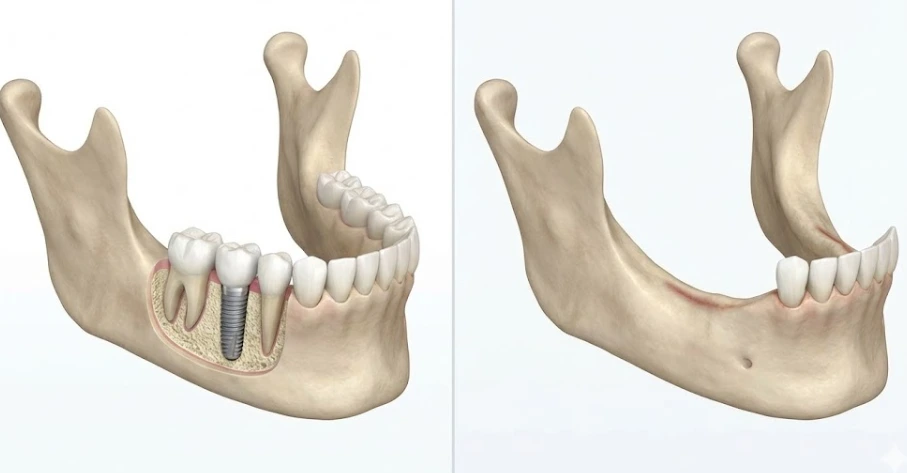
However, if we closely inspect what the result would be had we neglected this particular step, the consequence would be that a collapsed bone would not only make an implant difficult to put in but also drastically change one’s facial appearance. The lips may appear to be sunken in and the teeth adjacent can begin to tilt into the gap.
Here is what we see in the clinic when comparing immediate preservation versus a “wait and see” approach:
| Feature | Extraction with Socket Preservation | Simple Extraction (No Graft) |
| Bone Volume Retention | High (80-90% preservation) | Low (Significant “melting” of bone) |
| Future Implant Success | Predictable and straightforward | May require complex, expensive bone blocks |
| Healing Time | Integrated with standard recovery | May require 6+ months of secondary grafting |
| Facial Aesthetics | Preserves natural gum and bone contours | Can lead to a “sunken” appearance |
| Procedure Cost | Lower (performed during extraction) | Higher (secondary surgeries later) |
The “Sinus Eggshell” and Other Complexities
The question remains: is socket preservation necessary for every single tooth? While it is highly recommended for any site intended for an implant, it is vital in the upper jaw near the sinuses. The membrane of the sinus is as delicate as an eggshell skin. When bone is lost in the upper back teeth, the sinus expands downward, leaving no room for a replacement tooth.
By performing socket preservation here in Turkey, we often save patients from needing a much more invasive “Sinus Lift” procedure later on. It is a proactive philosophy that Professor Doctor Coşkun Yıldız champions—fixing the foundation before the house starts to lean.
Is it Right for You?
Choosing to have a bone graft immediately after extraction at Lema Dental Clinic is about protecting your investment. Whether you are traveling to Turkey for a full mouth restoration or a single replacement, the goal is the same: a stable, long-lasting result that looks and feels natural.
FAQ: Understanding Bone Grafting After Extraction
Not at all. Since the area is already numb for the extraction, you won’t feel the graft being placed. Most patients describe it as a sensation of “pressure” rather than pain. In fact, many find the recovery more comfortable because the graft protects the sensitive nerves at the bottom of the socket.
We use high-grade, biocompatible materials. These can be mineralized bone from a sterile lab, or sometimes we use “PRF” (Platelet-Rich Fibrin) derived from your own blood. Dentist Polen Akkılıç and her team will choose the material that best suits your biological needs.
You can, but it is much more difficult. It’s like trying to rebuild a foundation after the house has already settled and cracked. Doing it immediately is simpler, cheaper, and yields a much better aesthetic result for your gums.
Typically, the bone needs 3 to 4 months to fully mature and become solid enough to support an implant. During your visit to Turkey, we will provide you with a precise timeline based on your individual healing rate.
Rejection is extremely rare. These materials are “osteoconductive,” meaning they don’t stay in your body forever; they act as a guide for your own natural bone cells to move in and take over.
- Araujo, M. G., & Lindhe, J. (2005). Dimensional ridge alterations following tooth extraction. An experimental study in the dog. Journal of Clinical Periodontology, 32(2), 212-218.
- Avila-Ortiz, G., Elangovan, S., Kramer, K. W., Blanchette, D., & Dawson, D. V. (2014). Effect of alveolar ridge preservation after tooth extraction: a systematic review and meta-analysis. Journal of Dental Research, 93(10), 950-958.
- Horowitz, R., Holtzclaw, D., & Rosen, P. S. (2012). A review of alveolar ridge preservation, and an introduction to a new procedure for graftless ridge preservation. Journal of Evidence-Based Dental Practice, 12(3), 118-131.
- Pagni, G., Pellegrini, G., Giannobile, W. V., & Rasperini, G. (2012). Postextraction alveolar ridge preservation: biological basis and clinical relevance. International Journal of Dentistry, 2012.
- Wang, H. L., & Kotsakis, G. A. (2014). Alveolar ridge preservation. Periodontology 2000, 66(1), 138-156.

