


Daily retainers keep smiles straight
Congratulations! That day you have always dreamt of is finally here. The orthodontists took off the brackets, the wires were taken apart, and for the first time after maybe months or even years, you allowed your tongue to go over the smooth, straight teeth.
Still, the time when the braces get removed is not a full stop to your orthodontic story. Actually, it is the beginning of the most crucial stage of your treatment: retention.
Unfortunately, a considerable number of patients see a retainer as a sort of fashion accessory or an item that can be worn “if they remember.” But that is a very risky misjudgment. Professor Doctor Coşkun Yıldız is fond of saying that orthodontic treatment is like pushing a huge rock up a hill. Braces are the energy that pushes the rock to the top of the hill. Your retainer is the wedge that you place behind it to prevent it from rolling back down. If you don’t have one, then gravity or, in this case, biology, will win.
The Science of the Shift: Why Teeth Want to Move

Why do teeth relapse? It isn’t because they are stubborn. It’s because they are surrounded by living, dynamic tissue.
When Dentist Polen Akkılıç and her team use braces to move your teeth, they aren’t just sliding them through inert concrete. They are actively remodeling the jawbone. On one side of the moving tooth, bone is broken down (resorption), and on the other side, new bone is built up (deposition).
This process takes time. Even after your teeth are straight visually, the bone around their roots hasn’t fully hardened. It’s like setting fence posts in wet cement. If you remove the supports before the cement cures, the posts will lean.
Furthermore, the ligaments that attach your teeth to the bone act like tiny, stretched rubber bands. They have a “memory” and are constantly pulling the teeth back toward their original, crooked positions. Your retainer is the only thing resisting this biological pull until the new bone has fully solidified and the ligaments have reorganized.
The Lema Approach: Securing Your Investment
In our clinical experience at Lema Dental Clinic, we find that the first 6 to 12 months after braces are absolutely crucial. This is when the risk of relapse is highest. We don’t just hand you a piece of plastic and wish you luck. We develop a personalized retention protocol for every patient.
Retainer Types: Pros, Cons, and What to Expect
Understanding your tools is half the battle. Here is a breakdown of the most common retainer types we use in our Turkey clinic:
| Retainer Type | Description | Pros | Cons |
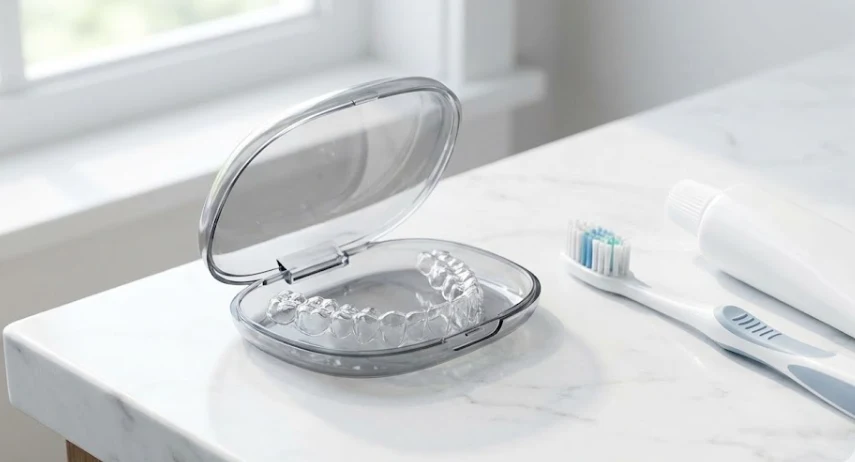
| Essix (Clear) | Transparent plastic tray, similar to clear aligners. | Nearly invisible, comfortable, protects against grinding. | Can wear out or crack over time; requires diligent cleaning. |
| Hawley | Traditional metal wire and acrylic plate. | Very durable, adjustable by dentist, allows teeth to “settle” naturally. | Highly visible wire, can affect speech initially, bulkier feel. |
| Fixed (Bonded) | A thin wire bonded behind the front teeth (usually lower). | Invisible from the front, permanent, no need to remember to wear it. | Makes flossing more difficult, can break without you noticing immediately. |
The Cost of Complacency
What happens if you skip wearing your retainer? At first, nothing noticeable. A night or two might pass without consequence. But let’s look closer at the cumulative effect.
One of the things that may strike you is that your retainer feels really tight when you wear it again after a few days or a week without it. That tightness is in fact a sign that your teeth have already started shifting. If you can bear the pain, you might even be able to move them back into the right position. After months or weeks of leaving it out, however, your retainer may not fit at all.
When that happens, there are not many choices. You might have to get a new, expensive retainer to make the teeth stay in their new, slightly misaligned position, or in the cases where relapse is very serious, you will be required to wear braces or aligners a second time to fix the movement. We want to help you stay away from this situation.
A Lifetime Commitment to Your Smile
The question remains: “How long do I have to wear this?” The honest answer, and the one we give every patient at Lema Dental Clinic, is: “For as long as you want your teeth to remain straight.”
While the required hours per day will decrease over time—often shifting to nighttime-only wear after the first year—the need for some form of retention never truly goes away. Your body changes as you age. Your jawbone naturally shrinks slightly, and forces from chewing and speaking continue to exert pressure.
Think of wearing your retainer not as a chore, but as a simple, nightly insurance policy for the investment you made in your smile here in Turkey.
FAQ: Straight Talk from the Doctor
Yes, a slight snugness is normal, especially if it’s been out for a few hours. However, if it feels painfully tight or like it doesn’t fit all the way down, it means your teeth have shifted. Wear it full-time for a few days to see if they move back. If the pain persists, contact us immediately.
Treat it like your teeth. Brush it gently with a soft toothbrush and cool water every time you brush your teeth. Avoid hot water, which can warp plastic retainers. You can also use specialized retainer soaking tablets once or twice a week for a deeper clean.
You should only drink plain, cool water with your retainers in. Remove them for all meals, snacks, and any other beverages (coffee, soda, juice). Eating with them can crack the plastic, and sugary drinks can get trapped against your teeth, leading to rapid decay.
Don’t panic, but don’t wait. Call Lema Dental Clinic immediately. Every day you go without it increases the risk of your teeth moving. If you have a fixed retainer that breaks, it’s less urgent but still requires a repair appointment as soon as possible to prevent the now-unsupported tooth from shifting.
Ideally, yes. The bone biology that allows us to move your teeth also allows them to move back. Most patients graduate to wearing their retainer only while sleeping, which becomes a simple, effortless part of their nightly routine, guaranteeing their smile lasts a lifetime.
- Little, R. M. (1981). The irregularity index: a quantitative score of mandibular anterior alignment. American Journal of Orthodontics, 80(1), 36-48.
- Proffit, W. R., Fields, H. W., & Sarver, D. M. (2013). Contemporary Orthodontics (5th ed.). Elsevier Health Sciences.
- Al-Moghrabi, D., Salazar, F. C., Pandis, N., & Fleming, P. S. (2018). Compliance with removable orthodontic appliances and adjuncts: A systematic review and meta-analysis. American Journal of Orthodontics and Dentofacial Orthopedics, 154(2), 180-191.
- Ren, Y., Maltha, J. C., & Kuijpers-Jagtman, A. M. (2004). Optimum force magnitude for orthodontic tooth movement: a systematic literature review. The Angle Orthodontist, 73(1), 86-92.
- Melrose, C., & Millett, D. T. (1998). Toward a perspective on orthodontic retention? American Journal of Orthodontics and Dentofacial Orthopedics, 113(5), 507-514.

