


Yes—dental scaling is safe with a dental diamond if manual tools are used.
You adore a nice shine. That little crystal attached to your canine or lateral incisor gives a stylish touch to your smile, one that you feel is truly yours. However, now your six-month check-up is near, and a certain anxiety is creeping in. Will the vibration of the cleaning tool make your diamond fall off? Will the hygienist accidentally chip the gem–or, even worse, the tooth?
Such inquiries are not without reason. At Lema Dental Clinic in Turkey, we encounter the blend of cosmetic appeal and clinical hygiene every day. The brief reply is: Yes, dental scaling can be done safely with a dental diamond if the dentist is skilled and experienced.
We can, however, dissect the issue more deeply by investigating the workings of the procedure where the sparkle is kept safe while the gums are freed from disease.
The Mechanics of the Maneuver
If you think of your tooth gem like a fancy glass vase that has been glued onto a marble floor, then the illustration is perfect. When we mop the floor (the surface of your tooth), we want to remove the dirt (tartar) without knocking over the vase.
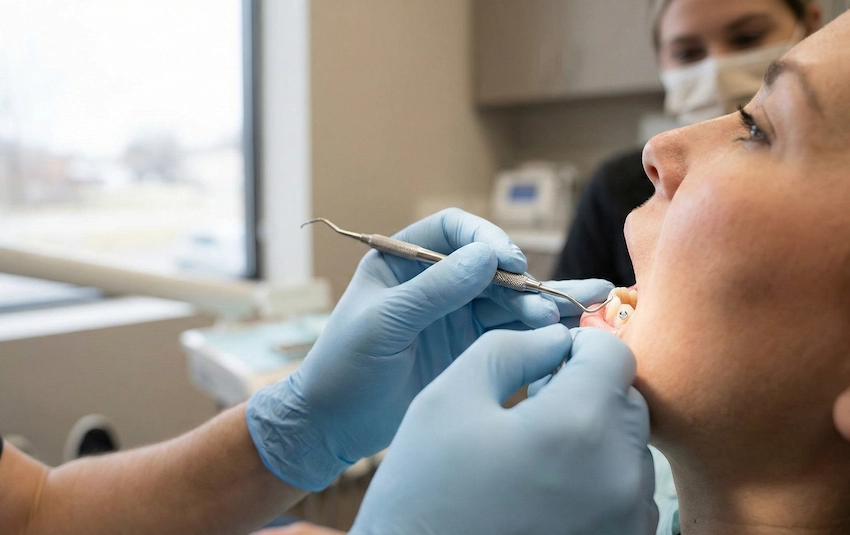
The usual dental scaling is done with ultrasonic scalers that are devices emitting high-frequency vibrations to break the calculus deposits. Should the tip of such a device be placed right onto your dental diamond, then the vibration can be the cause of the bonding being broken or the crystal being cracked. On the other hand, dental professionals who are very well trained and experienced, such as those in the Dentist Polen Akkılıç team, treat the gem as a ‘no-fly zone’ for the ultrasonic tips.
We change from heavy-duty machinery to fine, delicate hand instruments. We gently go around the perimeter of the gem with the scaler so that plaque is not allowed to build around the area of the bonding (which is a well-known trap for bacteria) without any direct tension being given to the jewelry itself.
Why You Cannot Skip the Clean?
“Skipping” can be tempting as far as the dentist is concerned, because the icon has to be “saved”. Doctor Professor Coşkun Yıldız frequently reproaches the patients’ reasoning in this way. The dental diamond leads to the formation of an extremely small shelf-sized junction where the 2 pieces, i.e., the enamel and the jewelry, meet. This junction is like a magnet that attracts plaque. By not going to the dentist for professional cleaning, you allow plaque to harden, in time, into tartar which will cause, basically, inflammation of the gums next to the nicest of your accessories.
You really don’t want a little sparkling diamond to be sitting on top of your red, bleeding gums,
The value of the gem, in terms of visual appearance, is totally dependent on the state of health of the surface on which it is installed.
Deep Cleaning & Bond Inspection: Beyond Surface Maintenance
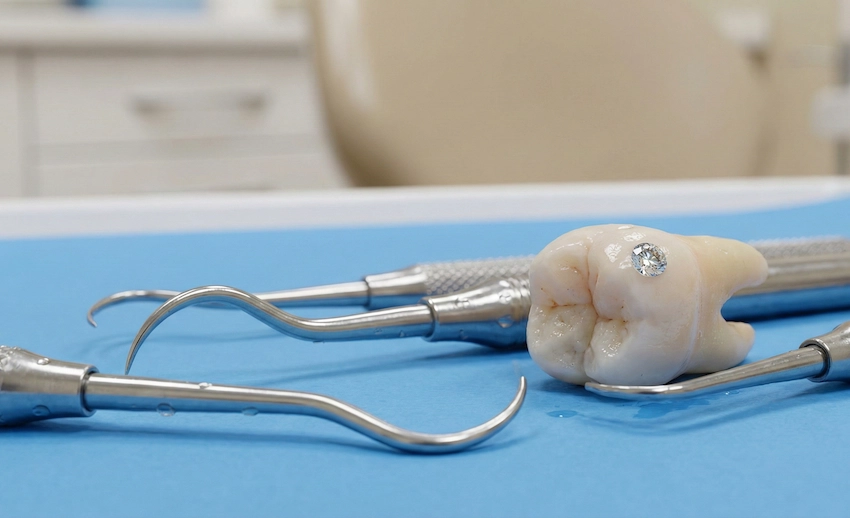
In our Istanbul branch, we usually change our action plan for the patients living with oral jewelry. We don’t just “clean around it”; we inspect the integrity of the bond. Most of the time, the appointment for scaling is also the best time to determine whether your diamond is already loose or not. In case the bond is weak, it is definitely much safer for us to take it off and put it on again in a sterile environment rather than you swallowing it unconsciously during your meal.
Comparing the Techniques
Not All Cleanings Are Created Equal. Here’s How We Distinguish Between a Standard Cleaning and One That Has Been Adapted for Dental Diamonds:
| Feature | Standard Ultrasonic Scaling | Precision Scaling (with Dental Diamond) |
| Primary Tool | Ultrasonic tip (high vibration) | Manual scalers (curettes/hand scalers) |
| Contact Area | Entire tooth surface | Around the gem perimeter, the gem surface avoided |
| Risk to Dental Diamond | High if the ultrasonic tip contacts the gem | Low due to controlled, manual pressure |
| Polishing Method | Standard polishing paste or air-flow | Fine-grit paste; air-flow avoided on the gem |
| Plaque Removal | Fast, high-volume removal | Precise, detailed cleaning around bonding margins |
| Safety Level | Not recommended directly over the gem | Recommended for patients with dental diamonds |
| Clinical Control | Limited to bonded jewelry | High control and visibility for the clinician |
FAQs: Your Concerns Answered
Well, not if you’re using the right technique. Real diamonds are hard enough to resist even scratching, but we need to remember that ‘tooth gems‘ can often be glass crystals or pieces of gold. Those are softer materials. The trick that we use to not scratch the gem is simply not to let the metal tool touch the face of the gem at all. We do not clean the jewelry—the cleaning is carried out on the tooth.
There is no reason at all that it should hurt. In case your gums are in good condition, you will not feel any pain. On the other hand, if you have been neglecting to brush the area around the gem because you were worried that this might dislodge it, then these particular gums can be inflamed. Then you could expect to have a bit of sensitivity when disinfecting and removing the bacteria that are causing the redness and swelling.
This is pretty much the time when the bond has been so weak your gem has been ready to fall for a while. The vibration and pressure are just revealing the problem that has been there without anyone noticing. The nice part, though, is that you are already here at Lema Clinic, so we can proceed with the cleaning and re-bonding right away.
We need to be cautious here. While Air-flow–a jet of water and powder at a high pressure–does a wonderful job in removing stains, it can lead to the loss of the original shine of the crystals or it can even weaken the glue. Usually, we cover the gem during the procedure or,” we very carefully point the spray away from it, so that its brilliance is maintained via its preservation.
Adhere to the standard six-month interval. Should you have more than one gem or the kind of complicated and intricate design (like a grill or a sizable piece of gold), Dentist Polen Akkılıç might be more inclined to recommend a four-month interval. This is reasoning from the fact that those types of designs hold more leftovers of food than a bare tooth surface.
- Mishra, N., & Narang, I. (2021). Cosmetic Dentistry and Tooth Jewellery: A Review. International Journal of Advances in Case Reports, 8(2), 55-58.
- Pahwa, H., & Lamba, A. (2018). Tooth Jewellery: A simple way to sparkle your smile. Journal of Advanced Medical and Dental Sciences Research, 6(8), 24-27.
- Jayant, P., & Singh, S. (2019). Periodontal health status in patients with tooth jewellery: A clinical study. Journal of Indian Society of Periodontology, 23(1), 56-60.
- Bhatia, S., & Arora, V. (2020). Effects of extrinsic tooth decorations on oral hygiene and gingival health. British Dental Journal, 228(1), 33-37.
- Yıldız, C. (2023). Minimally Invasive Approaches in Aesthetic Dentistry: Bonding Protocols and Maintenance. Istanbul University Faculty of Dentistry Journal, 57(3), 112-118.

