


You minimize risk with expert surgery, good hygiene, and proper aftercare.
A brand-new smile can change a person’s life forever. When patients come to Lema Dental Clinic in Turkey the first thing they say to each other is in a whisper: “What if it doesn’t work?”
The success rate for all-on-4 dental implants is most of the time more than 95%. However, that remaining 5% is not just a statistic—it’s a person’s health and money. Professor Doctor Coşkun Yıldız has on many occasions remarked that the All-on-4 surgical technique is a wonder of engineering, yet its triumph hinges on a fine balance of surgical accuracy and the patient’s dedication.
In most cases the “failure” is not a random event. It often results from a series of events in that one or more links could have been broken.
The Pedestal: The Importance of Accuracy
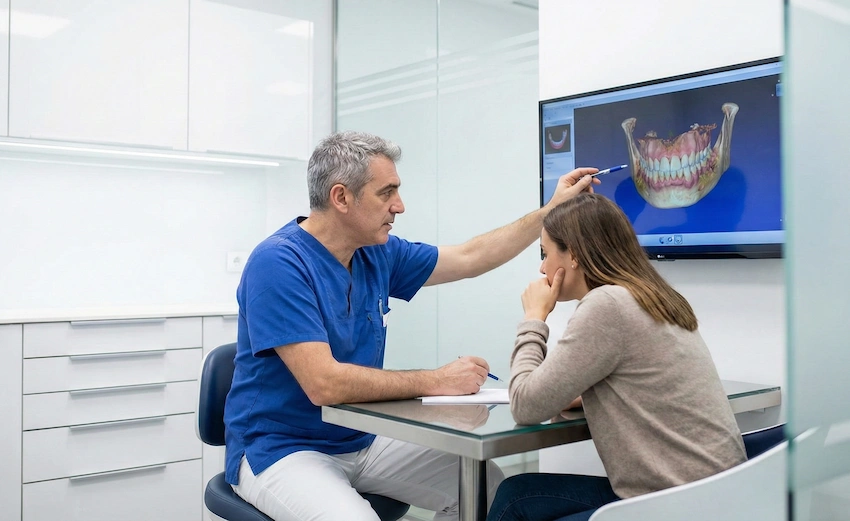
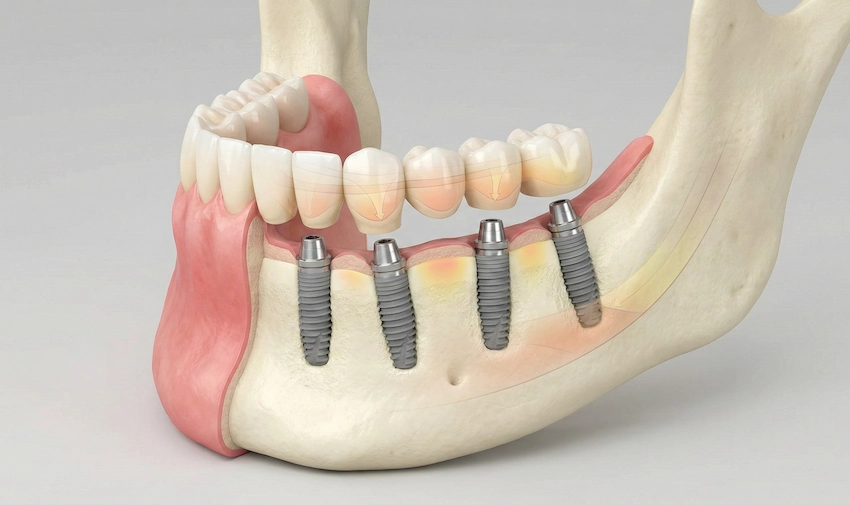
The jawbone is like the foundation of a skyscraper. If the soil is unstable or the piles are off vertical, then the whole building is at risk. The dental word for this is osseointegration; the bone accepts a titanium post just as if it were a member of the family.
Dentist Polen Akkılıç and her team at our practice point out that failing can be traced back to two phases: early failure (the bone does not bond) or late failure (infection or mechanical stress several years later).
Preventing Early Failure: The Surgical Edge
The early failures are most frequently blamed on “micromotions.” If during the first several weeks the implant moves even 0.1 mm or less, the bone will not be able to unite with the implant. But in that case, the body will produce fibrous tissue instead—acting like a scar around the implant and thus making the implant loose.
We take into account many factors contributing to stability by performing three-dimensional imaging to assess the bone quality and density before making a single surgical incision. We angle the back implants so as to avoid bone grafts while ensuring that they reach the strongest areas of your jawbone.
Peri-implantitis: The Hidden Danger
If surgery is the “building” phase, then maintenance is the “upkeep.” The main reason that All-on-4 bridges wear out and need replacing is not a hard piece of food but bacteria.
Peri-implantitis is an inflammatory disease much like gum disease in its action. It causes the deterioration of the bone that supports your implants. But in a little more detail: implants, unlike natural teeth, lack periodontal ligaments—which serve as a “cushion.” Also, they bring blood and immune cells to the area. Hence, the infections can penetrate the bone in the vicinity of an implant at a very rapid rate.
What we usually observe here is that patients who treat their All-on-4 bridges like they are a “set-and-forget” device are the ones who risk the most. You need to floss it every day under the bridge with the special floss designed for that purpose or a water flosser.
Comparison: Risk Factors and Success Drivers
| Factor | High Risk of Failure | Success Strategy at Lema Dental |
| Smoking | Constricts blood flow; slows healing. | Smoking cessation 2 weeks before/after. |
| Bone Density | “Soft” bone or insufficient volume. | 3D Guided surgery & angled placement. |
| Oral Hygiene | Plaque buildup leading to infection. | Custom hygiene protocol & regular check-ups. |
| Systemic Health | Uncontrolled diabetes. | Pre-operative blood work & health screening. |
| Mechanical Stress | Teeth grinding (Bruxism). | Night guards and balanced occlusion. |
The “Human” Element: Your Role in the Process
So, the question is, what is it can you do as a patient? While Professor Doctor Coşkun Yıldız takes care of the technical excellence, the “biology” part of the healing is actually up to you.
- Be Truthful About Habits: Your chances of implant failure will be quite higher if you are a smoker. It’s like trying to start a fire when it’s raining; nicotine blocks the blood which is the “source” of the “building blocks” needed by the bone for healing.
- Following the Soft Diet Rule: Your implants are basically “on probation” for the first few months. Eat only soft foods. Giving too much “bite force” to an implant that is healing is a sure way to get a disaster.
- Twofold Benefit of Turkey: Your trip to Turkey for the procedure enables you to benefit from the cutting-edge technology at Lema Dental Clinic; however, you also need to consider proper planning of your recovery time. Don’t return to a very stressful routine too quickly.
Mechanical Harmony: The Art of the Bite
Dentist Polen Akkılıç frequently says that an All-on-4 bridge is similar to a high-performance car. If the alignment is wrong, the tires (implants) will be damaged very quickly. We dedicate a considerable amount of time to “balancing your bite.” If one half of your mouth makes contact a bit more forcefully than the other, it results in a “hammer effect” which, in the long run, can lead to the titanium posts becoming loose.
Frequently Asked Questions
“Be on the lookout for the ‘Warning Signals.’ As per my experience, if a person suffers from pain still after the first two weeks, or if there is a hefty amount of swelling and, to top it all, if there is any movement in the bridge, then the person should see the doctor immediately. A healthy implant should feel as solid as a rock.” — Professor Doctor Coşkun Yıldız.
“Not at all. If peri-implantitis is spotted at the very beginning stage, a doctor can go for a thorough cleaning in the area around the implant or can use a laser to disinfect the surface. The most important thing is to react if you notice that the gum around the implant is becoming red or that it is bleeding.”
“In fact, smoking adversely influences implant healing since tobacco can reduce the oxygen in your blood. If bone cells do not get oxygen, they will not be able to attach themselves to the titanium. We don’t impose smoking cessation just for the sake of creating an obstacle. We ask for smoking cessation so that your body will heal naturally and effortlessly.”
Titanium is a material that has been designed to be biocompatible, that is, the body does not perceive it as a ‘hostile agent.’ Truly allergic reactions are extremely uncommon. Most of the time, when people talk about ‘rejection,’ they mainly refer to infection and lack of healing due to the presence of other health ailments, which is what they erroneously equate with implant rejection or failure, explains the doctor.
“As long as you strictly adhere to the post-treatment care instructions given to patients at Lema Dental Clinic, the implants can easily serve you for a lifetime. This is somewhat like a partnership in which we on our part lay down the foundation while you extend the care.”
- Malo, P., de Araújo Nobre, M., Lopes, A., Moss, S. M., & Molina, G. J. (2011). “All-on-4” immediate-function concept for completely edentulous maxillae: a clinical report on the medium- (3 years) and long-term (5 years) outcomes. Clinical Implant Dentistry and Related Research.
- Soto-Penaloza, D., Zaragozí-Guzmán, C., Peñarrocha-Diago, M., & Peñarrocha-Diago, M. (2017). The all-on-four treatment concept: Systematic review. Journal of Clinical and Experimental Dentistry.
- Chrcanovic, B. R., Albrektsson, T., & Wennerberg, A. (2014). Smoking and dental implants: A systematic review and meta-analysis. Journal of Dentistry.
- Lopes, A., de Araújo Nobre, M., & Maló, P. (2015). Risk factors for adjacent-implant failure: A retrospective cohort study. The Journal of Prosthetic Dentistry.
- Albrektsson, T., Zarb, G., Worthington, P., & Eriksson, A. R. (1986). The long-term efficacy of currently used dental implants: A review and proposed criteria of success. International Journal of Oral & Maxillofacial Implants.

