


Gentle brushing prevents tarnish daily.
Gold teeth seem to be more than just a fashion statement, as the shiny metal is a biocompatible and durable material that has been around for a long time. Whether you get a permanent gold crown placed by our specialists in Turkey or a removable grill piece such as a ring, we all at least partly understand the challenge: maintaining the mirror finish without damaging the metal or even your gums.
We at Lema Dental Clinic have had lots of encounters with patients who either treat their gold teeth with careless abandon or neglect them completely.
Quite simply, gold is a soft metal. It is a noble metal, no doubt, but it is a malleable one that can be bent or shaped. If you were to scrub it just as hard as you would a ceramic floor tile, you would most probably leave tiny scratches that are not visible to the naked eye. Such scratches can harbor microbes, thus resulting in a fading of the tooth color and in the worst case, the gums may suffer from inflammation.
The Biology of “Dull” Gold
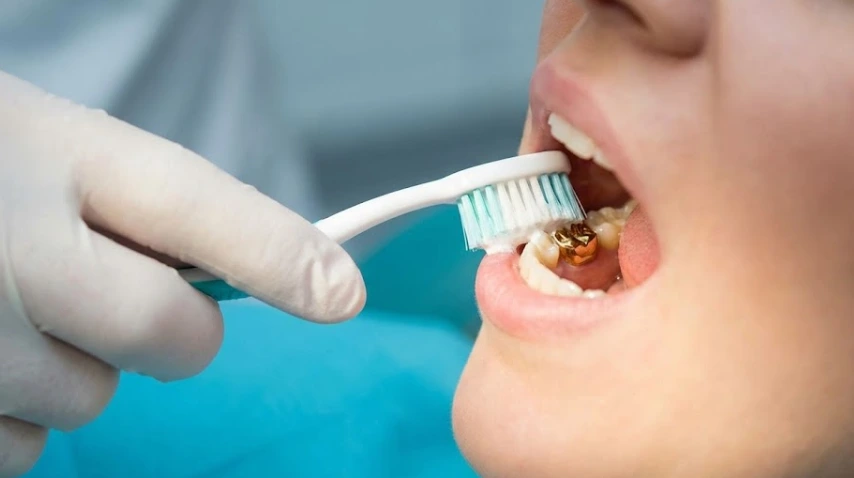
What about gold that loses its sparkle is a biological issue? It is not due to rusting. High-karat dental gold is not going to be oxidized like steel. What one sees is actually a “biofilm“—a layer of plaque, food residue, and saliva protein that is sticky.
Imagine your gold tooth as if it were a luxury car that has been left out in the rain. The car itself is not harmed but it has a layer of dirt covering the paintwork that is not visible anymore. If you keep the dirt there, it will, over time, turn into tartar, which is as hard and as “cements” your gum line.
Prof. Dr. Coşkun Yıldız, our most frequent guest-speaker, always tells the patients, “The gold itself is not only sterile but also the margin between the gold and your tooth is where bacteria have the greatest chance of residing. And if you don’t clean that joint, you will not only lose the shine but also put the tooth at risk.”
Daily Cleaning Protocol: The “Soft Hands” Approach
Dentist Polen Akkılıç, who is in charge of the clinic, explains maintenance in such a way that the rule is very easy to remember: non-abrasive hygiene.
For Permanent Gold Crowns & Veneers
The only option left for you is cleaning in the mouth if your gold has been cemented and you cannot take it out to soak.
- The Brush: The very soft bristle toothbrush is the one you should opt for. Medium and hard bristles will cause micro-abrasions on the gold surface.
- The Paste: Whitening toothpastes or those containing baking soda are to be avoided as these have particles (silica) that are used to scrub the enamel, but they will scratch gold. Instead, use a gel toothpaste that does not contain abrasive ingredients.
- The Floss: This one must always be done. The “margin” of the gold crown is where it is in contact with your natural tooth. Flossing daily helps to prevent decay from the metal being underneath the metal.
For Removable Grillz
Never wear your removable piece at bedtime, please.
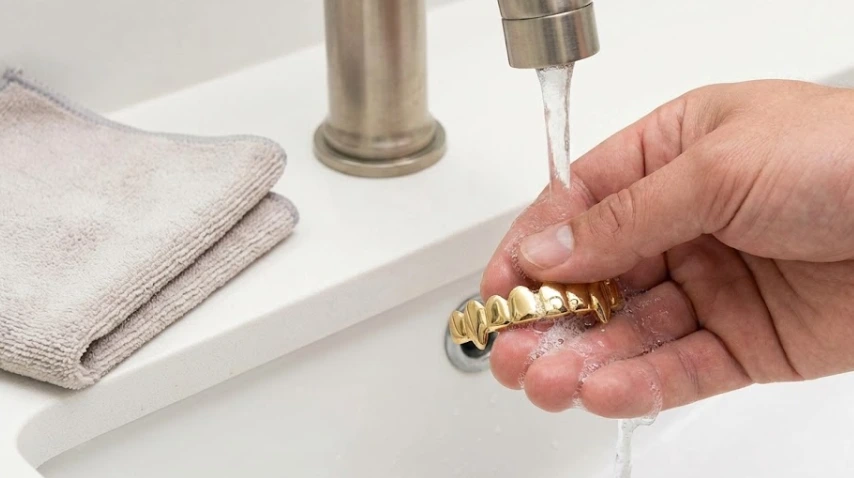
- Remove and rinse: Use warm water (not too hot) when washing it.
- Soap wash: If soap is used in place of toothpaste, then a mild, fragrance-free dish soap would do the trick. It eliminates the grease and saliva but it does not scratch the metal.
- Dry thoroughly: Use a microfiber cloth like the one for glasses. Cotton towels tend to leave lint while paper towels may cause scratches.
Comparison of Cleaning Agents
We have broken down the common cleaning methods so that you can decide on the best tool to use.
| Cleaning Agent | Safety for Gold | Shine Result | Risk Level |
| Mild Dish Soap | High | Excellent (Grease removal) | Low |
| Whitening Toothpaste | Low | Poor (Causes micro-scratches) | High (Abrasive) |
| Baking Soda / Salt | Very Low | Dull / Matte finish | Severe (Scratches) |
| Ultrasonic Cleaner | High | Professional Shine | Low (Use caution with gems) |
| Jewelry Polishing Cloth | High | High Gloss | Low (External use only) |
Avoiding the “Black Line” Phenomenon
One of the most frequent complaints is the appearance of a dark line along the gums. Professor Doctor Coşkun Yıldız points out that this is hardly ever the gold actually tarnishing. Mostly, it is a sign of receding gums or inflammation caused by plaque.
A toothbrush has to be angled 45 degrees toward the gum line when you clean. It is a delicate balance. You want to eliminate the bacteria without damaging the soft tissue. If you see your gums bleeding near your gold teeth, then it is not an allergy; it is most probably gingivitis.
Expert Answers on Gold Maintenance
We generally advise against standard jewelry cleaners found in department stores. Many contain toxic chemicals like ammonia that are safe for a ring on your finger but are dangerous to put in your mouth. If you want a chemical clean, use a specific specialized cleaner for dental appliances or dentures.
Yes, absolutely. Nicotine and tar are sticky substances. They bond to the gold surface much faster than they bond to natural enamel. Over time, this creates a yellowish-brown, dull film that is very difficult to brush off. Smokers will need professional polishing much more frequently.
Technically, you can, but Dt. Polen Akkılıç strongly advises against it. Gold is soft. Chewing hard foods (nuts, ice, hard candy) can dent or warp the shape of the grill, ruining the fit. Plus, food gets trapped between the metal and your natural tooth, creating an acid bath that rots the tooth structure silently.
If you have already scratched your gold with a hard toothbrush, you cannot “brush” the scratches out. You need professional polishing. At Lema Dental Clinic, we use high-grade jeweller’s rouge and soft buffing wheels to restore that mirror finish without removing excessive material.
High-quality dental gold (18k or 22k) is inert and should not have a taste. If you taste metal, it often means there is a reaction happening with other metals in your mouth (like old amalgam fillings) or the gold alloy is of low quality and contains base metals like nickel.
- Anusavice, K. J., Shen, C., & Rawls, H. R. (2013). Phillips’ Science of Dental Materials (12th ed.). Elsevier Health Sciences.
- Knosp, H., Holliday, R. J., & Corti, C. W. (2003). Gold in Dentistry: Alloys, Uses and Performance. Gold Bulletin, 36(3), 93-102.
- Roberts, H. W., & Berzins, D. W. (2019). Color Stability and Tarnish Resistance of Dental Gold Alloys. Journal of Prosthetic Dentistry, 121(1), 120-126.
- American Dental Association. (2022). Cleaning Your Teeth and Gums: Oral Health Basics. ADA Division of Science.
- Yıldız, C., & Topaloğlu, B. (2024). Hygiene Protocols for Fixed Prosthodontics in Aesthetic Dentistry. Turkish Journal of Periodontology, 15(2), 112-118.

