


Choose a gold teeth design that fits your lifestyle, durability needs, and style preference.
A Gentleman’s Guide to Selecting Gold Teeth Designs
Gold has symbolized status, power, and durability for thousands of years. Here at Lema Dental Clinic, Turkey, in the modern dental world, especially, we’ve experienced a great comeback of men coming to our clinic for gold dental work. It’s not just a matter of “bling” anymore; it’s more like a smart combination of self-expression and top-notch restorative dentistry.
In fact, choosing a gold tooth design is almost the same as getting a tailor-made suit or a luxury watch. Apart from matching your facial features, it needs to fit your lifestyle and, most importantly, be beneficial for your oral health. Professor Doctor Coşkun Yıldız stresses that even though it is the beauty that draws patients to our clinic in Istanbul, it is the precision of the clinic that makes them stay satisfied for a very long time.
Why Gold? The Clinical Perspective

We shouldn’t jump straight to talking about shapes and styles without first closely examining why gold is still considered the “gold standard” in prosthodontics. In terms of biocompatibility, gold alloys are an extremely good match. You can consider gold as the “gentle giant” of the dental world which not only refrains from grinding down the opposing natural teeth but also is able to withstand the strong-chewing forces without fracturing.
Dr. Polen Akkılıç and her staff at our clinic work on the mouth as if it were an intricate engine. Gold serves as a buffer in this case. While in some cases, porcelain may be prone to chipping, gold has a certain “flexibility” that imitates the natural enamel wear of teeth.
Selecting Your Design: The Three Pillars
In our discussions with male clients at Lema, we usually come up with three “vibes”, which are basically design categories:
- The Subtle Restoration: A single gold crown or inlay in the posterior area. It’s a sort of “hidden” luxury—only revealed when you laugh out loud.
- The Classic Front-Facing Statement: A total gold incisor or canine. The person who wants his confidence to be immediately visible is the man for this.
- Relief & Iced-Out Textures: This is done by detailed engraving work or small diamond settings in the gold.
Comparing Your Gold Dental Options
Here is what we believe our patients see when they decide on one out ofthe different gold-based solutions:
| Design Type | Durability | Reversibility | Best For… |
| Full Gold Crown | 20+ Years | Permanent | Restoring function and making a strong style statement. |
| Gold Inlay / Onlay | High | Permanent | Replacing old fillings with a superior metal option. |
| Removable Grills | Moderate | High | Occasional use without permanent tooth alteration. |
| Open Face Frame | High | Permanent | Creating a design “window” that shows the natural tooth. |
The “Tailored Fit” Analogy
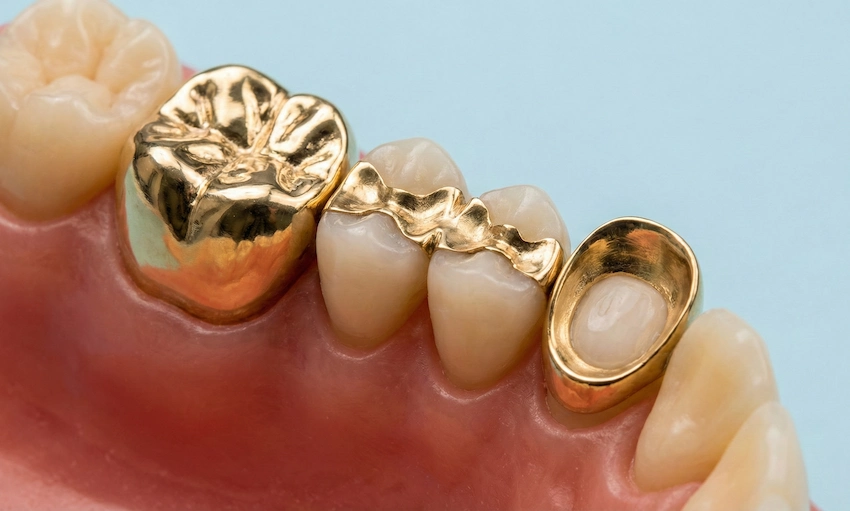
We tell our patients that a gold crown should be as perfectly fitted as a wedding band. If the fit is wrong (at the point where the gold meets the gum), the entire “outfit” is basically ruined. Prof. Dr. Coşkun Yıldız explains that fit is not only about the visual aspect in the mirror, but also how it prevents the bacteria from sneaking underneath.
The question is: How do you pick the right “tone”? Not all gold is yellow. A few men go for a rose gold shade that is warmer and more in line with their skin tone whereas others select the classic 22k deep yellow for the most powerful effect.
The Lema Journey in Istanbul
Taking a decision on Turkey for your dental treatment is not just about affordable prices but also about getting the best artistry. Dr. Polen Akkılıç and her team employ digital scanning to totally align your gold creation with your bite so that it doesn’t only “look cool”. We don’t think that one solution fits all. Your jawline, smile width, and even your skin undertones influence whether you should pick a dull finish or a lacquered one.
Common Questions We Hear at the Clinic
The straightforward answer is no. Pure 24k gold is actually too soft for the size of a mouth. Under biting pressure, it would deform. At Lema Dental Clinic, we mostly apply 16k to 18k gold alloys. It serves not only as a rich, iconic color carrier but also as a tooth strong enough to handle a steak dinner.
Actually, if the dental work is carried out properly, it goes the other way round. Thus, gold is not only resistant to the accumulation of plaque but also highly resistant to bacterial growth. Nevertheless, if the “fit” is poor, food can get stuck. That’s why the accuracy of Professor Doctor Coşkun Yıldız is so crucial—we guarantee a flush fitting which allows you to maintain hygiene without much effort.
A gold crown is a type of restoration that is there to stay. If at some point, you wish to have a white smile, we will just exchange the gold crown for a zirconia or E-max porcelain crown. It is a very simple procedure but it requires a new crown.
Most of the time, we can complete the entire process starting with the design of the gold tooth to its casting and fitting within 3 to 5 days. We want you to have a great time in Istanbul and leave this beautiful city with a smile on your lips.
Gold tooth installation is no different than standard crown placement. To make you comfortable during the procedure, local anesthesia is used. The majority of our patients report the sensation post-treatment as “solid”—it is the feeling of having a very strong and reliable tooth.
- Anusavice, K. J., Shen, C., & Rawls, H. R. (2012). Phillips’ Science of Dental Materials. Elsevier Health Sciences.
- Donovan, T. E., & Cho, G. C. (2001). Predictable aesthetics with metal-ceramic and all-ceramic crowns: The state of the art. Journal of the California Dental Association, 29(9), 661-670.
- Kelly, J. R., & Nishimura, I. (2008). Science-based guidelines for maximizing outcomes through regenerative medicine and restorative dentistry. Journal of Prosthetic Dentistry, 100(6), 417-424.
- Knosp, H., Holliday, R. J., & Schnetz, C. (2003). Gold in dentistry: Alloys, uses and performance. Gold Bulletin, 36(3), 93-102.
- Wataha, J. C. (2002). Alloys for prosthodontic restorations. Journal of Prosthetic Dentistry, 87(4), 351-363.

