


Clean removable dentures daily using a soft brush and denture cleaner.
Getting a set of dentures brings relief with some worry. You have your smile again, but you are also holding a super-sophisticated medical device that needs very gentle handling. From our clinical experience at Lema Dental Clinic in Istanbul, we can say that most damages of removable dentures does not happen in the mouth but at the sink during cleaning.
It is a common misconception among patients that because their artificial teeth are not real, they can not be damaged. In fact, the truth is the opposite. We use colloquial comparisons when referring to denture acrylic with our patients here at the clinic: “biological windshields” i.e. the material is resistant to weather and pollution but abrasively cleaning such a shield will cause microscopic scratches that eventually corrode it and keep dirt at the same time.
Below are some of the tips we give to our clients in Turkey to maintain good hygiene without jeopardizing the mechanical properties of the prosthesis.
The Microscopic Reality: Why “Brushing Harder” is Dangerous
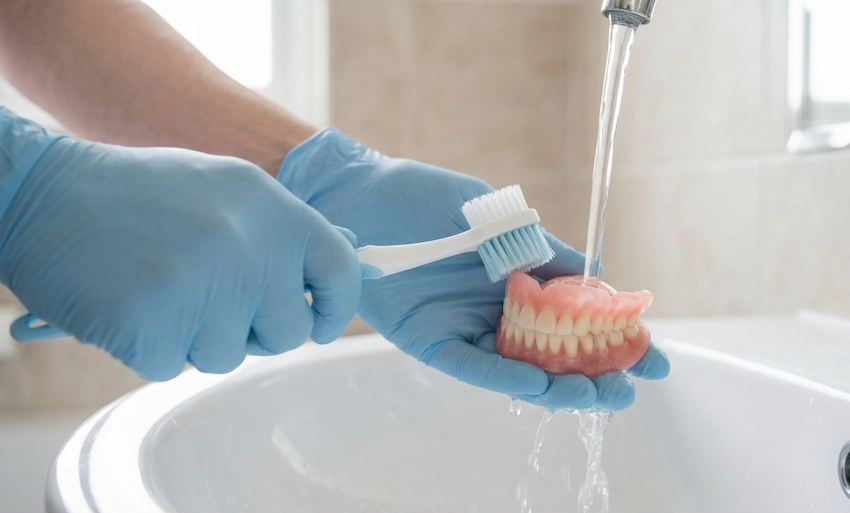
The very fact that you can scrub with the same force as you did on your natural teeth makes it very appealing to clean dentures. Nevertheless, Professor Doctor Coşkun Yıldız repeatedly explains that the structure of denture acrylic is porous. If one looks at it through an electron microscope, it is not a flat surface like that of a sheet of glass but rather a sponge with many, very small holes that are invisible to the naked eye.
The act of cleaning dentures with abrasive substances (e.g., whitening toothpaste) or a brush with hard bristles is equivalent to using sandpaper over the denture surface. What you are doing is causing the denture surface, which is like a sponge, to develop very deep channels. These tiny passages become home to denture stomatitis-causing bacteria and fungi such as Candida albicans. They proliferate and produce the inflammation which causes severe discomfort when wearing dentures and pain.
The Daily Routine: A 3-Step Clinical Protocol
Dr. Polen Akkılıç along with her team of dental professionals strongly recommends a “Remove, Brush, Soak” method to maintain a healthy oral flora.
1. The Mechanical Clean (The “Remove & Brush”)
You cannot clean a house while you are still standing inside it. The same applies here. You must remove the denture to clean all surfaces.
- The Safety Net: Stand over a sink filled with water or put a folded towel in the basin. If the denture falls out of your wet hands, it hits a cushion, not a hard porcelain surface. A drop as low as 30 cm can shatter a precision-molded base.
- The Tool: Use a brush meant only for dentures. If you don’t have one, then a toothbrush with soft bristles will work. Do not use medium or hard-bristle brushes.
- The Agent: Use dish soap (mild) or a denture paste that has been specially formulated. You should never use regular toothpaste. Toothpaste is abrasive as it is meant for scrubbing enamel, which is the hardest material in the human body. Acrylic, on the other hand, is very soft, meaning that toothpaste scrubs it like sandpaper.
2. The Chemical Clean (The Soak)
Brushing physically gets rid of all the food particles that can be seen. Bacteria that cannot be seen are killed during soaking.
You should put a denture cleaning tablet in water that is warm enough to dissolve the tablet, but the water should not be hot.
Put the denture completely under water.
This process of chemical cleaning allows the chemical to work inside the porosities of the denture as we talked about earlier, killing the bacteria that cause bad breath and that a brush cannot reach.
3. The Rinse and Rest
Before any further use with the mouth, the dentures must be rinsed thoroughly with cold or lukewarm water. It is not advisable to allow chemicals to be in contact with the gums of the wearer.
Dr. Polen Akkılıç explained in a clinical scenario that the skin of our wrist would suffer the same way as our gums if the watch were never taken off. She said, it gets soggy, irritated and prone to infection. Your gums need to breathe as well. It is always our recommendation to take out dentures for at least 6 to 8 hours a day, usually, this is done while sleeping.”
Choosing Your Cleaning Arsenal: A Comparison
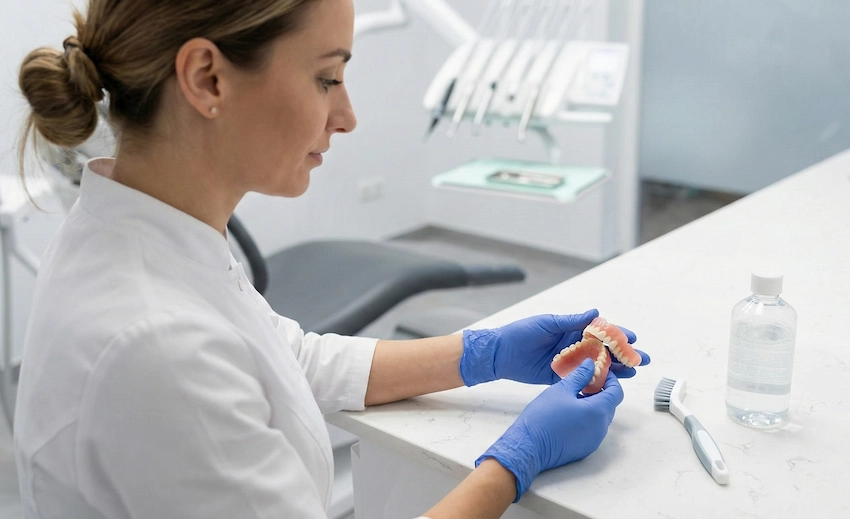
We often get questions from our patients about the various “home remedies” they have read about on the internet. What follows is a comparison of some of the most popularly used household cleaning agents against each other, in terms of their safety and effectiveness.
| Cleaning Agent | Abrasiveness | Bacterial Kill Rate | Safety for Acrylic | Verdict |
| Denture Tablets | Low (chemical action) | High (99.9%) | Excellent | Recommended |
| Mild Dish Soap | Low | Low (mechanical only) | Good | Good for brushing only |
| Whitening Toothpaste | Very high | Medium | Dangerous | Avoid strictly |
| Bleach (Household) | N/A | High | Destructive | Never use (whitens the pink gum acrylic) |
| Vinegar | Low | Medium | Moderate | Use only for calculus (tartar) removal occasionally |
Common Pitfalls: What Breaks the Prosthesis?
Many times, a prosthetic that we have repaired could have been avoided, especially if you have a lab in Turkey. The most common culprit? Heat.
It is quite similar to thermoplastic that is used to make your denture conform to your mouth. If you boil the denture to “sterilize” it, you are essentially causing the plastic memory to warp. This means that it will not fit intimately with your jaw anymore. Once the denture no longer fits, the consequence of wearing it is painful sore spots and the denture will be unstable. Select water that is just warm to the touch always.
FAQ: Direct Answers from the Clinic
Not at all. You have to think of your gums as soft tissues that need to be given time to rejuvenate. Pressure applied constantly leads to stagnation of capillary blood and the bone underneath starts to resorb (shrink). By removing your dentures before going to bed, you allow your saliva to work as a natural cleanser and moisturizer for the gums.
For a short term and an occasional tartar removal (your 15-minute soak in 50/50 white vinegar and water should be perfect), it is okay if you do this once or twice a month. Vinegar is different from denture tablets in that it is not an effective bacterial killer and the taste of it can be dreadful because thorough washing is a must.
Definitely not. Household bleach will be too harsh. It will bleach the pink gum part of your denture to white and make the acrylic brittle to the point of fracture. Lema Dental Clinic is your safest option for stain removal through professional polishing only.
Change your denture brush every 3-4 months or even earlier if it starts looking frayed as in the bristles are bent or loose. You are using a worn-out brush is the same as not brushing at all because the plaque is not removed.
This mainly indicates that the bacteria have already gone deep into their micropores, and the reason for this is abrasive brushing i.e. scratches. Maybe your denture has been with you for quite a while and the material is degrading thus leading to a bad odor. If the soaking solution cannot get rid of the smell, I suggest the denture get a professional touch in Istanbul. It may be time for a re-line or a new base.
- Felton, D., Cooper, L., Duqum, I., Minsley, G., Guckes, A., Haug, S., … & Deal, Chandler. (2011). Evidence-based guidelines for the care and maintenance of complete dentures: a publication of the American College of Prosthodontists. Journal of Prosthodontics, 20(s1), S1-S12.
- Duyck, J., Vandamme, K., Krausch-Hofmann, S., Boon, L., De Keersmaecker, K., Jalon, E., & Teughels, W. (2016). Impact of denture cleaning method and overnight storage condition on biofilm mass and composition: a cross-over randomized clinical trial. PLoS One, 11(1), e0145837.
- Papadiochou, S., & Polyzois, G. (2018). Hygiene practices in removable prosthodontics: A systematic review. International Journal of Dental Hygiene, 16(2), 179-201.
- Goiato, M. C., Dos Santos, D. M., Haddad, M. F., & Pesqueira, A. A. (2014). Effect of denture cleansers on the surface roughness and hardness of a reline resin. Brazilian Dental Journal, 25(5), 396-400.
- Lucena-Ferreira, S. C., Ricomini-Filho, A. P., Silva, W. J., Cury, A. A. D. B., & Cury, J. A. (2013). Influence of daily immersion in denture cleanser on multispecies biofilm. Clinical Oral Investigations, 17(9), 2179-2185.

