


The standard is twenty teeth total.
When patients come from abroad to Istanbul, upon their arrival their initial query concerns the shade of the teeth: “How white can I get my teeth?” However, the second question is usually the one that matters the most from a clinical perspective, and that is about the amount. “Do I have to get all my teeth done, or just the front ones?”
The solution is hardly ever a simple one. It is a math problem of geometry based on your individual anatomy.
At Lema Dental Clinic, a Hollywood Smile for us is not only a set of white veneers but an architectural project. If you remodel the front of a house and leave the sides in a dilapidated state, the curb appeal disappears the moment you look from an angle. The same thing goes for your smile. While regular packages usually mention certain numbers, Professor Doctor Coşkun Yıldız points out that what we treat is the smile line and not just the teeth.
The “Social Six” vs. The Full Corridor
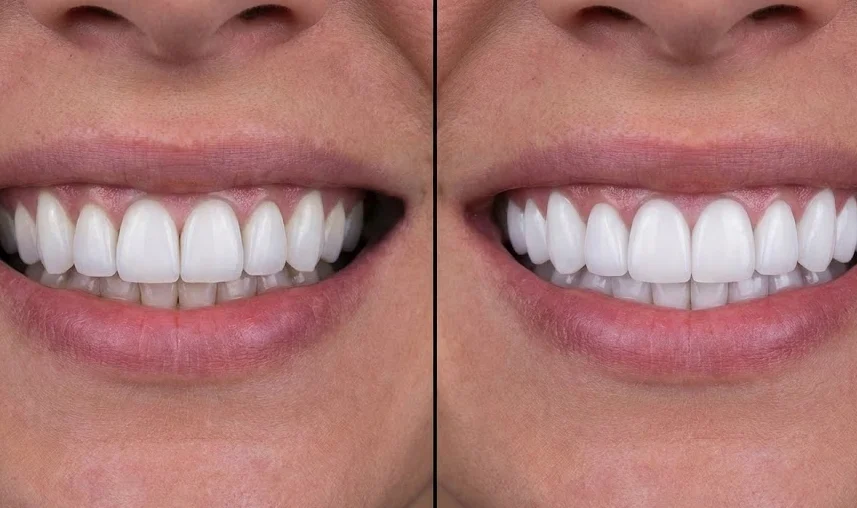
Many years ago, the field of cosmetic dentistry was concentrated on the “Social Six“—the six front teeth (canine to canine) that are visible when one speaks softly. But let us scrutinize more deeply the reason why the method mentioned above sometimes does not succeed in giving the “wow” factor that goes with a Hollywood Smile.
When you laugh or smile widely, the lips retract to show the “buccal corridor”—the dark area between your teeth and the corners of your cheeks. Should we only fix the frontal six teeth, the result will be a very bright center and dark, shadowy corners. This gives rise to the “chicklet” effect, i.e. teeth appear fake and disconnected from each other.
Dentist Polen Akkılıç and her team generally suggest extending the procedure back to the premolars or the first molars. It is similar to making a visual continuation of the arch which results in a full, confident smile such as seen on magazine covers.
The Magic Number: Why “20” is the Standard
At Lema Dental Clinic in Turkey, based on our clinical experience, the treatment plan that is most than often opted for includes 20 teeth. This is the explanation:
- 10 Upper Teeth: This counts the central incisors and extends back to the second premolars or first molars. This is so that when you give a broad smile, all the teeth that are visible are similar in shape and color.
- 10 Lower Teeth: Although when talking, the lower teeth are less visible, they play an important role in the “smile arc” and bite balance. Having the lower arch treated means that your smile is harmonious top-to-bottom.
Yet it is the anatomy that decides the final number. Patients with small mouths may be able to get the desired result with 16 teeth (8 top, 8 bottom). On the other hand, those who have large, very charismatic smiles (a Julia Roberts smile, for example) might need 24 or even 28 units so that no naturally yellowing tooth gets exposed from the back.
Comparing Treatment Scopes
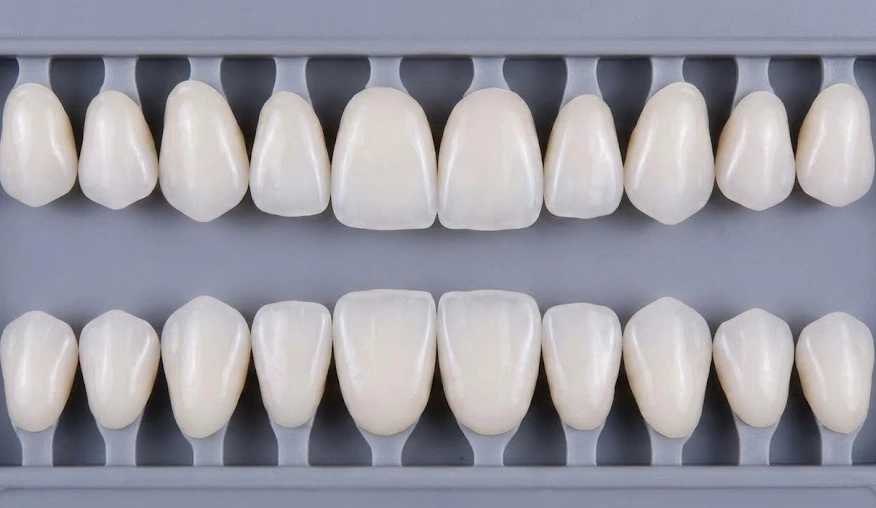
The decision isn’t just aesthetic; it’s functional. Here is how we categorize the treatment scopes in our clinic:
| Treatment Scope | Teeth Count | Visual Impact | Clinical Recommendation |
| The “Social Six” | 6 Top / 6 Bottom | Moderate. Good for talking, but lacks “fullness” when laughing. | Rarely recommended for a full makeover; risks “contrast” issues. |
| The Standard | 10 Top / 10 Bottom | High. Fills the buccal corridor. The “Gold Standard” for 90% of patients. | Best balance of aesthetics and minimal intervention. |
| The Wide Arch | 12-14 Top / 12-14 Bottom | Maximum. A “wall-to-wall” white smile. | Required for patients with wide dental arches or prominent laughter lines. |
| Full Mouth | 28 Teeth | Total Restoration. | Necessary if bite alignments (occlusion) need correcting along with aesthetics. |
The Monochromatic Dilemma
Venir colors matching is one of the most important elements that Dentist Polen Akkılıç emphasizes during the doctor-patient discussion. If you decide to put veneers on only the upper 10 teeth and keep the lower ones natural, then you will be whitening the lower teeth all your life to get them to match the upper ones.
In fact, natural enamel can never be as white as the Zirconium or E-max porcelain with permanent, high-value. Eventually the lower teeth will get stained by coffee and food while the upper ones will be like new. This leads to a quite shocking “dual-tone” effect. To be sure of the color match, we nearly always recommend carrying out treatment on both the upper and lower jaw at the same time.
A Metaphor for Harmony
Imagine your smile as a choir. If the first row singers (your front teeth) are wearing sparkling, brand-new uniforms, but the second row (your molars) are in old, worn-out garments, the audience (the people you meet) will immediately see the difference. A Hollywood Smile is the whole group performing together as one.
FAQ: Direct Insights from Our Doctors
You technically can, but we often advise against it if you are choosing a very white shade (BL1 or BL2). The contrast between your new bright upper teeth and your natural, yellowish lower teeth will be very obvious. If you choose a natural shade, doing only the top is more feasible.
Great question. A standard Hollywood Smile package refers to veneers or crowns on existing teeth. If you are missing back teeth (molars), we must address that first, likely with implants. You cannot build a stable roof (smile) without the back pillars (molars).
Modern technology allows us to be extremely conservative. For laminate veneers, we often remove less than 0.3mm of enamel—comparable to the thickness of a contact lens. The goal is to resurface the tooth, not destroy it.
At Lema Dental Clinic, we respect your time. Because we have our own in-house digital labs, we can typically complete a full 20-tooth transformation in just 5 to 7 days, allowing you to enjoy a mini-vacation in Istanbul simultaneously.
If you have a narrow jaw, placing veneers can actually help broaden your smile visually without surgery. We build out the ‘buccal corridor’ with the veneers, giving the illusion of a wider, more supportive arch.
- Coachman, C., & Calamita, M. (2012). Digital Smile Design: A Tool for Treatment Planning and Communication in Esthetic Dentistry. Quintessence of Dental Technology, 35, 103-111.
- Fradeani, M. (2004). Esthetic Rehabilitation in Fixed Prosthodontics: Esthetic Analysis. Quintessence Publishing.
- Moore, T., et al. (2005). Buccal corridors and smile esthetics. American Journal of Orthodontics and Dentofacial Orthopedics, 127(2), 208-213.
- Tjan, A. H., Miller, G. D., & The, J. G. (1984). Some esthetic factors in a smile. The Journal of Prosthetic Dentistry, 51(1), 24-28.
- Gurel, G. (2003). The Science and Art of Porcelain Laminate Veneers. Quintessence Publishing.

