


It redefines smiles by enabling faster, more precise, and natural-looking dental restorations.
Digital Dentistry: CAD/CAM Technologies
For a very long period, it was generally accepted that visiting a dentist involved some sort of discomfort, especially when it came to the messy and gag-inducing putty for dental impressions. It was cold and uncomfortable, and, to be honest, not always accurate either. But, at Lema Dental Clinic, which is in the heart of Turkey, these are no longer issues.
We call the new phase the era of the “Digital Architect.” Thanks to CAD/CAM (Computer-Aided Design and Computer-Aided Manufacturing), we’re not just restoring teeth anymore; we’re crafting smiles with the exactness of an aerospace engineer and the aesthetic sense of a Renaissance sculptor.
The Digital Handshake: What CAD/CAM?
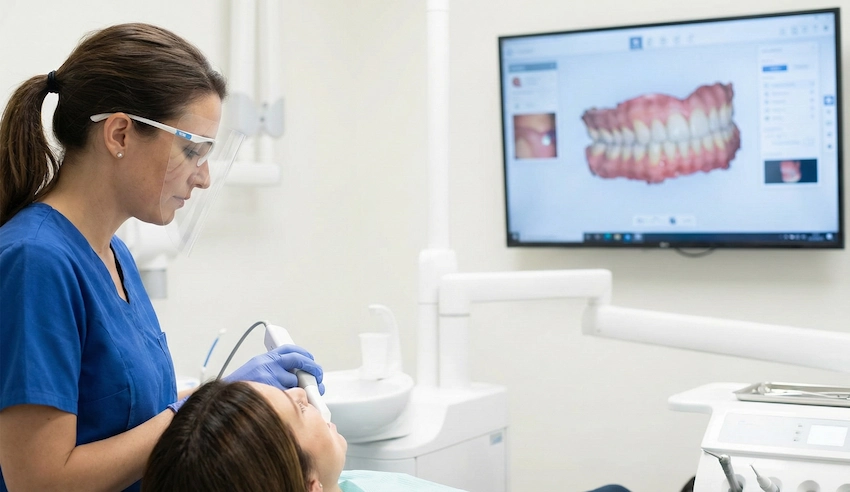
Think about creating a dental crown the old-fashioned way, similar to constructing a house with only hand-drawn plans and manual labor. There would be numerous opportunities for errors. CAD/CAM entirely transforms that narrative. It is akin to a GPS for your dental restoration.
For us, the clinical journey starts not with a gooey tray but with a geometric intraoral scanner that looks like a wand. It captures thousands of frames per second and forms a 3-D digital map of your mouth with comprehensive details down to the smallest unit of length.
Prof. Dr. Coşkun Yıldız regularly points out that the level of granularity provided permits us to find things that the human eye or even normal X-rays might overlook. Subsequently, with your “digital twin” ready, we shift to the designing stage. This is when Dentist Polen Akkılıç and her staff come into the picture. They utilize cutting-edge software to ‘carve’ the new tooth digitally even before the first piece of porcelain is handled.
What Makes Precision So Important (Custom-Tailored Suit)
There is always the option to purchase an off-the-rack suit and it might fit “well enough.” On the other hand, a tailor-made bespoke suit will become a second skin.
That is exactly the level of comfort CAD/CAM dental restorations provide.
However, let’s go further into the reasons why this is a revolution for our visitors coming to Turkey:
- The Fit: The workflow is so accurate that the closeness between the restoration and the tooth is almost without a gap. This means bacteria will not be able to infiltrate, which is the main reason why crowns get defective.
- The Speed: Things that used to take a fortnight for a lab can nowadays, in several cases, be done within a very short time.
- The Aesthetics: By picking from a gigantic range of digital tooth shapes and ceramic blocks, we are able to replicate the exact translucent properties of the natural enamel.
Comparing the Old vs. The New: A Clinical Overview
| Feature | Traditional Lab Method | Lema’s CAD/CAM Technology |
| Impression Type | Silicone/Alginate Putty (Messy) | 3D Intraoral Scanning (Clean) |
| Turnaround Time | 7–14 Days | Same-Day or 24-48 Hours |
| Accuracy | Subject to material shrinkage | Micron-level digital precision |
| Patient Comfort | High gag reflex risk | Completely non-invasive |
| Adjustments | Often required at the chairside | Minimal to none |
The Artistry of the “Milling” Process
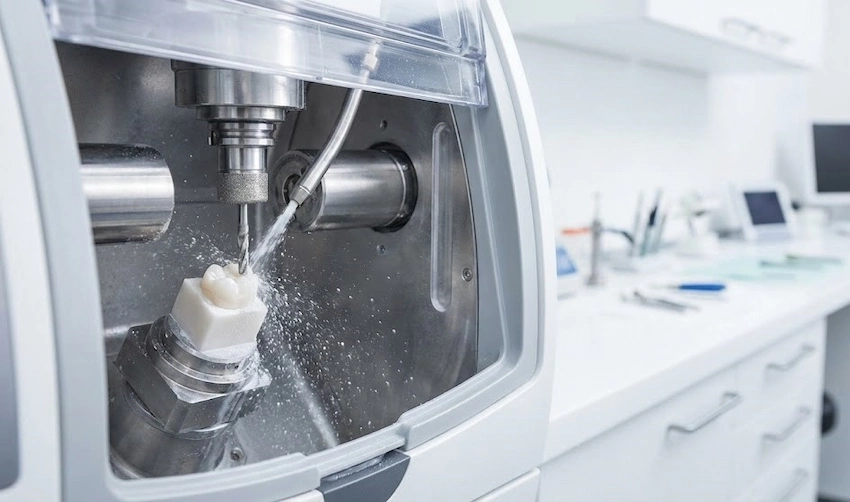
The question remains: How does a digital file become a physical tooth? Once the design is perfected by our clinical team, the file is sent to an in-house milling machine. This is essentially a high-tech 3D printer’s more powerful cousin. It carves your crown or veneer out of a solid block of high-grade ceramic or zirconia.
Here is what we see in the clinic: patients are often mesmerized by the speed. It’s a bit like watching a diamond being cut. This process eliminates the “temporary crown” phase that so many people dislike—those plastic caps that feel bulky and often fall off while you’re eating.
A Human Touch in a Digital World
It is easy to get lost in the “coolness” of the tech, but the hardware is only as good as the hands that guide it. At Lema Dental Clinic, we treat these digital tools as an extension of our clinical expertise. Dentist Polen Akkılıç and her team spend hours refining the digital shade-matching to ensure that when your new smile catches the light in the Istanbul sun, it looks entirely natural.
Turkey has become a global leader in dental tourism precisely because we pair this high-level technology with a deep sense of hospitality and patient care. We aren’t just using computers; we are using data to be more empathetic to your needs, reducing your time in the chair and maximizing the lifespan of your dental work.
Frequently Asked Questions (From Our Patients)
“Absolutely. Unlike X-rays, the intraoral scanner uses safe, visible light to ‘photograph’ your teeth. It’s as safe as taking a picture with your smartphone, just much more detailed!” — Lema Clinical Team.
“While it is incredible for crowns, veneers, and inlays, the reality is that some complex full-mouth reconstructions still benefit from a hybrid approach. We always evaluate what will give you the longest-lasting result.”
“That’s a common fear! But because we have total digital control, we can add ‘characterization’—tiny details that mimic natural teeth. We want your smile to look like the best version of you, not a set of piano keys.” — Dentist Polen Akkılıç.
“In our experience, CAD/CAM restorations often outlast traditional ones because the fit is so tight. With proper hygiene, you are looking at a 10–15 year lifespan, and often much longer.”
“The technology we use at Lema is the same—and often more advanced—than what you’ll find in London or New York. The difference is that here, we can offer this ‘VIP’ technology at a much more accessible point, allowing you to recover in one of the world’s most beautiful cities.” — Professor Doctor Coşkun Yıldız.
- Beuer, F., Schweiger, J., & Edelhoff, D. (2008). Digital dentistry: an overview of recent developments for CAD/CAM-generated restorations. British Dental Journal, 204(9), 505-511.
- Miyazaki, T., Hotta, Y., Kunii, J., Kuriyama, S., & Tamaki, Y. (2009). A review of dental CAD/CAM: current status and future perspectives from 20 years of experience. Dental Materials Journal, 28(1), 44-56.
- Davidowitz, G., & Kotick, P. G. (2011). The use of CAD/CAM in dentistry. Dental Clinics of North America, 55(3), 559-570.
- Trost, L., & Scherer, W. (2014). CAD/CAM Dentistry: The Future is Now. Journal of the California Dental Association.
- Rekow, E. D. (1987). Computer-aided design and manufacturing in dentistry: A review of the state of the art. The Journal of Prosthetic Dentistry, 58(4), 512-516.

