


Turn dental visits into play.
Any small child will probably think of a dental clinic as an unfamiliar and weird place. After all, there are so many things happening at once: brightly lit rooms, mechanical noises, people wearing masks. Of course, a mom or dad has to be a bit worried about how their kid will react. However, the secret we at Lema Dental Clinic in Turkey have discovered is that the first visit of a child is not only a medical check-up; it is the start of the child’s lifelong relationship with health.
We have noticed that the aim is not just to carry out a dental examination. It is more about making the child so cheerful that the child feels like they have just fulfilled an exciting quest and comes out beaming.
The Power of “Pre-Visit” Play
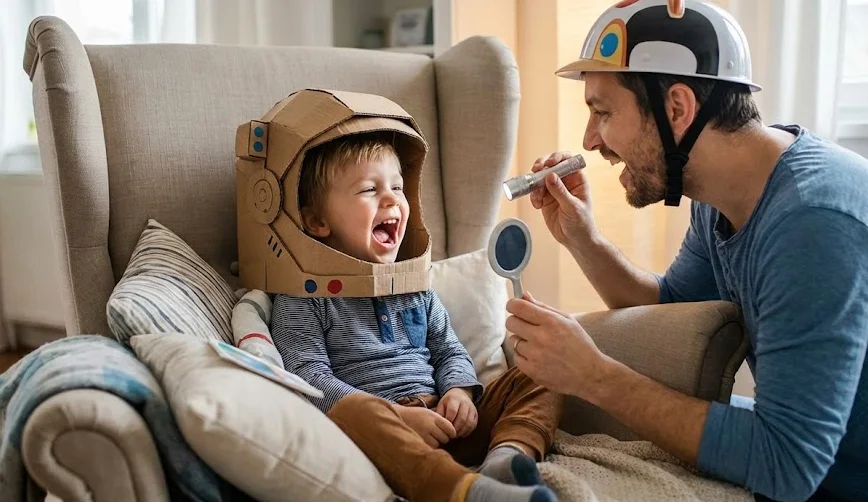
Actually, children are just a mirror of our feelings. If we are scared of going for a check-up, they will sense it and become scared too. Professor Doctor Coşkun Yıldız often repeats that the best first visits actually start at home when parents get their kids ready a few days before the whole family comes to Turkey.
What if the dental chair was really a seat in a spaceship? At home, you can play a small game with your kid by letting them sit down in a big chair and pretending that it is “blast off” while you use a small flashlight to “count their pearly white stars.” When the dentist’s check-up is turned into a game of discovery, the clinical setting will not seem like a scary first time but rather a familiar follow-up.
Words Matter: Choosing Your Vocabulary
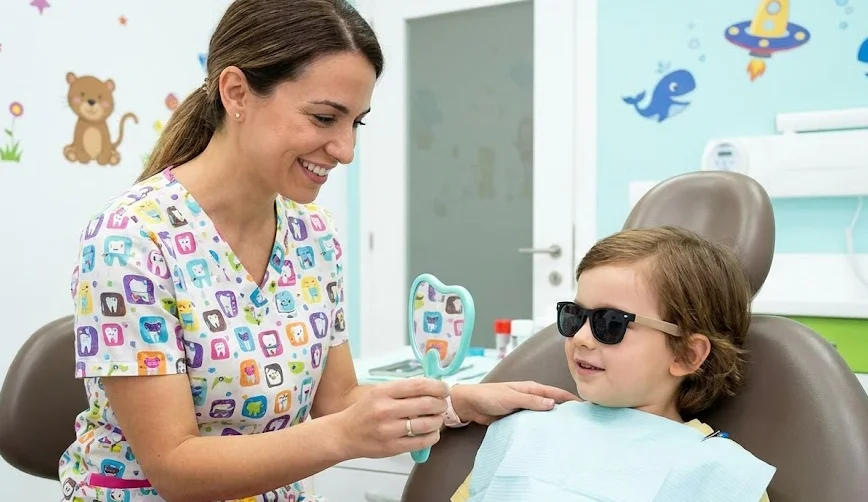
But let’s examine our vocabulary a bit more closely. When it comes to children’s dental care, some words work exactly like “sugar bugs,” and we should get rid of them. We never say “pain,” “shot,” or “hurt,” even when we promise the child that it won’t happen. The young mind usually ignores the “won’t” part and only keeps the scary word.
Dentist Polen Akkılıç and her team use the “Tell-Show-Do” approach. We tell the kids what a tool is (we give them funny names), we demonstrate the tool by using the finger or toy of a child that we have explained, and then we do the actual treatment. Such honesty is trust, trust that is far deeper than any ”surprise.”
Preparation Strategy: A Parent’s Cheat Sheet
So, the question is: what are the exact things that you should do and say? Below is a quick summary to help you perform the “Dos and Don’ts” correctly before you come to see us.
| Instead of… | Try… | The Reason Why |
| “Don’t worry, it won’t hurt.” | “The dentist is going to count your teeth!” | Focuses on a neutral, curious action rather than fear. |
| “If you’re good, I’ll buy you a toy.” | “We’re going to learn how to keep your smile bright.” | Avoids framing the visit as something “bad” that requires a bribe. |
| Using words like “Needle” or “Drill.” | “Water sprayer” or “Tooth whistler.” | Softens the sensory experience with playful metaphors. |
| Explaining complex procedures. | Keeping it simple and light. | Prevents “information overload” that can lead to anxiety. |
The “Lema” Experience: Why Turkey for Pedodontics?
We often have families coming to Lema Dental Clinic as we not only know that pediatric dentistry has a psychological side but also the medical side of it. Besides, we give the same care that a gardener gives to a fragile sapling to the jawbone and teeth, meaning that the roots must have a healthy environment to grow strong.
This is what we normally face in the clinic: a child who is given the freedom to decide on picking the “flavor” of the cleaning paste or holding a mirror to see his or her teeth, will have a lower heart rate and wonder will take over. Following this route, Turkey has become a center of this compassionate approach, combining state-of-the-art diagnostics with a culture that is genuinely warm towards children.
After the Visit: Celebrating the Milestone
Lastly, the “Mission Accomplished” phase is the wrap-up. Whether the little one was very well behaved or needed some friendly assistance, the emphasis must always be on the bravery of the child. A simple sticker or a high-five from Professor Doctor Coşkun Yıldız can make a kid feel like a superhero. This positive reinforcement works as an “orthodontic sealant” for their memory, thus, helping children anticipate their next visit.
Small Smiles FAQ: Direct Answers for Parents
The general rule is “First tooth, first birthday.” Even if there are only a couple of teeth, this visit allows us to check that the “foundation” (the gums and jawbone) is developing correctly.
The reality is… we are prepared for that! Dentist Polen Akkılıç and her team are experts at de-escalation. Sometimes, a “lap exam,” where the child stays in your lap while we look, is all it takes to make them feel safe.
Absolutely. In fact, for the first visit, your presence is like an “anchor” for them. We want you to be part of the adventure.
We strongly advise against it. Children are like little sponges; they soak up our hidden anxieties. Try to speak about the dentist as a “tooth friend” who helps us stay healthy.
Not at all. It is usually quite short—about 20 to 30 minutes. We spend more time talking and playing than actually “working” to ensure the child feels at home in our clinic in Turkey.
- American Academy of Pediatric Dentistry. (2020). Periodicity of Examination, Preventive Dental Services, Anticipatory Guidance/Counseling, and Oral Treatment for Children.
- Townsend, J. A., & Wells, M. H. (2019). Behavior Guidance of the Pediatric Dental Patient. Pediatric Dentistry: Infancy through Adolescence (6th ed.). Elsevier.
- Klingberg, G., & Broberg, A. G. (2007). Dental fear and anxiety in children: A review of prevalence and concomitant factors. International Journal of Paediatric Dentistry, 17(6), 391-406.
- Venham, L. L., et al. (1977). Parent’s presence and the child’s response to dental stress. Journal of Dentistry for Children, 44(3), 213-217.
- Sharpe, M. S., et al. (2016). The “Tell-Show-Do” Technique in Pediatric Dentistry: A Systematic Review. Journal of Clinical Pediatric Dentistry.

