


Mini implants hold dentures, while All-on-4 supports a fixed full arch.
Mini Implants vs. All-on-4: What Actually Happens in the Surgery Room?
Trying to distinguish between dental treatments is like trying to read a map you aren’t familiar with. You have a destination in mind, a place that you could enjoy fresh fruits and be confident of your smile in photos, but the directions are full of complicated terms. At Lema Dental Clinic in Istanbul, we reckon that the ideal patient is an informed one.
The discussion about Mini Dental Implants (MDIs) versus All-on-4® should not just focus on the price but also on the fundamental base of your face.
The Mini Method: Definitely More Than a Smaller Version
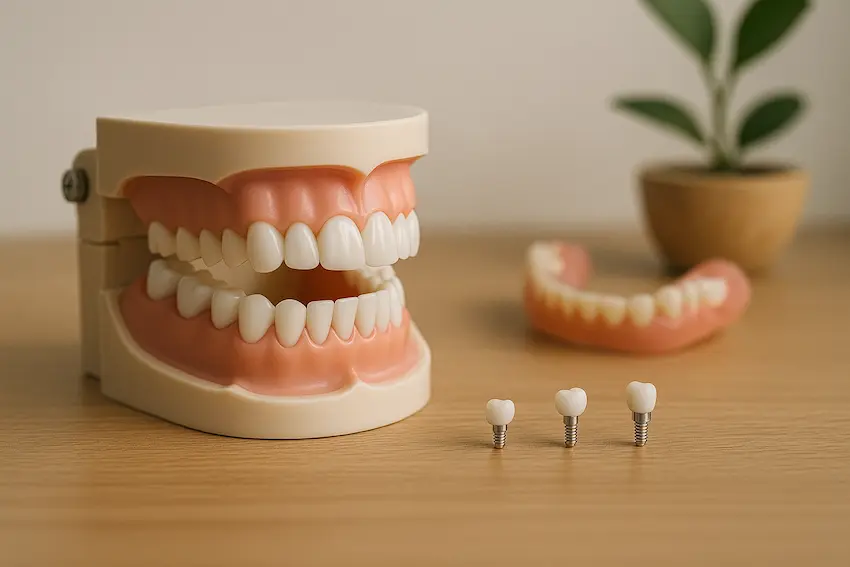
Right off the bat, there’s a misconception that a mini implant is a “little kid” version of a standard one. It’s not. Just envision that you’re trying to hang a heavy mirror on a weak wall. A standard implant is like a heavy-duty toggle bolt that goes deep into the stud. A mini implant is more like a thin wood screw.
Professor Doctor Coşkun Yıldız continuously mentions mini implants are a “smart” means of resolving the problems in the short term. Considering they are so thin—that is, just about the diameter of a toothpick—they aren’t necessitating such a large “real estate” in your jawbone. For patients with a considerable loss of bone density who are not willing to go through bone grafting for a long time, this is definitely good news.
Nevertheless, let’s take a detailed glance at the terms. The fact is that, although they are easier to place, they simply don’t have the surface area to bear the enormous crushing forces of a human bite on their own. That’s why we almost always utilize them just to “pin down” a denture that keeps falling out of the mouth.
All-on-4: The Architect’s Preference
Whereas mini implants are intended for stabilization, the All-on-4 technique is a complete remake. Dentist Polen Akkılıç and her team view this operation as setting up a machine. Instead of throwing handfuls of small pins, we rely on 4 sturdy titanium pillars which are accurately angled.
The truth is that inclining those back implants at 45 degrees is a “cheat” of human anatomy. Thus, it enables us to move aside the places where the bone is typically thin, such as the sinus cavities, and to place the implant in the solid and strong bone at the front of the jaw.
Which One Wins? A Practical Comparison
Here is what we see in the clinic when we compare these two paths for our patients in Turkey:
| The Decision Factor | Mini Implants (MDI) | All-on-4 Dental Implants |
| The “Feeling” | Still feels like a denture (but stable) | Feels like your natural teeth |
| The Surgery | Tiny “pinhole” entries; very fast | Strategic surgery; highly precise |
| Jawbone Needs | Works in very narrow ridges | Uses existing bone via tilting |
| Maintenance | You take them out to clean | You brush them in your mouth |
| The “Forever” Factor | May need replacement in 5–7 years | Designed to last a lifetime |
The Question Remains: Why Choose One Over the Other?
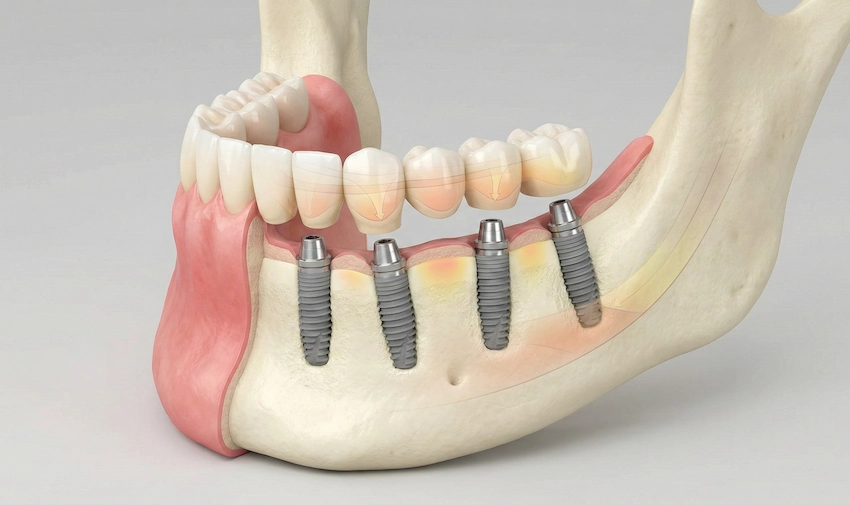
The reality is, it usually comes down to your lifestyle goals. If you are comfortable with a removable denture but are tired of it “floating” or using messy adhesives, mini implants are a fantastic, cost-effective upgrade. They provide that “click” of security.
However, if you want to forget you ever lost your teeth in the first place, All-on-4 is the answer. It is a fixed, permanent bridge. At Lema Dental Clinic, we see the psychological shift in patients who go from “wearing teeth” to “having teeth.”
Why Istanbul? The Lema Standard
Choosing to have this procedure in Turkey allows you access to technology that many local clinics simply haven’t invested in yet. We don’t guess. We use 3D guided surgery to ensure that whether we are placing a 2.0mm mini implant or a 5.0mm All-on-4 post, it is placed with sub-millimeter precision.
FAQ: Direct Answers from Our Clinical Team
Absolutely not. Whether we go the “mini” route or All-on-4, we never let a patient leave Lema Dental Clinic without a functional, beautiful smile. We provide high-quality temporary teeth the same day.
Not necessarily. The question remains: where is the bone thin? Often, even when the back of the jaw is thin, the front is strong enough for All-on-4. Or, we use mini implants to work within the narrow space you have left.
Here is what we see in the clinic: All-on-4 looks more natural because we can custom-design the “emergence profile”—basically, how the tooth looks coming out of the gum. Mini implants support a denture, which can sometimes look a bit bulkier.
Mini implants require you to remove the denture and clean the “O-rings” and the posts. All-on-4 stays in. You use a water flosser and a toothbrush just like you did with your original teeth.
It sounds more intense than it is. Most of our patients tell us the anticipation was the worst part. With the sedation protocols used by Dentist Polen Akkılıç, you’ll likely remember very little of the actual procedure.
- Malo, P., et al. (2019). “The All-on-4 design concept: A 10-year longitudinal study.” Journal of Clinical Periodontology.
- Shatkin, T. E. (2015). “The efficacy of mini dental implants in the atrophic mandible.” International Journal of Oral Implantology.
- Babbush, C. A. (2011). “Dental Implants: The Art and Science.” Elsevier Health Sciences.
- Vogel, R. C. (2013). “The transition from failing dentition to All-on-4.” Practical Procedures & Aesthetic Dentistry.
- Bulard, R. A., & Vance, J. B. (2005). “Multi-clinic evaluation of mini dental implants for long-term denture stabilization.” Journal of the American Dental Association.

