


High-noble gold resists tarnishing.
For more than a few centuries, gold has served as the “gold standard” in restorative dentistry due to its high durability unlike mere appearance, which is only its luster. Nevertheless, one of the most frequent fears of patients coming to our clinic in Turkey is that the shiny look will inevitably be lost, become black, or get a dull patina.
The brief reply is that gold doesn’t get tarnished. But the fact is we never put pure 24-karat gold inside a patient’s mouth. Pure gold is just too soft for human chewing which generates pressure of thousands of pounds. To achieve a restoration that can be handed down to the next generation, we resort to dental alloys.
At Lema Dental Clinic, we highly value the concept of totally truthful disclosure of the materials that make up your smile. Understanding the chemistry of your dental work is such an important phase that results in having healthy teeth for your whole life.
Dental Gold: not so “Just” Gold
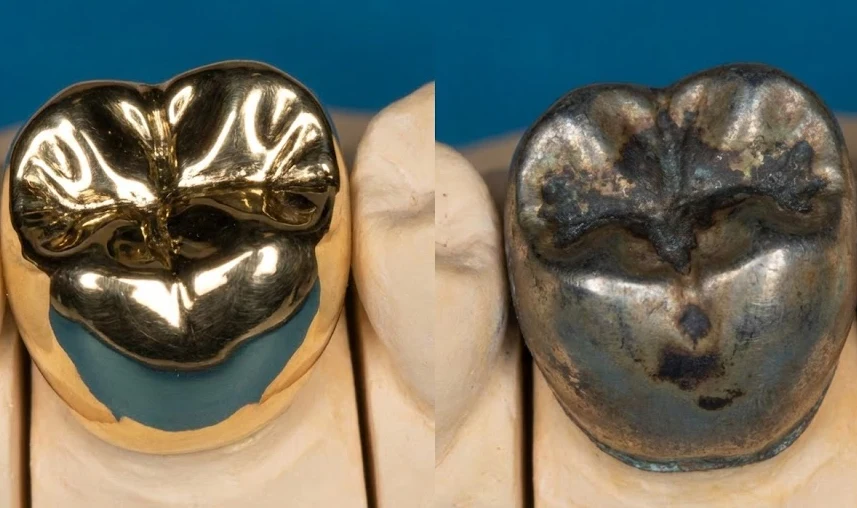
For instance, a pure gold crown, when worn, would easily get molded by the fingers like Play-Doh in no time. So, Professor Doctor Coşkun Yıldız uses the example of gold that it would have to be “strengthened” by mixing with other noble metals such as platinum, palladium, and silver to keep the resulting alloy in good condition.
Nevertheless, let’s dig into how chemistry works here. Gold, being chemically inactive, thus does not change its properties by getting in contact with oxygen or acids which are present in the mouth; however, the metals that are added to the alloy at times behave in a different manner. A dental crown that contains a high proportion of copper or silver may be subjected to slight surface oxidation after being in use for a very long time. More explanation to this phenomenon can be found in the following way: it is not the tooth decay but rather a surface-level chemical reaction similar to when an old coin loses its brightness.
High-Noble Metal vs. Base Metal: Lema’s Experience
Based on our practical experience at Lema Dental Clinic, the “tarnish” that the patients try to avoid is a problem deeply related to low-quality, base metal alloys use almost secretly. Some other clinics employ “gold-colored” metals, which are basically high content nickel or chrome. These components are quickly oxidized and frequently cause a dark and ugly line to be formed at the gum tissue.
Dentist Polen Akkılıç and her team put their trust in high-noble alloys. These combinations are made up of at least 60% noble metal (gold, platinum, palladium), including at least 40% pure gold. The gold then acts as a shield for the other metals which greatly reduces the possibility of the color changing to an extent that it can be noticed.
Comparing Alloy Stability and Color Risk
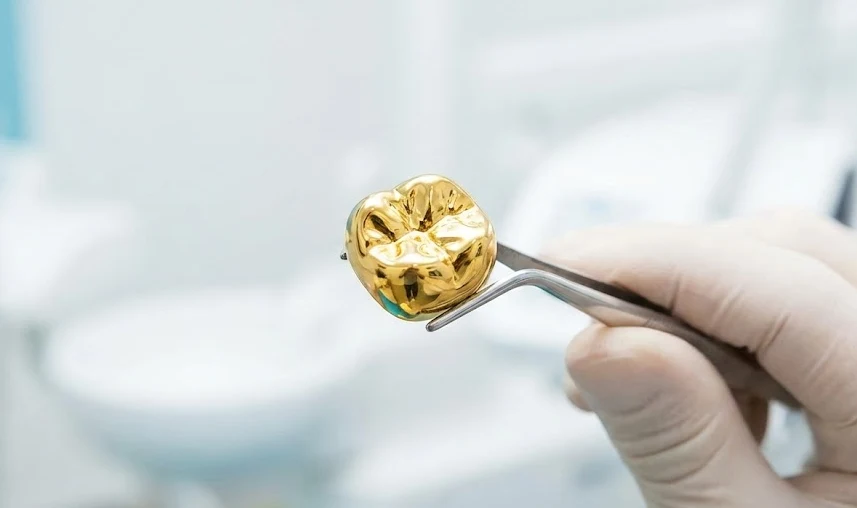
Selecting the most suitable alloy involves balancing factors such as strength, cost, and how it will look over time. This is a comparative look at the different choices in relation to whether they change color over time or not:
| Alloy Type | Gold Content | Tarnish Resistance | Long-term Color Stability |
| High Noble (Yellow) | >40% Gold | Extremely High | Remains brilliant for decades |
| Noble (White/Silver) | <40% Gold | High | May dull slightly over 15+ years |
| Base Metal (Gold-plated) | 0% Gold | Low | Likely to turn grey or black |
| Lema Custom Alloy | Optimized | Highest | Guaranteed clinical stability |
Factors That “Dim” the Shine
The question remains: if the metal is stable, why do some gold teeth look “different” after five years? Often, what a patient perceives as tarnishing is actually a film of biofilm or surface staining.
Imagine a gold crown as a luxurious sports car. The paint (the gold) retains its original color, yet if it’s exposed to road salt and dust (plaque and coffee stains), it will look dull. Besides, since gold is softer than porcelain, it can also get microscopic scratches from abrasive toothpastes. These minuscule scratches change the way light is reflected, thus making the tooth look less “shiny” compared to the time it was placed in our clinic in Turkey.
Maintenance for a “Golden” Lifetime
Dentist Polen Akkılıç and her team recommend a specific care routine for gold restorations. Using a non-abrasive, fluoride-rich toothpaste and a soft-bristle brush ensures that you aren’t “sanding down” the polish of your crown. Regular professional cleanings at Lema Dental Clinic allow us to gently re-polish the gold, restoring its original mirror-like finish without removing any metal.
FAQ: Direct Insights from Our Surgeons
The reality is that a high-quality, high-noble crown will never turn black. If you see blackening, it is usually a sign that the crown was made from a base-metal alloy or that there is significant decay at the margin where the crown meets the tooth.
Gold is non-porous, so it doesn’t soak up stains like natural enamel or old composite fillings. However, a ‘film’ of tobacco or coffee residue can sit on top of the gold. A professional dental cleaning will wipe this right off.
This usually happens with ‘white gold’ alloys. Over many years of heavy brushing, the yellow-gold atoms on the very surface can wear down, revealing the whiter palladium or silver underneath. It is still a healthy crown, just a shift in hue.
We can’t ‘paint’ more gold onto it while it’s in your mouth, but we can professionally polish it to a high shine. In most cases, a 10-minute clinical polish makes it look brand new again.
At Lema, we often use higher-quality alloys than the standard ‘insurance-grade’ metals used elsewhere. We source our materials globally to ensure they meet the strictest biocompatibility and tarnish-resistance standards.
- Anusavice, K. J., Shen, C., & Rawls, H. R. (2012). Phillips’ Science of Dental Materials. Elsevier Health Sciences.
- Givan, D. A. (2002). Precious metals in dentistry: Alloys and their uses. Dental Clinics of North America, 46(4), 721–736.
- Knosp, H., Holliday, R. J., & Schnorr, R. (2003). Gold in dentistry: Alloys, uses and performance. Gold Bulletin, 36(3), 91–102.
- Wataha, J. C. (2002). Alloys for prosthodontic restorations. Journal of Prosthetic Dentistry, 87(4), 351–363.
- Powers, J. M., & Wataha, J. C. (2013). Dental Materials: Properties and Manipulation. Mosby.

