


The “Insurance Policy” for Your Teeth.
Face it, no one is jumping out of bed, squealing with joy at the thought of having to sleep with plastic in their mouth. It is something quite inconvenient. What’s worse, most people who grind their teeth don’t know that until the damage becomes permanent and very visible.
To put it simply, cases like this are the everyday bread and butter at Lema Dental Clinic. A patient comes in for a routine check-up in Turkey, and without even a word, they can tell by the teeth “flatness“. The little cracks. The receding gums. Professor Doctor Coşkun Yıldız is always telling his patients that tooth grinding (bruxism) is equivalent to rubbing a marble countertop with sandpaper for eight hours every night. That’s how eventually, the marble disappears.
The “Shock Absorber” Analogy
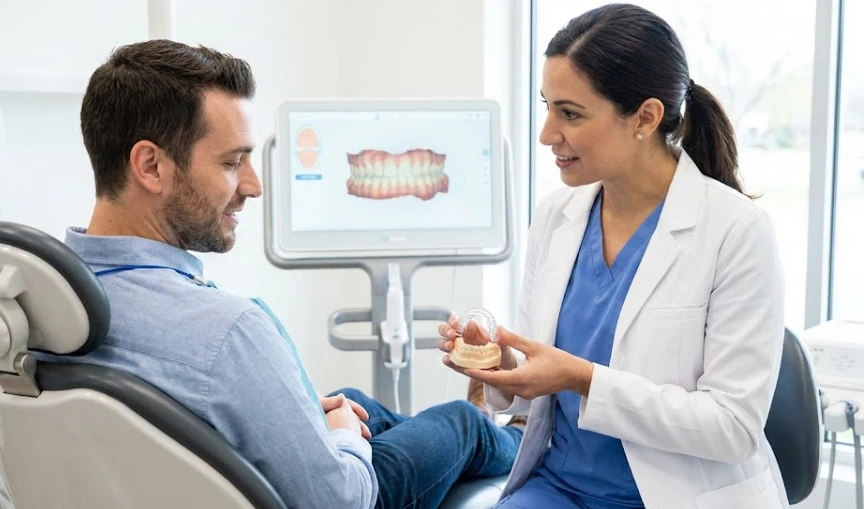
Think of your jaw like a high-performance car. Your teeth are the tires. When you grind your teeth at night, you aren’t just “touching” them together; you are applying up to 250 of pressure per square inch. That is enough force to crack a walnut.
A custom mouthguard acts as your car’s bumper. It is designed to take the hit so that your “frame” (your teeth and jaw joint) doesn’t have to. It’s a sacrificial layer. We’d much rather you wear down a piece of medical-grade acrylic than your own natural enamel.
The Clinical Hunch: Why “Store-Bought” is a Recipe for Disaster
I’ve noticed a pattern in our Istanbul clinic: patients try to save money by buying a “boil-and-bite” guard from a local pharmacy. Dentist Polen Akkılıç and her team often have to have a difficult conversation with these patients later.
In fact, an ill-fitting guard can exacerbate the problem of grinding. If the guard is not in alignment with your particular bite, your brain will perceive it as a foreign body that must be ”chewed.” You end up clenching harder. At Lema Dental Clinic, we use 3D digital impressions to ensure the guard is balanced to the millimeter. If it’s not balanced, you aren’t just protecting your teeth; you’re straining your TMJ (jaw joint).
Signs You Are a “Secret” Grinder
You might think you’re fine because you don’t hear a grinding sound. But bruxism is often silent.
- The Morning Headache: If you wake up with a dull ache in your temples, that’s not “just stress.” That’s muscle fatigue from clenching all night.
- Scalloped Tongue: Look in the mirror. Do the sides of your tongue have indentations from your teeth? That’s a major red flag.
- Sensitive Teeth: If cold water makes you wince, it might not be a cavity. It might be that you’ve ground away the protective enamel.
Custom Lab Guard vs. Over-the-Counter (OTC)
| Feature | Custom Guard (Lema Dental) | Store-Bought (OTC) |
| Material Quality | High-density, medical-grade acrylic | Soft, porous plastic |
| Bite Alignment | Corrects jaw position | Can shift teeth or worsen bite |
| Breathability | Sleek, low-profile design | Bulky and uncomfortable |
| Durability | Lasts 3 to 5 years | Usually wears through in months |
| Protection | Protects both teeth and TMJ | Only protects teeth surfaces |
FAQ: Straight Talk from Professor Doctor Coşkun Yıldız
This is the biggest fear,” says Professor Doctor Coşkun Yıldız. “The reality is that a custom guard is much smaller than people think. It only covers the biting surfaces. Because it’s so thin and fits like a second skin, most of our patients in Turkey forget it’s even there after three nights.
It’s not just worth it; it’s mandatory,” explains Dentist Polen Akkılıç. “If you spend thousands on porcelain veneers, you must protect them. Porcelain is strong, but it’s brittle under grinding pressure. No guard? No guarantee.
We can make them for either the top or bottom,” the team notes. “Generally, we prefer the top teeth for comfort, but for some patients with specific jaw issues, a lower guard is more effective. We decide this during your digital scan.
Don’t use toothpaste—it’s too abrasive and creates tiny scratches where bacteria hide,” the team advises. “Rinse it with cold water and use a dedicated denture cleaner or mild soap. Simple as that.
“The problem is you don’t know when you’ll be stressed in your sleep,” says Professor Doctor Coşkun Yıldız. “Consistency is the only way to prevent long-term joint damage. Make it a habit, like charging your phone.”
- Manfredini, D., & Lobbezoo, F. (2010). Relationship between bruxism and temporomandibular disorders: a systematic review of literature from 1998 to 2008. Oral Surgery, Oral Medicine, Oral Pathology, Oral Radiology, and Endodontology.
- Solberg, W. K., et al. (1975). Nocturnal electromyographic evaluation of bite-guard therapy. Journal of Oral Rehabilitation.
- Okeson, J. P. (2019). Management of Temporomandibular Disorders and Occlusion. Elsevier Health Sciences.
- Macedo, C. R., et al. (2007). Occlusal splints for treating sleep bruxism (tooth grinding). Cochrane Database of Systematic Reviews.
- Wassell, R. W., et al. (2002). Clinical considerations in splint therapy. British Dental Journal.

