


Yes—untreated baby cavities can damage developing adult teeth.
Can Baby Tooth Decay Affect Permanent Teeth?
Repeating to themselves it’s a reassuring phrase parents often say: “Anyway, it’s only a baby tooth and it will eventually fall out.”
This kind of phrase is one of the statements that we hear almost every day in Turkey. As parents ourselves, we fully understand the reasoning behind it. To be honest, nobody cares to spend time, money, and emotional energy on a tooth that is going to fall out anyway, right?
At Lema Dental Clinic, we are more than happy to show you the exact phenomenon that happens below the surface and why early intervention is the only time that the future “Hollywood Smile” can be saved.
Neighboring Effect
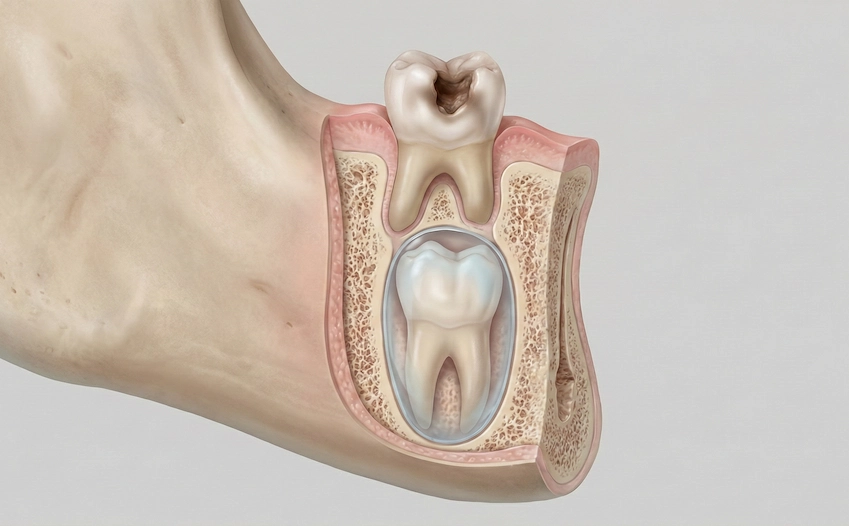
To really understand why it is risky you have to visualize the anatomical structure of a child’s jaw. The jaw is not just a single solid piece of bone but more like a dense, living area.
Think of a baby tooth as a penthouse and the permanent tooth that is growing as the person living in the apartment under the penthouse. In general, they coexist peacefully. However, if a baby tooth cavity is not treated, the decay will not be limited to the enamel only. The decay will infiltrate the pulp and the tooth will become infected.
As soon as the root infection of the baby tooth is established, an abscess will be formed. The moment when the main damage takes place is that. Let’s say the baby tooth infection is a leak from an upstairs apartment, and the developing permanent tooth below is being drip-soaked.
Dr. Coşkun Yıldız often tells parents that since the enamel of the permanent tooth is still soft and developing, this infection can physically modify the development of the tooth. The result of this is that Turner’s Hypoplasia—a condition in which the tooth wears out the spots or with the pitted corresponding enamel that can’t be white, yellow, or brown—is a permanent defect.
After the tooth comes out, no amount of tooth brushing can get rid of the spot. The damage is there even before the tooth is seen for the first time.
They Cut Your Ground: The Space Maintenance Issue
Along with the infection risk, there is also a physical problem. Baby teeth are like biological guide rails which means they only leave the right amount of space for adult teeth that will be larger to come in.
When a baby tooth has to be removed in a hurry (without a space maintainer) due to severe decay—a situation that Dentist Polen Akkılıç and her team try very hard to prevent—the adjacent teeth will block the space by moving into the empty spot. It’s like dominoes falling.
One of the visual cues of permanent teeth is trying to come out, which means they are closed in or blocked by a door that has been shut. So, the adult tooth will be angled, come out behind the other teeth, or even remain impacted in the bone. A filling that was done for a simple cavity will become a complicated orthodontic treatment for years.
Bacterial Burden

The poor oral hygiene of children is frequently ignored. The mouths of children with dental caries carry a very high bacterial load.
When new clean permanent teeth of a child appear, they are totally exposed to the risk of a wicked environment. It’s just like when a new house is established in a burning neighborhood. Thus newly erupted adult teeth are very likely to get a decay if they are not protected almost immediately after they show up because cavity-causing bacteria (Streptococcus mutans) settle on the new teeth very quickly.
Overview of Risks
Here is a helpful decision-making for you on whether treatment is necessary or the best option is to let it go. We have come up with the following comparison.
| Condition / Stage | Main Symptoms | Risk to Permanent Teeth | Treatment Complexity |
| Untreated Small Cavity | Possible sensitivity to sweets and cold | Bacterial level increases if untreated; minimal damage if detected early | Low: Simple filling |
| Deep Decay (Reaching the Pulp) | Pain, possible abscess | Very high risk of Turner’s hypoplasia (discoloration, pitting of permanent tooth) | Moderate: Pulpotomy or extraction |
| Early Extraction (No Space Maintainer) | Visible smile gap | Space loss: a permanent tooth may become blocked or crowded | High: Braces or clear aligners |
| Abscess / Infection | Swelling, fever, severe pain | Permanent tooth structure damaged; systemic health risk | Very serious: Surgery + restorative treatment |
How Lema Dental Clinic Treats Pediatric Decay in Turkey
Oh, here in Turkey, when you visit us, the first thing that comes to our mind about you is that we want to save your tooth. We don’t simply “pull and pray.”
If saving the tooth is an option, Dentist Polen Akkılıç may recommend that the tooth be treated with a pulpotomy (a “baby root canal“). It really is a quick and easy one, without pain, where the infected nerve part is removed, and the tooth is kept alive and retains the root. This makes vital space for the adult tooth.
The issue is not only leaving a hole if the tooth is taken out; in addition, we put a space maintainer—a small, custom metal loop that stops the teeth next to the hole from coming in and thus the spot for the permanent tooth is saved.
FAQ
Most definitely. Although we cannot “heal” the enamel, we can hide the defect. Resin infiltration, composite bonding, or even veneers later in life can be options depending on the severity. But the best and most inexpensive way will always be prevention by treating the baby tooth rather than fixing the permanent tooth after.
Almost always it is. I know this word “root canal” sounds very terrifying but the procedure for youngsters is very different—more straightforward—than the one for an adult. We say pulpotomy. And it only takes a few minutes. Besides saving the baby tooth, the main goal is to protect the permanent tooth that is under the baby tooth from impacts caused by losing the baby tooth earlier than expected.
It is something that we experience day-to-day. Even though our clinic in Turkey has been designed to be a calming place, a tranquil environment, at times we also offer the option of sedation. What is most important is that the personnel were educated for interaction with children. Through the use of the “Tell-Show-Do” technique, we do not surprise them. We believe that trust will be built when the children are not tricked and this means that they will not suffer dental anxiety when they grow up.
There is a heated debate on the issue but here is the clinical truth: Breast milk is not the villain, and stagnation is. If milk (breast or bottle) is left on the teeth overnight and saliva production drops while sleeping, bacteria multiply in an ideal environment. We advocate for wiping the gums or teeth with a cloth after night feedings in order to lessen the risk.
We recommend scheduling the first visit the moment your child’s first tooth erupts—ideally by age one. These early appointments are just a quick, happy introduction, but they allow us to establish a crucial baseline. The reality is, we routinely treat toddlers under general anesthesia for severe, preventable rot.
- Broadbent, J. M., et al. (2005). Dental caries experience in the primary dentition and permanent dentition: A birth cohort study. Journal of Dental Research, 84(11), 1006-1016.
- Cipriano, S. A., & Santos, R. B. (2019). Turner’s Hypoplasia: A case report and review of the literature. Journal of Clinical Pediatric Dentistry, 43(6), 373-376.
- Holm, A. K. (1994). Oral health in the preschool child. International Dental Journal, 44(2), 161-169.
- Lin, Y. T., & Lin, Y. T. (2011). Survey of space maintainer usage in the primary dentition. Journal of the Formosan Medical Association, 110(5), 331-336.
- Salami, A., et al. (2018). The effect of deciduous teeth decay on the eruption pattern of permanent successors. International Journal of Paediatric Dentistry, 28(3), 256-263.

