


Bone grafting requirements for All-on-6.
Patients who want a full-arch restoration in Turkey often wonder if their jawbone is “strong enough” to accommodate six implants. The All-on-6 system is popular for its stability, and that stability relies on having a good biological foundation. Professor Doctor Coşkun Yıldız says that despite bone grafting being a standard procedure, it is not a must for every case. Here at Lema Dental Clinic, we aim to assess the current condition of the alveolar ridge and find the most reasonable way to a permanent smile.
The Biological Necessity: Why Grafting Occurs
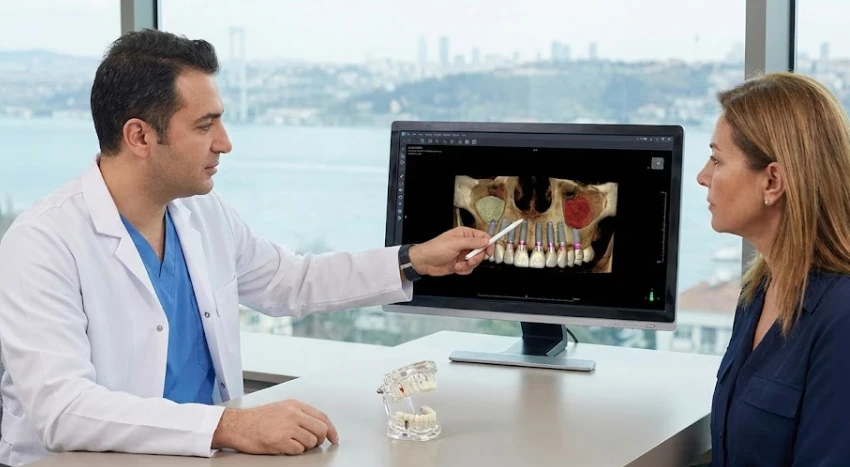
The need for a bone graft is primarily determined by the duration of tooth loss. When teeth are missing, the jawbone no longer receives the stimulation it needs to maintain its density, leading to bone resorption (atrophy).
- The Upper Jaw (Maxilla): In many cases, the bone at the back of the upper jaw is thin, and the sinus cavities have resulted in some degree of expansion (pneumatization). Under such circumstances, a sinus lift may be required, which is a particular method of bone grafting, to gain sufficient vertical height for the two implants at the back in the All-on-6 arrangement.
- The Lower Jaw (Mandible): While the lower jaw is naturally denser, long-term denture wear can flatten the ridge. To ensure the implants have enough “width” to be fully encased in bone, a ridge expansion or horizontal graft may be required.
- Quality Over Quantity: Dentist Polen Akkılıç and her team emphasize that we don’t just look for bone height; we look for cortical density. Six implants distribute chewing forces extensively, so each anchor point must be robust.
Advanced Diagnostics: Avoiding Unnecessary Procedures
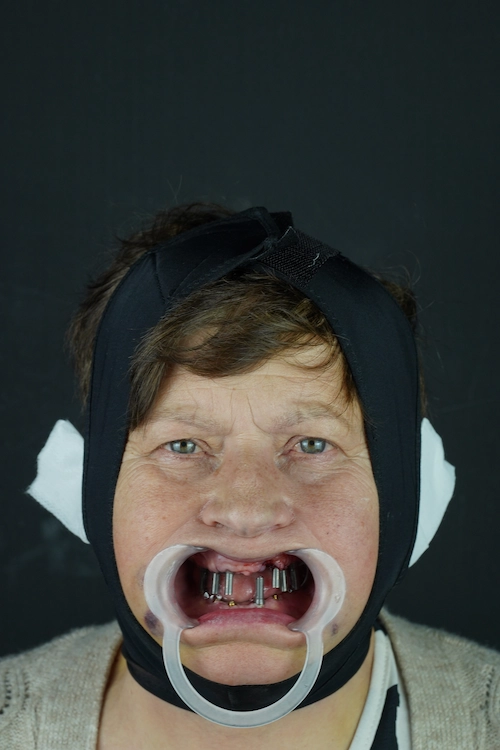
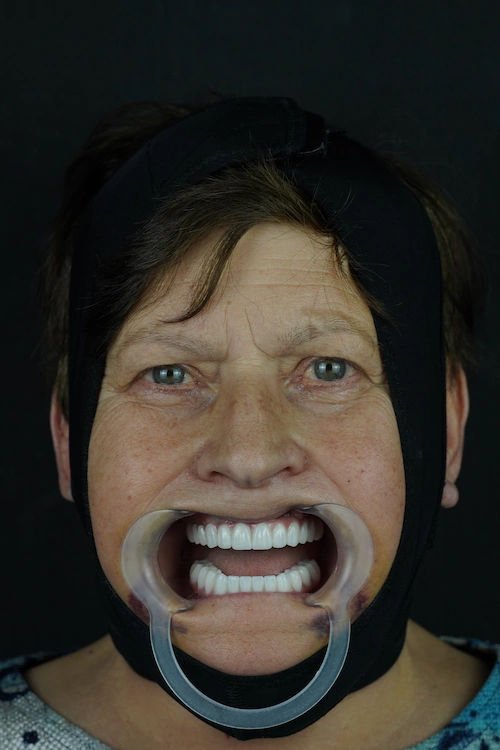
At Lema Dental Clinic, we use high-tech 3D imaging to potentially avoid grafting where other clinics might insist on it. By using CBCT scans in Turkey, we can identify pockets of high-density bone that are invisible on standard 2D X-rays.
- Tilted Implant Techniques: Sometimes, we can tilt the posterior implants to utilize the available bone, similar to the All-on-4 concept, but still achieve the All-on-6 configuration.
- Short Implants: In specific anatomical scenarios, we may use specialized “short and wide” implants that provide the necessary surface area without needing to graft deep into the bone.
- Digital Surgical Guides: These allow us to place implants with sub-millimeter precision, making use of every available fragment of natural bone in Turkey.
Decision Matrix: Grafting vs. No Grafting
| Patient Condition | Likely Solution in Turkey | Grafting Needed? |
| Recent Tooth Loss | Immediate All-on-6 | Rarely |
| Moderate Bone Atrophy | All-on-6 with Sinus Lift | Likely (Upper Jaw) |
| Severe Ridge Thinning | Ridge Augmentation + Implants | Yes |
| Good Bone Density | Standard All-on-6 | No |
FAQ: Clinical Realities of Bone Augmentation
Not at all. The procedure is performed under local anesthesia or sedation at Lema Dental Clinic. Most patients describe the sensation as a “pressure” rather than pain. In Turkey, we provide advanced post-operative care to manage any swelling during the initial 72 hours.
Usually, the grafting can be done simultaneously with the implant placement. This means you won’t need an extra trip to Turkey. However, if the bone loss is extreme, we might perform the graft first and wait a few months for it to mature before placing the implants.
We typically use high-grade biocompatible synthetic bone or bovine-derived minerals, which act as a scaffold for your natural bone to grow into. Professor Doctor Coşkun Yıldız ensures that all materials used in our clinic meet the highest international safety standards.
Sometimes, yes. All-on-4 was specifically designed to minimize the need for grafting by tilting the implants. However, if you have the bone volume for All-on-6, it is generally the “sturdier” investment. Dentist Polen Akkılıç and her team will present both options after your 3D scan in Turkey.
If a significant graft is performed, the 3-month window for osseointegration might be extended to 4 or 6 months to ensure the new bone is fully mineralized and ready to support the final bridge.
- Misch, C. E. (2007). Contemporary Implant Dentistry. Elsevier.
- Buser, D., et al. (2017). Bone Augmentation Procedures in Implant Dentistry. International Journal of Oral & Maxillofacial Implants.
- Pikos, M. A. (2019). Bone Augmentation in Implant Dentistry: A Step-by-Step Guide. Quintessence Publishing.

