


View your final smile first.
The greatest fear our patients bring into the consultation room isn’t usually the pain. It is the uncertainty. “What if I don’t look like myself?” “What if the teeth are too big?” These are the whispers of doubt that keep people from pursuing the transformation they deserve.
In our clinical experience at Lema Dental Clinic, we realized long ago that verbal descriptions of a “perfect smile” are simply not enough. One person’s “natural white” is another person’s “too bright.”
The reality is that traditional dentistry often relied on a “wait and see” approach. You would undergo the procedure and hope the final result matched the image in your head. But let’s look closer at how technology has shattered that old paradigm. Enter Digital Smile Design (DSD)—the GPS for modern aesthetic dentistry.
The Blueprint Before the Building
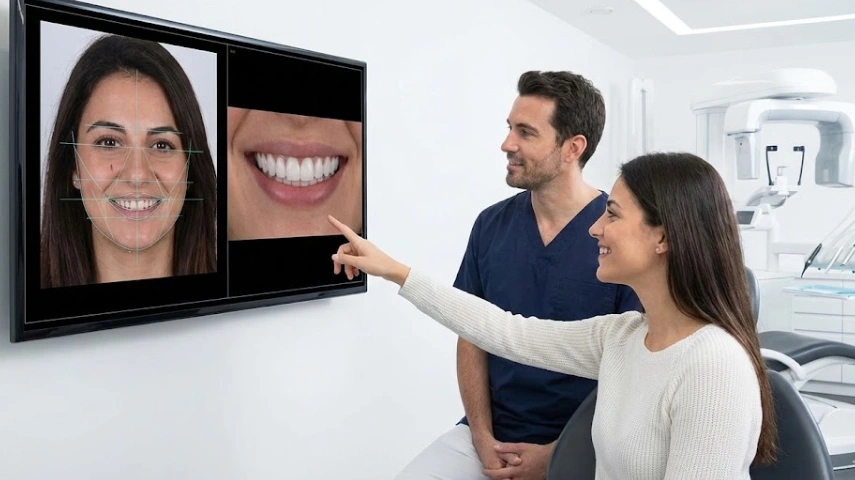
Professor Doctor Coşkun Yıldız often notes that performing a smile makeover without a digital design is like a contractor trying to build a luxury villa without an architectural blueprint. You might get a house, but will the windows be where you wanted them?
Digital smile design, we make 3D images of your face, lips, and teeth. Not only do we look at the way your teeth move when you smile, laugh, and talk, but we also look at the fit and the ratio of your face that we look to see if the new teeth will fit on your real bone structure.
Think of it as a “test drive” for your face. Before a single tooth is touched or a single implant is placed here in Turkey, you see the destination.
How the Magic Happens: The Lema Process
When you visit Dentist Polen Akkılıç and her team, the process feels less like a medical exam and more like a professional photoshoot.
- High-Definition Capture: We start with a series of professional photos and videos of you in motion.
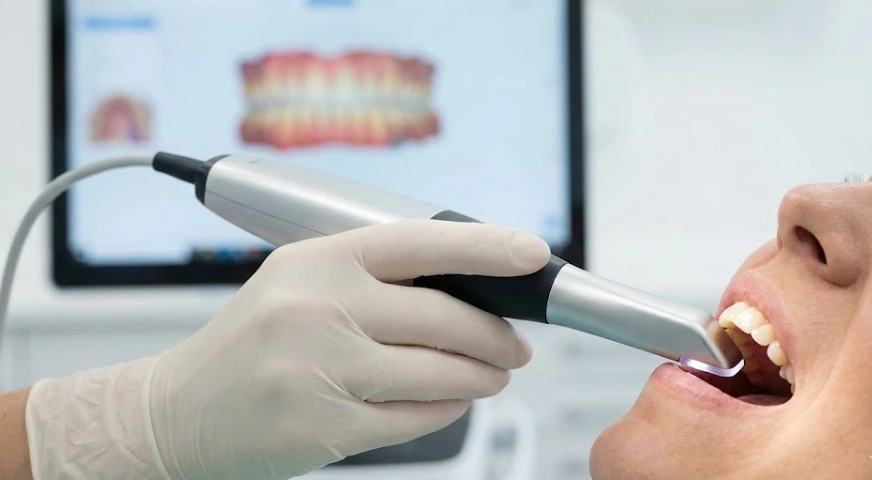
- Intraoral Scanning: Instead of those messy, gag-inducing putty impressions, we use a digital wand to “map” your mouth with laser precision.
- The Digital Workshop: Our team uses specialized software to “sculpt” your new teeth. We adjust the length, width, and translucency to a fraction of a millimeter.
- The Physical Mock-up: Here is where it gets real. We can often create a temporary “try-on” smile that snaps over your existing teeth. You can look in the mirror and see the future version of yourself in 3D.
The question remains: why does this level of detail matter? Because it eliminates the “surprise factor.” When you see the result beforehand, the anxiety of the surgery vanishes, replaced by the excitement of the upcoming change.
Comparing the Old Way vs. The Digital Way
The difference between traditional methods and DSD is the difference between a hand-drawn map and a satellite navigation system.
| Feature | Traditional Approach | Digital Smile Design (DSD) |
| Predictability | Estimated based on manual models. | High-definition, 3D visual certainty. |
| Patient Collaboration | You see the result at the end. | You are the co-designer of your smile. |
| Accuracy | Subject to manual laboratory error. | Digitally precise measurements. |
| Emotional Experience | High anxiety/uncertainty. | Confidence and peace of mind. |
| Speed | Often requires mid-process adjustments. | Streamlined, “first-time right” execution. |
Why “Human” Artistry Still Rules
You might wonder if the computer is doing all the work. Here is what we see in the clinic: technology is only as good as the hands that guide it.
While the software provides the precision, the “soul” of the smile comes from the doctors. Professor Doctor Coşkun Yıldız and Dentist Polen Akkılıç bring decades of aesthetic intuition to the screen. They know that a smile that is “mathematically perfect” can sometimes look fake. They deliberately introduce tiny, natural imperfections—the way light hits a corner or a subtle variation in shade—to ensure your smile looks like it belongs to a human, not a machine.
Choosing to have your Digital Smile Design done in Turkey at Lema Dental Clinic means you aren’t just getting a procedure; you are getting a curated, personalized experience where your voice is heard before the first step is ever taken.
From the Specialist’s Desk: Your Questions Answered
Not at all. The design phase is entirely non-invasive. We are simply taking photos, videos, and digital scans. It is actually the most relaxing part of the entire journey—you get to sit back and watch your transformation take shape on a screen.
That is the whole point! If you feel the teeth are too square or you’d prefer a softer look, we can adjust the digital sliders right then and there. We don’t move forward until you say, ‘That’s the one.
We use it for almost everything. Whether it’s a full-mouth reconstruction with dental implants or a simple set of E-max veneers, DSD serves as our master plan. It ensures that the final crowns fit perfectly into the aesthetic puzzle we’ve created.
Usually, the initial scanning and photo session takes about 30 to 60 minutes. Our lab and doctors then spend a few hours (or sometimes overnight) perfecting the digital model. You will typically see your ‘new smile’ within 24 to 48 hours of your first visit.
The reality is that the technology we use at Lema Dental Clinic is the gold standard globally. By choosing Turkey, you are accessing world-class surgeons like Professor Doctor Coşkun Yıldız and high-end tech at a value that is simply not possible in many other countries. We invest in the latest software because we believe every patient deserves to see their future before they commit to it.
- Coachman, C., & Calamita, M. A. (2012). Digital Smile Design: A Tool for Treatment Planning and Communication in Esthetic Dentistry. Quintessence of Dental Technology.
- Jafri, Z., et al. (2020). Digital Smile Design: An innovative tool in aesthetic dentistry. Journal of Oral Biology and Craniofacial Research.
- Meereis, C. T., et al. (2016). Digital Smile Design: A Tool for Planning and Communication. Operative Dentistry.
- Stanley, M., et al. (2018). Digital Smile Design – A digital tool for aesthetic and functional dentistry. International Journal of Esthetic Dentistry.
- Zhu, J., et al. (2021). The accuracy of digital smile design in predicting the final aesthetic outcome. The Journal of Prosthetic Dentistry.

