


Diamond tooth gems last longer, while crystal tooth gems are cheaper but less durable.
Diamond vs. Crystal Tooth Gems: Choosing the Right Sparkle for Your Smile
However, the trend of tooth jewelry has now evolved from being a fashion statement of just a few to a trendy product that enhances the appearance of your teeth. At Lema Dental Clinic in Istanbul, it is a trend to have patients who are keen on brightening up their smile with some sparkle. The choice most of the time, however, is left to that shining question: A Diamond Tooth Gem or a Crystal Tooth Gem?
It’s very clear that while both offer a stunning look, they are totally different in their light refraction, durability, and how well they match with your tooth enamel.
The Magnetism of a Diamond: Timeless and Sturdy
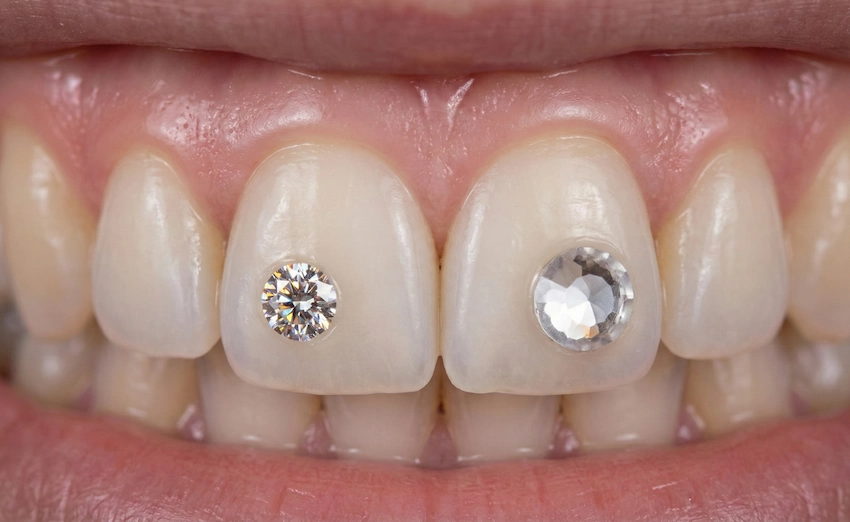
If Prof Dr Coşkun Yıldız were to talk to his patients about the best dental aesthetics, he might compare a diamond tooth gem to a perfectly-fitted suit. It’s not just about which one looks prettier; in fact,a diamond is also a symbol of stability.
Diamonds, apart from having a very high refractive index, also reflect light in such a way that it looks like they are “dancing”, which is why people call them “dancing stones”. Because a diamond is the most resistant material on earth, it will not be scratched or get dull even after a very long time. So if you want your ‘signature’ smile forever, the diamond is the perfect choice.
Considerable Surface Treatment
Is this one of the doubts that come up when any of us is thinking about permanently attaching these tiny pieces of bling to our teeth? One of the most common questions we receive at the clinic is how those small stones can be not only beautiful but also harmless to the teeth. If anything, the procedure of bonding small sparkly things to the teeth surfaces with the help of medical-grade dental composites that are practically the same material as the fillings for invisible teeth is so gentle that it hardly hurts the patient at all, even on this slight level, according to Dentist Polen Akkılıç and her team. No drilling. No pain. Consider them as the application of a high-tech “sticker” which is totally biologically compatible.
Crystal Gems: A Versatile Alternative
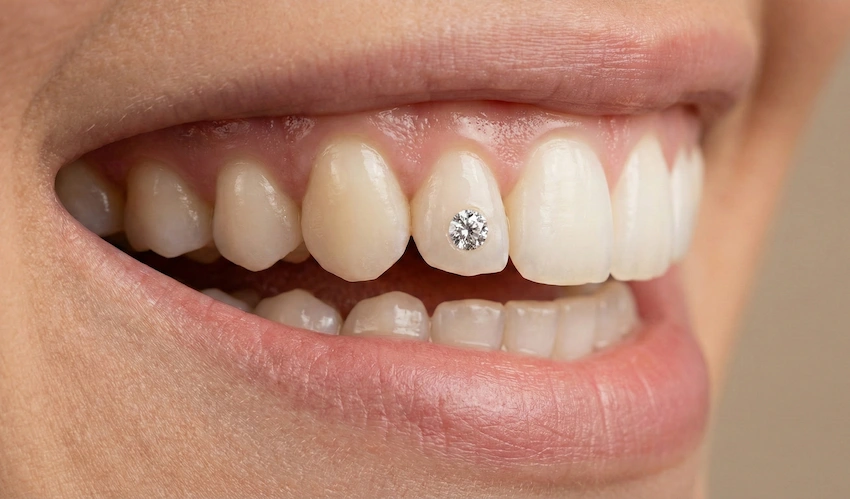
Crystal gems, which are usually created from top-notch lead glass or pieces of Swarovski, are very tempting. They have a spectacular shine, and you can pick any color you like. Thus, whereas a diamond stands as a symbol of everlasting heritage, a crystal is more about being trendy and fashionable.
The question is still there: what is the advantage of a crystal? According to many of our foreign patients visiting Turkey, they believe that crystals provide an elegant way of changing their style for less money as opposed to a real stone. It is said that diamonds are slightly higher than crystals and that is one of the reasons why some patients choose crystals as they feel more comfortable with the inside of the lips.
Comparing Your Options: Diamond vs. Crystal
Choosing between the two involves balancing your budget with your long-term goals. Here is how they stack up side-by-side:
| Feature | Diamond Tooth Gem | Crystal (Swarovski) Gem |
| Durability | Extremely High (Scratch-proof) | Moderate (May dull over time) |
| Light Reflection | Deep, multi-dimensional fire | Bright, surface-level sparkle |
| Profile | Slightly higher (Conical base) | Very flat and low-profile |
| Longevity | Can last years with proper care | Typically 6 months to 2 years |
| Biocompatibility | Excellent (Inert) | Excellent |
The Lema Dental Clinic Approach in Turkey
At our clinic in Istanbul, we don’t just “attach” a stone to a tooth. We consider the whole face.
Professor Doctor Coşkun Yıldız explains that the placement should be according to the “smile line” – the curve your lower lip forms when you smile. If the jewel is placed even a millimeter too high or too low, it might look like a piece of food rather than a gem.
What we observe in the clinic is that patients who come to Turkey for dental work generally get their gem work done along with a professional whitening treatment. A diamond on a yellow tooth is like putting a silk ribbon on a dusty box; the contrast simply doesn’t work. We make sure the “canvas” is as bright as the ”art.”
FAQ: Straight Talk from Our Doctors
We do not cause any pain at all. It’s even referred to as ‘bonding’ at my clinic. After that, we put on the adhesive and fix everything with a light. You won’t feel any pain and in 20 mins you’ll be smiling with a brand-new smile.”First, we use a gel to make the tooth surface rough for a few seconds only, then we apply the adhesive.
Yes, you really should! A gemstone is like a little pebble in a river; plaque easily gathers on the sides. Brushing and flossing are extremely important activities that you should regularly carry out to not only maintain the health of the enamel around your gem but also to keep the gem nice and clean.
It is reversible. We just take off the stone and then smooth the leftover composite with a polish. Your enamel will be okay and like nothing has ever happened.
High-strength, medical-grade bonding agents are what we use. But we’re still biting very hard pieces (like ice or hard candy) with the tooth that has the gem; we do not recommend doing that. Also, if it were to fall off, it’s most probably swallowed without you knowing and then passes naturally through the body.
Even though it’s a very simple procedure, the clinical environment makes a big difference. In Lema Dental Clinic, we have hospital-grade sterilized equipment and use top-tier materials that you normally wouldn’t get in a beauty salon. Basically, you get world-class talent in a luxury environment.
- Featherstone, J. D. (2008). The science and practice of caries prevention. Journal of the American Dental Association, 131(7), 887-899.
- Heymann, H. O., Swift, E. J., & Ritter, A. V. (2013). Sturdevant’s Art and Science of Operative Dentistry. Elsevier Health Sciences.
- Pini, N. P., et al. (2015). Advances in dental veneers: materials, applications, and aesthetics. Clinical, Cosmetic and Investigational Dentistry, 7, 9-17.
- Powers, J. M., & Sakaguchi, R. L. (2006). Craig’s Restorative Dental Materials. Mosby.
- Swift, E. J. (2011). Critical appraisal: bonding to enamel and dentin. Journal of Esthetic and Restorative Dentistry, 23(4), 273-281.

