


Therapeutic pulpotomy is still one of the most successful dental operations to keep the tooth alive in the case of reversible pulp inflammation. According to Dental Code D3220, this conservative endodontic treatment enables dentists to cut out only the portion of the pulp that is infected and then protect the healthy tissue with the help of advanced medicaments. At LEMA DENTAL CLINIC, the work of the Dentist Polen Akkılıç and her team, and Professor Doctor Coşkun Yıldız, is centered around the idea of biological preservation, minimal intervention, and accurate restoration thus they guarantee safe and long-lasting clinical results for every patient.
This method aims to help the patient get control over the inflammation situation, to stop bacterial contamination, and to conserve the pulp as the natural sensory and defensive organ. By covering the tooth with medictions such as Mineral Trioxide Aggregate (MTA), Calcium Hydroxide, or Formocresol, dentists create the conditions for healing while also taking care of comfort and aesthetics. The D3220 code is a key element of standardized dental care and it is a reflection of clinical accuracy and patient safety being put first.
What is the Meaning of the Dental Code D3220?
The code D3220 stands for therapeutic pulpotomy which is the operation of removal of the coronal pulp when it gets inflamed and the radicular pulp is still normal. This dental code, which is approved by the American Dental Association (ADA), is used for the accurate recording of the conservative pulp therapy and it acts as a signal for the insurance systems that the treatment is of a biological nature. The code is critical in distinguishing a procedure that aims at saving a tooth naturally from one in which the tooth is either replaced or removed.
At LEMA DENTAL CLINIC during a D3220 pulpotomy, Dentist Polen Akkılıç and her team seclude the tooth with a rubber dam, cut off the inflamed coronal pulp, sterilize the chamber, and put a top-quality medicament such as MTA or calcium hydroxide. After that, the tooth is sealed with a restoration made of biocompatible material in order to keep bacterial infiltration away. The treatment is designed to cater to the patient’s comfort, emphasize long-term function, and conserve natural tissue.
When is D3220 Used?
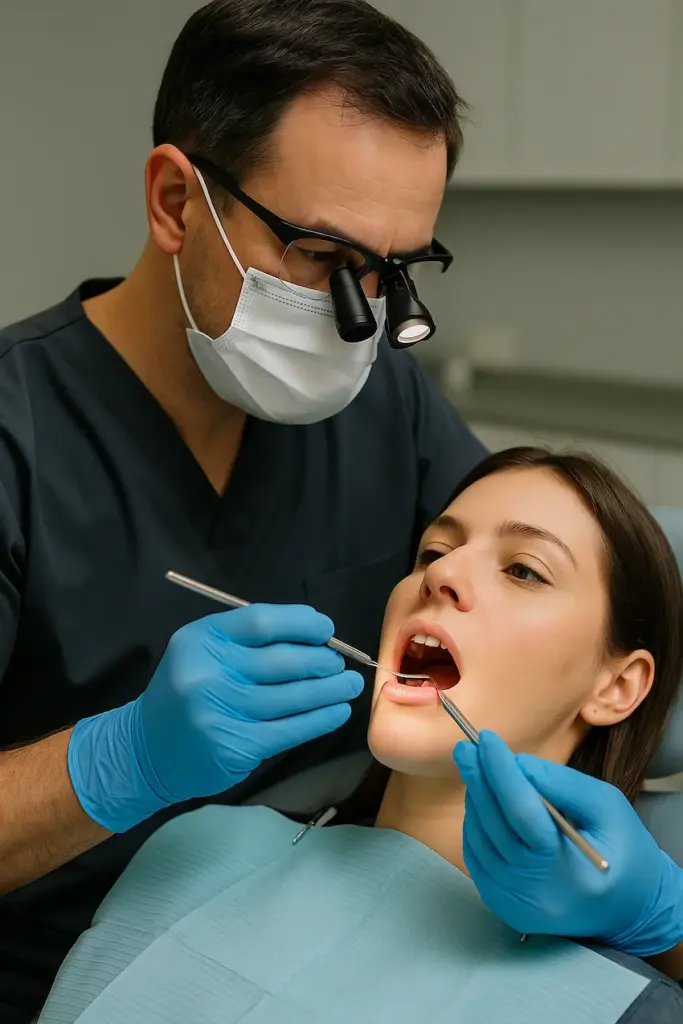
The first stage pulp (vital pulp) inflammation tissue can be seen in the photo under the microscope. The D3220 operation can only be implemented in this setting. Dentist Polen Akkılıç with her team and Professor Doctor Coşkun Yıldız at LEMA DENTAL CLINIC use radiographs and pulp vitality tests for a thorough examination and decide if therapeutic pulpotomy might be the right solution. This remedy avoids pulp damage that is beyond the limit of reversibility and gives the tooth the ability to keep its natural function.
A part of the clinical main indications and conditions when the D3220 is employed are described below:
- Deep carious lesions close to the pulp chamber: It is a condition in which decay brings the tissues necessary for life very close to the pulp even though the latter is still reversible. In that case, coronal pulpectomy is carried out and then the free pulp is covered with some agent such as Mineral Trioxide Aggregate (MTA) or Calcium Hydroxide to promote its healing and thus maintain pulp vitality.
- Mechanical pulp exposure: Dulness and infection become inevitable if the exposure of pulp is not treated timely manner. Here, the localized mechanical pulpotomy D3220 can be employed for immediate treatment to prevent infection and inflammation.
- Reversible pulpitis with pain response: Patients experiencing transient sharp pain upon taking ice or consuming sweet foodstuffs might be a candidate for D3220 treatment since their pulp is in a reversible condition and capable of self-healing.
- Pediatric and adolescent patients: The intervention of this nature in developmental teeth allows root elongation and apex maturation to take place naturally without any sudden endodontic discontinuity.
- Post-traumatic pulp exposure: The trauma does not lead to necrosis if the pulp is treated in time and properly stabilized and the D3220 work done after the incident prevails in such instances.
- Vital permanent teeth requiring conservative care: D3220 provides long-term elimination of the pain problem and keeps the tooth functional for adult patients who opt for biologically conservative methods against root canal therapy.
- No periapical pathology can be detected from the radiographic imaging: An absence of dark areas or radiolucency at the root apex is a prerequisite for the performance of D3220.
- Bleeding control after pulp removal: When hemostasis is achieved within a couple of minutes, it signals that the pulp is alive, and D3220 can be carried out safely.
Dentist Polen Akkılıç and her team advise that the most important factor is the determination of the case for this operation. A pulp with features of necrosis, fistula formation, and continuous bleeding that cannot be controlled may require a full root canal treatment (D3310–D3330) instead. Each patient gets a treatment plan that suits him or her the most and aims at maximum preservation of the natural tissue combined with comfort, biocompatibility, and a successful outcome over time.
How Do Dental Practices Use D3220?
Dental clinics like LEMA DENTAL CLINIC incorporate D3220 into a unified diagnostic and billing system as a means of communication. It is a tool that facilitates the sharing of information between clinicians, insurance providers, and patients. The documentation for each intervention is supported by preoperative radiographs, results from pulp vitality testing, and a detailed description of the materials used. Such openness assures that the remuneration is done correctly and at the same time, it increases the patient’s trust in their treatment plan.
In real-life practice, along with D3220, Dentist Polen Akkılıç and her crew perform post-treatment monitoring and radiographic follow-ups. After the recovery of the pulpotomy site, a permanent restoration like a composite filling or a zirconia crown is given to the patient. This is the part where the medicated chamber is safeguarded from the microleakage; thus, pulp vitality and the tooth’s structural integrity are maintained over the long run.
What Are the Advantages of Using Dental Code D3220?

Dental Code D3220 grants the dental team the possibility to perform the exact and local interventions that focus on saving the tissue and the comfort of the patient. The full root canal therapy which is the most invasive procedure of the dental pulp is avoided, time spent in the chair is shortened, and the healing process is faster. Patients under the care of Professor Doctor Coşkun Yıldız often say that the pain is significantly relieved within 24 hours and at the same time, they feel reassured that their natural tooth is kept intact.
From a professional point of view, the use of D3220 leads to the correct classification of cases, which, in turn, helps clinicians to align their treatment notes with the standards of insurance and health data. It is a quality indicator, showing that a dental practice is engaged in preventive and minimally invasive dentistry. At LEMA DENTAL CLINIC, the thorough use of D3220 is a demonstration of accuracy, integrity in documentation, and the highest level of patient-oriented care.
Warnings and Cautions for the Dental Code D3220
Even though D3220 brings about positive results, the dentist has to be very careful in the selection of the case and must have clinical discipline. Dentist Polen Akkılıç insists on pulp vitality testing before the operation. Pulp necrosis, periapical lesions, or advanced infections are some of the cases where the teeth are not suitable for a pulpotomy. Under such situations, a pulpotomy will result in continuous inflammation, secondary infection, or tooth discoloration.
The patients have to be aware that period after the surgery when they will experience some discomfort, which could be due to sensitivity or pressure, and it will usually disappear within a few days. If symptoms do not subside and radiographs show pathology, a further visit will be necessary. At LEMA DENTAL CLINIC, digital imaging, and vitality reassessment accompany every D3220 case as a means of ensuring that the intervention will be successful and safe over the long run.
When Would It Be Necessary to Cease Utilizing D3220 and Employ a Different One?
In the event that the tooth that received the treatment is characterized by ancessant pain, swelling, or signs of periapical infection on the radiograph, D3220 needs to be stopped, and the case should be converted to root canal treatment with codes D3310–D3330. These codes identify the process of a full pulpectomy and obturation are the procedures indicated for irreversible pulpitis or necrosis. The very first failure detection helps to avoid the consequences and keep the tooth still working after the final treatment.
According to Professor Doctor Coşkun Yıldız, D3220 should be discontinued if pulp vitality tests indicate necrosis or if the patient spontaneously complains about pain that is not caused by the stimuli. The dentist in this situation tells the patient the forecast and, afterwards, performs root canal therapy or, if the tooth is not restorable, extraction. Patient education and consent acquisition remain the most important elements even at this stage of the change.
Pulpotomy: A Biologically Relevant Procedure and Its Significance
A pulpotomy is a treatment that helps biologically to keep the living part of the pulp after the infected or inflamed part has been removed. The pulp is the tooth’s living core, made up of nerves, blood vessels, and connective tissue. By its preservation, the pulp still provides the tooth with food, sensitivity, and it becomes stronger. The dental operation that is carried out under Dental Code D3220 is to bring back the dentin to its normal function and stop the disease from getting worse.
Pulpotomy is clinically important as it ensures the survival of the natural tooth; however, it also contributes to the overall health and comfort of the patient. The maintenance of a natural tooth eliminates problems resulting from the shifting of teeth, bone loss, and the mental distress that is usually caused by extractions. The team comprising Dentist Polen Akkılıç and her staff performs the intervention with the utmost accuracy by using precision instruments, sterile barriers, and FDA-approved medicaments.
D3220 vs. Other Pulpotomy Codes
The following table demonstrates the distinctions between D3220, D3221, and D3222, enabling clinicians to select the most appropriate code for each clinical situation:
| Code | Procedure Name | Purpose and Indications | Pulp Vitality Status | Common Use Case |
| D3220 | Therapeutic Pulpotomy | Removal of coronal pulp and application of medicament (MTA, calcium hydroxide) to preserve vitality | Vital | Reversible pulpitis, deep caries, trauma |
| D3221 | Pulpal Debridement | Temporary removal of necrotic tissue to relieve pain before full endodontic therapy | Non-vital | Emergency relief of acute pain |
| D3222 | Partial Pulpotomy for Apexogenesis | Partial coronal pulp removal in immature teeth to encourage continued root development | Vital (immature) | Pediatric and adolescent cases with open apex |
At LEMA DENTAL CLINIC, doctors select the proper code based on diagnostic testing, age, and pulp status. This accuracy guarantees correct documentation, enhances treatment predictability, and supports ethical billing practices.
Key Steps in a D3220 Procedure
Each D3220 operation at LEMA DENTAL CLINIC is well-planned and carried out by the evidence-based method of leader Dentist Polen Akkılıç and her staff to ensure both the safety and the success of the treatment:
- Diagnosis and Radiographic Assessment: The dentist checks pulp vitality by electric and thermal tests and makes sure that there is no periapical infection.
- Anesthesia and Isolation: After local anesthesia is given, a rubber dam is used to isolate the tooth and thu, keep it free from contamination.
- Coronal Pulp Removal: With the help of magnification, the pulp tissue removed is inflamed and is taken out with sterile burs.
- Hemostasis and Medication: The bleeding is stopped, and a medicament like Mineral Trioxide Aggregate (MTA), Formocresol, or Calcium Hydroxide is put on the affected area to facilitate tissue repair.
- Sealing and Final Restoration: A glass ionomer liner or a composite resin is used to seal the chamber and thus, protect the treated area from the penetration of bacteria.
Such a careful plan is what makes it possible to have long-term clinical stability and natural tooth vitality, and at the same time, the highest standards of infection control and patient comfort are kept.
References
- American Dental Association. (2025). Current Dental Terminology (CDT) 2025: The ADA reference guide for dental procedure coding. Chicago, IL: American Dental Association Publishing.
- American Association of Endodontists. (2023). Clinical considerations for vital pulp therapy: Evidence-based recommendations for pulpotomy procedures. Journal of Endodontics, 49(4), 512–523. https://doi.org/10.1016/j.joen.2023.01.006
- Camps, J., & About, I. (2020). Biocompatibility and bioactivity of calcium hydroxide and mineral trioxide aggregate in pulp therapy. Dental Materials Journal, 39(6), 876–885. https://doi.org/10.4012/dmj.2019-331
- Parinyaprom, N., Nirunsittirat, A., Chuveera, P., Na Lampang, S., Srisuwan, T., & Srisatjaluk, R. (2018). Success rate of mineral trioxide aggregate versus calcium hydroxide for pulpotomy in carious vital permanent teeth. Journal of Endodontics, 44(3), 341–347. https://doi.org/10.1016/j.joen.2017.10.010
- American Academy of Pediatric Dentistry. (2024). Pulp therapy for primary and immature permanent teeth: Best practices. Pediatric Dentistry Reference Manual, 46(6), 290–297.
Frequently Asked Questions About Dentistry Code D3220
It represents a therapeutic pulpotomy procedure where the coronal pulp is removed, and a medicament is applied to preserve the vitality of the remaining tissue.
Dentist Polen Akkılıç and her team, along with Professor Doctor Coşkun Yıldız, perform this treatment using advanced endodontic materials and digital diagnostic tools.
The most effective medicaments include Mineral Trioxide Aggregate (MTA), Calcium Hydroxide, and Formocresol, all biocompatible and approved for pulp healing.
A D3220 pulpotomy usually takes between 30 and 45 minutes, followed by the placement of a protective restoration.
Yes, it can be performed on primary teeth, adolescent permanent teeth, and adult teeth with vital pulps and no apical pathology.
In suitable cases, D3220 preserves the tooth’s natural vitality, making it a more conservative and biologically beneficial option than root canal treatment.
If symptoms persist or radiographs show necrosis, the treatment transitions to a full root canal procedure to remove all pulp tissue.
Yes, regular check-ups and radiographs are necessary to monitor healing and ensure long-term pulp vitality.
Most dental insurance providers reimburse D3220 when performed with proper diagnostic documentation and justification.
At LEMA DENTAL CLINIC, success rates exceed 90% when performed under sterile conditions with biocompatible materials by expert clinicians.

