


Home remedies ease abscess pain briefly; only dental treatment cures it.
A dental abscess pain can be more than just a toothache. In fact, it’s more like the pain bell ringing in your head. It pulsates, it spreads to your neck or ear and it usually happens at night when help seems far away.At Lema Dental Clinic in Turkey, we see patients who come in with this extremely painful condition every day. Our immediate first step is to stop the suffering.
However, this is the hard thing we have to tell each patient who is sitting in our dental chairs: pain relief is not healing. It is only delaying the time until you can get medical attention.
Look at a dental abscess as a cooker that has been sealed and pressurized inside your bone of the jaw. You can lower the temperature for a brief moment and cool the pot’s outer surface but the release of the valve by a professional— who drains the infection and treats the source — is the only way to keep the pressure from increasing.
If you can’t bear the pain and want to get immediate relief, here are five ways to control the pain based on clinical procedures followed by Dentist Polen Akkılıç and her team, till you can come to us for treatment.
1. The Salt Water Rinse: Mother Nature’s Disinfectant
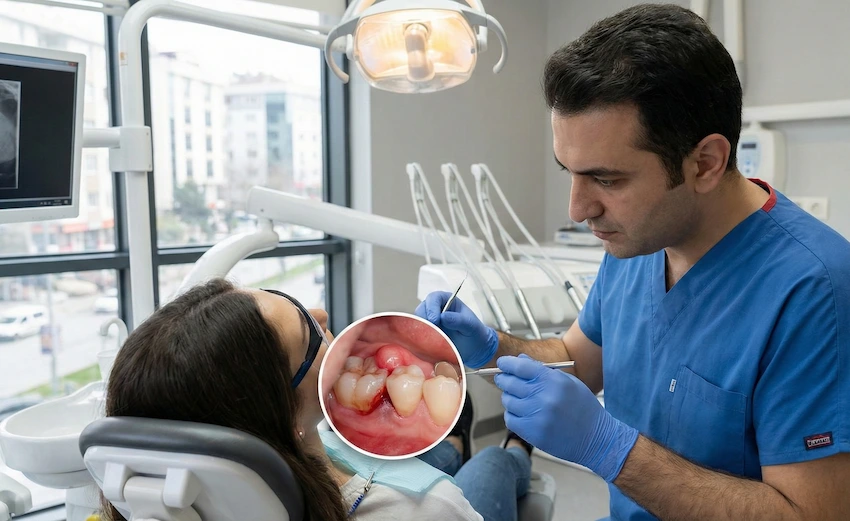
Don’t be fooled by the simplicity of this method; it is, without doubt, one of the most trustworthy primary treatments. A hypertonic salt solution works wonders by firstly, drawing out the fluid which causes painful pressure in your gums, and secondly by altering the pH balance of your mouth so that bacteria have difficulty growing.
How to do it:
- Put 1 teaspoon of salt into a glass of lukewarm (not hot) water.
- Be sure to swish the mixture around your mouth gently for at least two minutes.
- Spit out the rinse.
Professor Doctor Coşkun Yıldız has often pointed out that such a method is unable to penetrate the infection at the root level; nevertheless, it is a very effective anti-inflammatory and soothing agent for the highly irritated gum tissues. It works by breaking surface tension that allows you to relax more.
2. Cold Compress: Numbing the Nerve
If you get an infection, the effect may well be to cause swelling of your face. This swelling gets to be so tight that it presses against your nerves; hence, the nerves send very strong pain signals to your brain. So, the thing is to stop this signal.
When the blood vessels are closed by a cold compress on the cheek, it is the physiological flame that is extinguished.
The Strategy:
- Take ice or peas out of the freezer and wrap them in a thin towel.
- Put pressure on the part of your face that is hurting with the pack for 15 minutes.
- Remove the pack for 15 minutes so that your skin does not get damaged.
Warning: Never use heat treatment on an abscess. The hot blood will accumulate in the area, and as a consequence, the infection will spread quickly. The spreading of the infection is the wildfire that is fueled by gasoline.
3. Over-the-Counter Anti-Inflammatories
Once you have started to take it, ibuprofen is one of the non-steroidal anti-inflammatory drugs that can generally be more effective against dental pain than regular painkillers. The reason why these drugs can be considered better is that they target the inflammation, which is the cause of pain, not the pain itself as a symptom.
However, Dentist Polen Akkılıç points out that there is a very dangerous and common misunderstanding: never crush the pill and then smear it on your gums. This will result in “aspirin burn,” which is a chemical burn that harms your gums and adds a layer of pain to your problem. Read the medication leaflet.
4. Peppermint Tea Bags: A Cool Down for Your Gums
The application of tea bags is a very old remedy; nevertheless, peppermint contains menthol which is known to have a mild numbing effect.
Once you have brewed your tea and dried the tea bag, put it into the freezer for a few minutes. When it’s cold, place the tea bag right on the abscessed area. The cold combined with the menthol numbness can provide great relief. Although it is not a medical treatment, it’s a very good aid in the middle of the night when you would rather sleep than pace your room aimlessly.
5. The Only Permanent Fix: Root Canal or Extraction
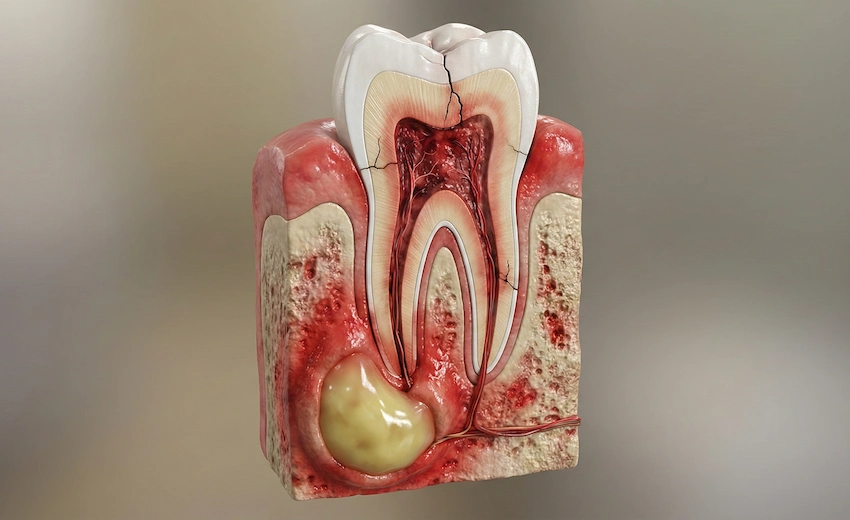
The four methods above are only a stopgap to help you through the time until you can see a professional. Once the medicine is out of your system, the pain will come back — probably even worse than before. The only way to prevent the pain in the future is to remove the infection.
At Lema Dental Clinic we focus on tooth-saving procedures when a lot of dentists would mechanically extract. With the help of Professor Doctor Coşkun Yıldız’s advanced imaging technique, he can even demonstrate to you the extent of the problem. Depending on the severity of the situation, we have two available options:
- Root Canal Treatment: removal of infected pulp (the contents of a pressure cooker), disinfection of the canal, and closure. The equilibrium is most likely to be restored right after the decompression has been enforced.
- Extraction: In cases where the tooth has been cracked or the bone has been so severely resorbed, the tooth can be extracted to provide immediate drainage to the abscess.
Comparing Your Options: Home vs. Clinic
The truth is that all the tricks of the trade that you can do at home only have a limit. This is how they compare to the professional treatment in Turkey.
| Feature | Home Remedies (Salt, Ice, Meds) | Clinical Treatment (Root Canal / Drainage) |
| Pain Relief Speed | 20–40 minutes (temporary) | Immediate post-procedure relief |
| Duration of Relief | 4–6 hours | Permanent solution |
| Mechanism | Masks symptoms; reduces surface swelling | Removes the source of infection |
| Risk | Infection can spread to the jaw/neck if delayed | Minimal; controlled clinical environment |
| Outcome | Pain returns | Tooth is saved or infection is fully removed |
FAQ: Answers from the Chair
No, it is not possible. The infection is either in the tooth or in the bone. The truth is, your body’s defense system cannot penetrate the tooth and kill the infection. The discomfort may go away after the nerve dies, but the infection will be there, slowly damaging your jawbone.
It might be a bit dangerous. The airplane’s air pressure is controlled. Essentially, it is just like when a chip bag gets bigger at a high altitude. So the gas in your abscess which is trapped can also expand which will cause unbearable pain. We advise you to get antibiotics from the local dentist before flying to Turkey, to stop the spread of the infection.
You are very much gambling with your life. If abscesses are neglected, they may lead to several dangerous conditions such as Ludwig’s Angina (swelling of the neck tissues) that may obstruct the airway, and sepsis (blood poisoning). Thus the infection spreads and reaches the heart or the brain. Run to a doctor!
This is the greatest worry, but actually, the outcome is different. The treatment itself shall stop the pain. At Lema Dental Clinic, we employ state-of-the-art anesthesia, which makes sure that you won’t feel the treatment—you will only feel the relief when the drain of that built-up pressure is done.
We always prioritize emergencies. Our VIP patient coordinators will definitely assist you with the booking of your appointment with Dentist Polen Akkılıç or any of our surgical specialists and organize your transportation right after your arrival if you are coming for treatment.
- Sanders, B. J., & Weddell, J. A. (2020). Dental abscess: Diagnosis and management in primary care. Journal of Clinical Pediatric Dentistry, 44(2), 77-82.
- Robertson, D., & Smith, A. J. (2019). The microbiology of the acute dental abscess. Journal of Medical Microbiology, 58(2), 155-162.
- American Association of Endodontists. (2021). Guide to Clinical Endodontics: Management of Acute Dental Pain. Chicago, IL: AAE.
- Matthews, D. C., & Sutherland, S. (2018). Emergency management of acute apical abscesses in the permanent dentition: A systematic review. Journal of the Canadian Dental Association, 84(1), 1-12.
- Lockhart, P. B., et al. (2019). The impact of dental infection on systemic health. Journal of the American College of Cardiology, 74(12), 1622-1635.

