


Crowns or veneers? It depends on your tooth health and smile goals.
Quite a few patients come to our Turkey clinic with a dream: the “Hollywood smile.”
They pursue a clearer, more balanced, and confidently beautiful appearance. Nevertheless, they are still confronted by the age-old decision: porcelain veneers or dental crowns. Indeed, both treatments can result in a fantastic new smile.
Still, they are designed for different clinical needs.
One can compare a veneer to a designer wallpaper update for your teeth–it merely changes their appearance. A crown, on the other hand, is like a construction renovation that not only changes the look but also strengthens the whole tooth.
Actually, your decision should be guided principally by how healthy your teeth are at the moment.
Learning the Two Procedures
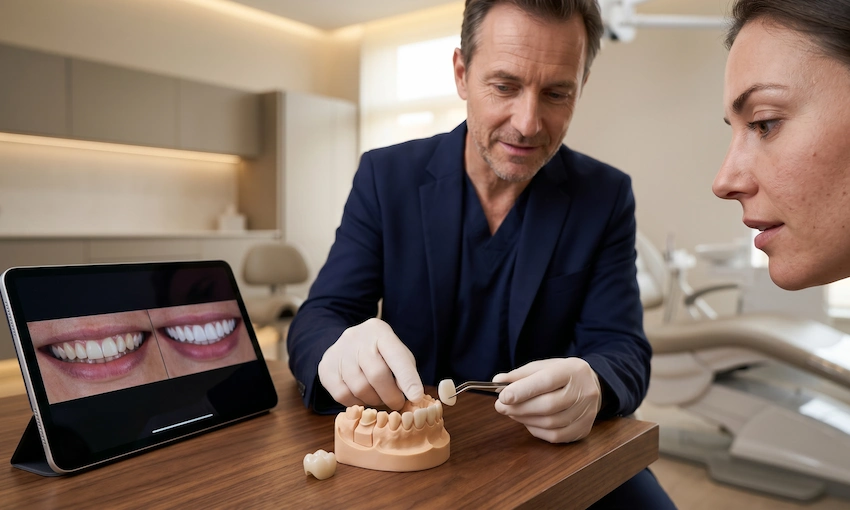
Prof. Dr. Coşkun Yıldız from the Lema Dental Clinic shares her main rule in this beautiful field: ’ Aesthetic dentistry does not offer ready-made solutions for everyone. Each of our teeth is a unique living structure that we deal with at our clinic.’
Porcelain veneers are very thin, made-to-measure shells that we attach to the front of your tooth. They are capable of:
- Aligning teeth that are slightly out of place.
- Making small gaps disappear.
- Covering up the most persistent discoloration.
On the other hand, dental crowns cover the whole tooth. They also add the element of strength. If a tooth is so deeply decayed, has suffered a big crack, or has undergone root canal treatment, then it definitely requires the assistance of a crown.
Short Comparison: What Are The Differences
Generally, one has to make a decision that involves a compromise between aesthetic wishes and the desire to keep one’s natural tooth the way it is as much as possible.
| Feature | Porcelain Veneers | Dental Crowns |
| Area of application | Front surface only | Full tooth coverage |
| Objectives | Aesthetic enhancement | Structural reinforcement |
| Prep time | Minimal tooth reduction | Extensive tooth reduction |
| Use cases | Chipped, stained, or gapped teeth | Heavily broken or decayed teeth |
| Durability | Highly durable | Exceptional strength |
Our Approach – Lema Dental Clinic
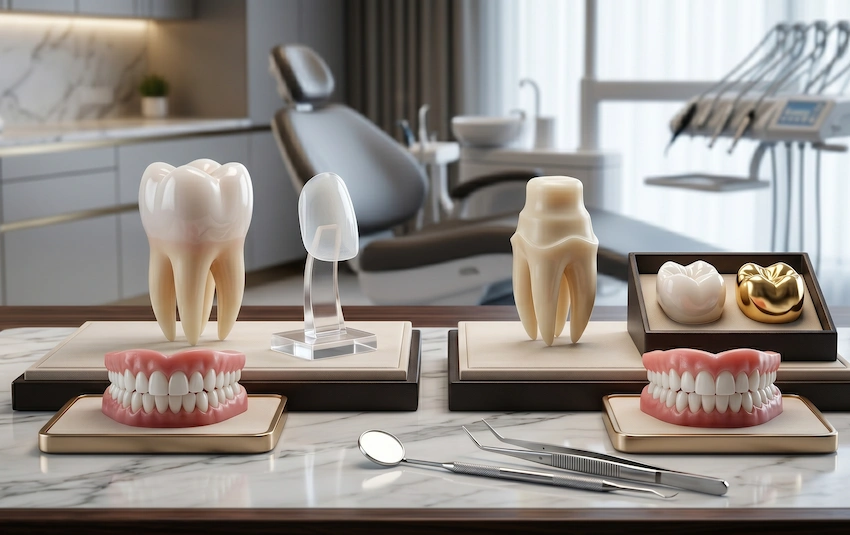
Dentist Polen Akkılıç and her team do a complete analysis of your bite when they intend to start a treatment with you. They look beyond your smile; in fact, they examine the way your teeth work together.
Do you suffer from nocturnal teeth grinding? We may recommend a certain material used for making your crown. This way, not only will your new smile be beautiful,l but also it will be
Lastly, we design for you a healthy, functional, and symmetrical face.
Frequently Asked Questions
According to Dr. Akkılıç, “The adjustment is super-thin enamel layer removal. It is often less than a millimeter. We do this to ensure the veneer sits perfectly against the gumline.”
“Generally, dental treatments would be completed within 5-7 days,” states Prof. Dr. Coşkun Yıldız. “These days will be enough for designing, prepping, and finally bonding. You will have your smile when you return to your country.”
“Both treatments are very resistant to stains,” says our staff. “High-quality dental porcelain does not absorb coffee or tea pigments as natural enamel does. So, you will maintain a bright smile for a long time.”
“No, nothing like that,” we usually tell our clients. “We apply modern local anesthesia, so you do not feel disturbing at all during tooth preparation. Most people say they are calm and comfortable.”
“Actually, we can make a decision about that once we have done the examination,” says the NYL Dental team. “We look over the X-rays and your ways of biting to determine the plan that suits you best.”
- Alhezaimi, K., et al. (2020). Longevity and clinical performance of porcelain laminate veneers. Journal of Esthetic and Restorative Dentistry.
- Pjetursson, B. E., et al. (2018). Survival and complication rates of resin-bonded fixed partial dentures. Clinical Oral Implants Research.
- Edelhoff, D., & Sorensen, J. A. (2002). Tooth structure removal in anterior teeth preparations. The Journal of Prosthetic Dentistry.
- Sailer, I., et al. (2015). Clinical outcomes of ceramic crowns: A systematic review. International Journal of Prosthodontics.
- Guess, P. C. et al. (2012). All-ceramic systems: Laboratory and clinical performance. Dental Clinics of North America.

