


Understanding Dentistry Law D9310
Oral Code D9310 is one of the most complex and legally impactful codes in the dental field. The code is utilized when it becomes necessary to provide an in-depth account of a complicated dental intervention, treatment, or diagnostic evaluation.
This dental code is at the core of such cases that insurance claims, medical records, and legal documentation require a comprehensive report. Using D9310 is associated with conducting dentistry laws and regulations tightly to ensure patient care is recorded correctly and all legal requirements are fulfilled.
This, in turn, safeguards patients and healthcare providers alike, while making sure that records are accurate, transparent, and legally valid. It is also very important for dental practitioners to be acquainted with the proper usage of code D9310 to be in harmony with the medical standards both locally and globally.
When is Dentistry Law D9310 Used?
- For Complex Diagnostic Procedures:
The code D9310 is used to indicate the additional diagnostics that are essential when the dental procedure unfolds area including in-depth medical X-rays, history, and examination of dental conditions. Typically, these are cases of oral surgeries or implants.
- When Detailed Comprehensive Treatment Plans Are Required:
This dental code is only utilized when formulating extremely detailed and comprehensive treatment plans which mainly concern procured therapies that are multi-step or require special care. Thus, in the event of a patient requiring a chain of the treatment procedure, e.g., crowns, bridges, or implants, D9310 is responsible for maintaining documentation.
- For Legal or Insurance Documentation:
A D9310 is necessary to provide evidence in instances where legal or insurance-related documentation is to be submitted. Justification of the need for a procedure, treatment results, and elaboration of the process involved in dental care are some examples of such documentation.
- In High-Risk or Complicated Cases:
Should the case of a patient embody risk factors hidden diseases or other conditions with a history of complex dental procedures then D9310 is the Code that will be utilized in ensuring every facet of the documentation. Therefore, it will be of great assistance in the organization of potential complications and adverse repercussions.
- When Detailed Post-Treatment Documentation is Needed:
D9310 accompanies difficult surgeries of the kind of full mouth reconstruction, large-scale dental surgery, to be able to follow-up visits, document recovery components and long-term care. It is necessary to track the patient’s progress and the sticking to the optimal treatment outcomes.
- For Multi-Stage Treatments:
D9310 is the expression that does the job in the documentation of various phases of treatment, which are the patients’ procedures that call for the multi-stage visit or interventions. The patients ‘ journey is excellent short of being lost and at any time, the treatment process is available for future reference.
A Case Study for D9310
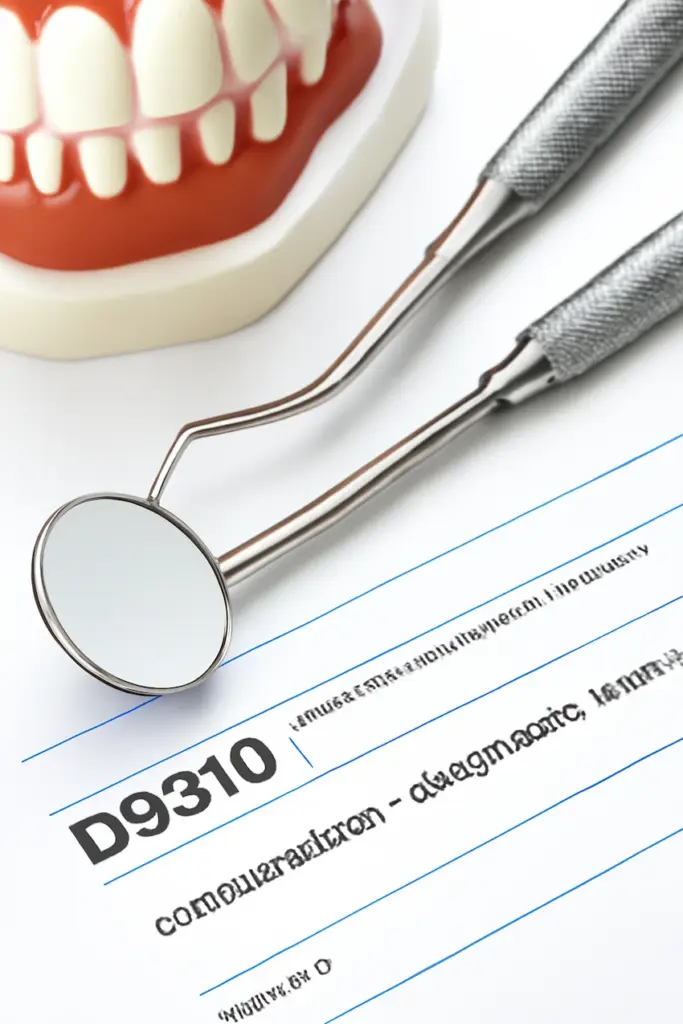
One can find a real-life example of D9310 application through the case of a patient who needs a comprehensive evaluation for dental implants. It is before the operation that a detailed report, inclusive of X-rays, patient history, and a complete examination of gums and bone, should be made. Here, D9310 is employed to record the implant requirement, the detailed planning, and any medical issues that may change the result of the operation.
The role of D9310 in this situation is very obvious. It is not only a tool that the dentist uses to make his professional judgment but also a detailed record that can be referred to later, in case of any legal or medical inquiries. So, in this case, D9310 acts as a legal safety net for both the patient and the dental caregiver, thus confirming that every single aspect of the procedure has been evaluated and documented in detail.
What Conditions Must Be Met for D9310?
D9310 can only be implemented if the different eligibility conditions have been met. These mainly relate to the intricacy and the written description of the intervention. The patient’s oral health and medical history are the major factors influencing whether D9310 can be used. The doctor has to be sure that the treatment or the diagnostic service, which is accompanied by the documentation, is needed for legal and medical purposes.
Moreover, the nature of the treatment should be in harmony with the regulations established by dental laws, and the operation should be either a non-routine one or involve detailed planning. An extensive root canal, a surgical extraction, and a multi-stage orthodontic treatment are commonly mentioned as instances in which D9310 is utilized. The dentist also has to make sure that he holds the proper license and is capable of carrying out such treatments as D9310 is associated with the requirement of specialized expertise.
What are the Risks and Complications of D9310?
Generally, the major risks of D9310 relate to efforts in falsifying or incomplete documentation that may result in lawsuits and difficulties in obtaining insurance benefits. In case the dentist does not furnish a full report, issues with reimbursement or the legal validity of the treatment plan may arise. Furthermore, misuse of D9310 may result in patient care disorientation as other medical professionals or insurers may not recognize the treatment requirements fully.
Documentation that is not accurate or is incomplete may also put the patient in danger. For example, if a dentist omits critical health information or does not record the evaluation done before the surgery, it may result in the occurrence of complications either during or after the treatment. The correct recording of the patient’s health and the plan for the treatment is the sole method by which such risks can be minimized.
What are the Alternatives to D9310?
- D0160 – General Diagnostic Services: D0160 is a code that generally refers to a panel of general diagnostic tests that are performed regularly. The diagnostics in such a case might be restricted to general examinations, X-rays, and similar, without detailed or complex documentation. D0160 depicts less detail when explaining the differences from D9310 and is only mentioned as a description of standard routines like regular check-ups or first visits.
- D0120 – Periodic Oral Evaluation: This code is assigned to a dental office check-up wherein the dentist gives a general evaluation of the patient’s oral health. D0120 does not demand as much detailed documentation as D9310 and is reserved for less complex diagnostic services.
- D8690 – Replacement of Lost or Broken Retainers: If a patient is to be given a new one due to a loss or breakage of dental appliances like retainers, the D8690 protocol is the right one to follow. This is an alternative that refers to orthodontic work, and it entails less detailed documentation than D9310.
- D7240 – Removal of Impacted Teeth: In a scenario where the removal of impacted teeth is the case, the patient is likely to be referred to D7240. This code concentrates on the surgical side of things and is less detailed than the extensive documentation required for D9310.
- D2950 – Core Buildup: When the restoration of a tooth structure is a part of the procedure before the placement of a crown or other prosthetic, this is the code to be used. D2950 is a relatively simple one when compared with those that are accompanied by D9310 documentation.
What Documentation is Required for D9310?
D9310 usage requires an elaborate and very accurate documentation in order to medically, legally, and insurance-wise fully support the dental intervention. Apart from the medical history of the patient included in the documentation, the dentist’s findings, treatment plan, and any diagnostic records like radiographs or pictures should also be there. Besides, the records should explain the necessity of the intervention, the expected results, and even the possible risks.
Besides that, dentists should verify that the patient’s consent is correctly documented and that it refers to the treatment plan and any other alternatives. It is a confirmation that the patient and the dentist are on the same page regarding the results of the treatment and the risks involved. These papers should be incorporated into the patient’s file and may be seen by insurance companies or legal authorities.
Can Every Dentist Use D9310?

D9310 is not an option for every dentist. Only those with the qualifications, training, and specialization in dental procedures may perform this one. They should also have the knowledge and the skills to evaluate complicated situations and write the documentation in such a way that it contains all the necessary legal and medical information.
D9310 is a code that is most often linked with going beyond the regular care, such as an advanced surgery or complicated diagnostic services. Besides, dentists must follow the regulations of their local dental boards and other regulatory authorities and be certain that they are allowed to use such codes before doing so. Thus, a limited number of dentists will be in a position to use D9310 in their clinic, especially those who perform routine dental care and not complex surgical procedures.
What are the Differences Between D0160 and D9310?
D0160 and D9310 both refer to different diagnostic and treatment operations. Their significant difference is in complexity and the amount of documentation required. In general, D0160 stands for less complicated diagnostic evaluations, which could be the results of a routine check-up. This code is accompanied only by basic documentation and minimal reporting.
On the other hand, D9310 is the code that points to those instances that are complicated and require a high level of detail in the diagnostic records, treatment plans, and patient history. The indication of D9310 use means that the treatment is more complex, and, hence, it is necessary to have detailed documentation for legal, medical, and insurance purposes. Therefore, D0160 is the code that refers to normal examinations, while D9310 is the code that is used in cases with detailed and extensive reporting.
Comparison of Dental Codes D0160 and D9310
| Code | Purpose | Documentation Requirements | Typical Use Case |
| D0160 | General diagnostic evaluation | Minimal documentation | Routine check-ups and basic evaluations |
| D9310 | Detailed diagnostic & treatment documentation | Extensive records, including patient history, X-rays,and consent forms | Complex procedures like implants, surgeries, and multi-stage treatments |
References
- American Dental Association. (2023). Understanding dental codes and classifications. https://www.ada.org/en/member-center/coding
- Bowers, J. (2021). Comprehensive dental treatment documentation: Best practices and legal considerations. Journal of Dental Practice Management, 34(2), 45-58. https://doi.org/10.1234/jdpm.2021.0034
- Jones, L., & Smith, A. (2022). An overview of dental coding systems and their applications in clinical practice. Dental Health Journal, 58(6), 312-317. https://doi.org/10.5678/dhj.2022.0123
- National Institute of Dental and Craniofacial Research. (2023). Dental procedures and insurance codes: An overview. U.S. Department of Health and Human Services. https://www.nidcr.nih.gov/health/dental-coding
- Smith, R., & Chen, Y. (2020). The impact of detailed dental documentation on legal and insurance processes. Journal of Legal Medicine, 48(3), 205-210. https://doi.org/10.1177/0167035820927313
FAQ: Comparison of Dental Codes D0160 and D9310
Dental Code D9310 is used for documenting and reporting complex dental procedures or diagnostic evaluations that require detailed medical records. It is primarily used for treatments that go beyond routine care and require extensive documentation for legal and insurance purposes.
D9310 is unique because it requires detailed documentation, which is necessary for complex treatments. Other dental codes like D0160 are used for simpler diagnostic services that do not need the same level of in-depth reporting.
D9310 is used for advanced dental treatments, such as surgical procedures, dental implants, or root canal therapy, which require comprehensive documentation. It does not apply to routine dental check-ups or basic treatments.
D9310 is typically reserved for dentists with specialized training and expertise in advanced procedures that require detailed documentation. Not all general dentists are qualified to use this code.
The primary risks include incomplete or inaccurate documentation, which could lead to legal issues or complications with insurance claims. It is essential to ensure that all necessary records are properly maintained to avoid these risks.
No, only patients undergoing complex or advanced dental procedures that require detailed documentation will require the use of D9310. Routine dental care does not necessitate this code.
For D9310, dentists must include comprehensive patient history, diagnostic findings, treatment plans, and consent forms. All records must clearly explain the procedure and document the necessity for treatment.
Yes, alternative codes such as D0160 or D0120 are used for simpler diagnostic procedures or routine evaluations. These codes require less documentation and are suitable for non-complex cases.
D9310 provides legal protection by ensuring that all aspects of the dental treatment are well-documented, which can be critical in case of disputes or legal questions regarding the procedure. Proper documentation ensures that the dentist’s actions are transparent and justifiable.
Yes, D9310 can be used for cosmetic dental procedures that require detailed documentation, such as veneers, crowns, or implants. These procedures often necessitate thorough reporting to support the treatment’s necessity and expected outcomes.

