


X-Guide uses real-time 3D navigation for precise implant placement and faster recovery.
Common Facts About X-Guide: The “GPS” of Modern Dental Implants
In the realm of oral surgery, the biggest challenge is to avoid uncertainty. For many years, a dental implant was placed by merely depending on 2D X-rays and the surgeon’s steady hand. Although this was an efficient way, it was analogous to trying to hang a picture frame accurately while wearing an eyepatch—you depended on estimation more than exact coordinates.
Imagine X-Guide as a super-accurate GPS that helps your jawbone to get around easily. Just like modern aviation that no longer allows pilots to land blindly in fog, we believe that eyeballing a temporary titanium screw’s exact position in your mouth shouldn’t be something your surgeon has to do.
What is X-Guide Navigation? (And Why Should You Care?)
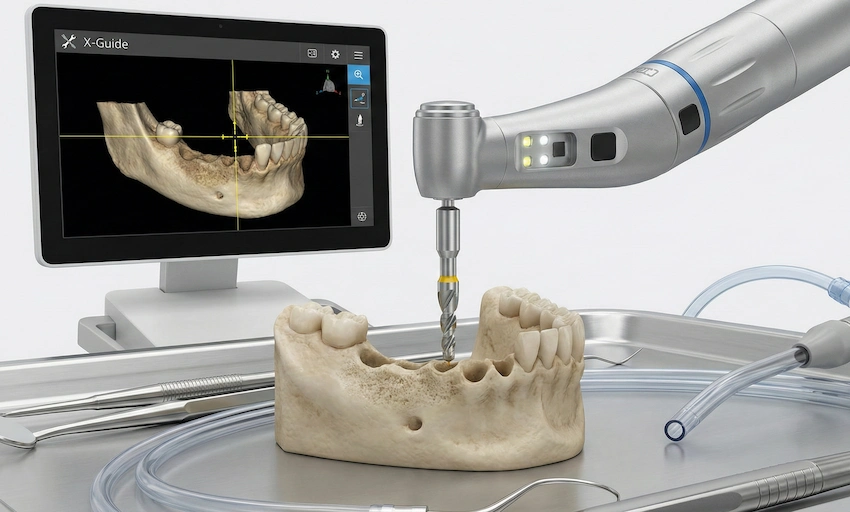
Here is the difference: Traditionally, after taking a scan and planning the surgery, the doctor transfers that plan mentally to your mouth. X-Guide makes the plan be shown on a screen in real-time, and if you move your head, the tracking moves with you. In other words, it takes the guesswork out of the equation.
Professor Doctor Coşkun Yıldız frequently points out that this technology helps a “good” outcome to be “perfect”. When one has to work in proximity to critical anatomy—such as the inferior alveolar nerve in the lower jaw or the sinus floor in the upper jaw—being accurate to the nearest millimeter is not something optional but a requirement.
The “See-Through” Surgery Effect
Just think about being able to see through the gums and locate the spots in the bone where it is densest and the nerves are hiding. This is pretty much the same as the X-Guide screen view.
We at our Istanbul clinic are so impressed by the way this technology reduces “chair time.” Because we know precisely where we are heading, there is no need to create big incisions for the bone to be inspected. As a result, a major surgical event is turned into a minimally invasive procedure.
The Role of the Surgeon vs. The Machine
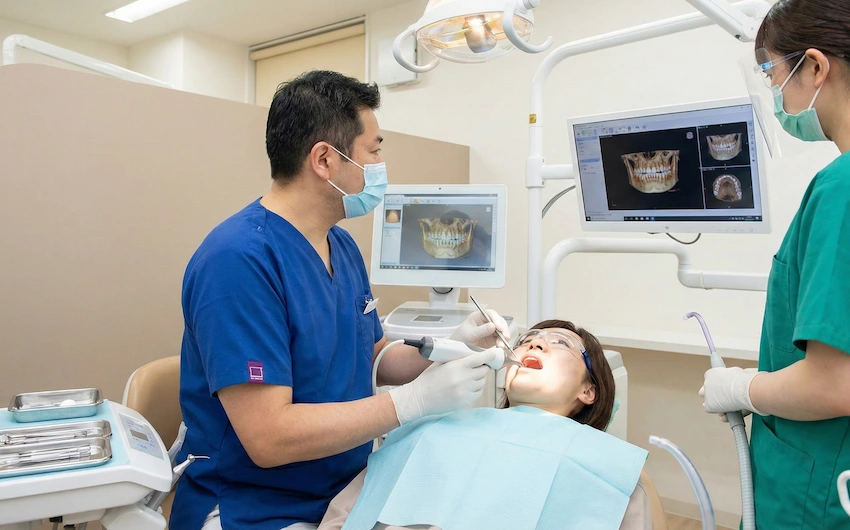
Many people mistakenly think that the robot performs the surgery. But that’s not the case really. The machine is the map; the surgeon is the pilot.
Dentist Polen Akkılıç and team always carefully base their work on this principle. The reason? The aesthetic success that a crown or bridge has depends solely on the implant angle below it. If the angle is not adjusted properly even by a slight degree, the tooth that has been restored might appear bulky or unnatural. X-Guide guarantees that the implant is positioned where the restoration team wants it for that perfect “Hollywood Smile.”
Comparison: Traditional vs. Navigated Surgery
People often ask us if doing things in the “old way” was unsafe. The answer is no; it was not unsafe. X-Guide is just a better, more accurate tool that metaphorically one could say, ‘sharpens the surgeon’s skills’. See how they compare in a clinical set-up:
| Feature | Traditional Freehand Surgery | X-Guide Navigated Surgery |
| Visual Guidance | Visualization based only on the surgeon’s mental planning from pre-operative scans | On-screen, real-time 3D interactive tracking |
| Invasiveness | Larger incisions (flaps) are usually required to see the bone | Mostly flapless (punch technique) thanks to digital guidance |
| Precision | Dependent on the surgeon’s manual steadiness | Accuracy up to ~0.1 mm and 1 degree |
| Patient Experience | Longer surgery with more post-operative swelling | Shorter surgery, faster recovery, less pain |
| Adjustability | Difficult to change the plan during surgery | The treatment plan can be adjusted instantly during the procedure |
Frequently Asked Questions
On the contrary, quite the opposite. Although the prep and digital planning beforehand take a little bit more time for us in the background, your time in the chair is mostly shortened. Actually, the time used for implanting is remarkably efficient since we don’t need to guess the angles of drilling or perform big incisions to check bone position.
Not at all. Even though Professor Doctor Coşkun Yıldız is very insistent on its use in complex cases—such as when there is hardly any bone left in a patient or implants need to be placed close to a nerve—we also apply it for a single implant. Why limit yourself to less precision just because the case is “simple”? We think every tooth deserves the highest standard of care.
Probably, there would be some additional cost to cover the technology side of things because of the need for special equipment and disposable tracking clips. However, most of our patients find the investment completely insignificant in the overall scheme of their treatment plan in Turkey when the decreased risk of complications and the increased lifespan of a well-placed implant are taken into consideration.
It is totally your choice. Since X-Guide makes the most local anesthesia sufficient by enabling such minimally invasive methods (frequently gum incisionless), the patient usually does not require general anesthesia. At any rate, you will feel the vibration but no pain. Surely, if you are anxious, sedation options are available.
This is a very important question. Basically, an implant is the equivalent of a house foundation. If the foundation is not straight, the walls (your new teeth) become crooked or weak. Dentist Polen Akkılıç will be able to create a crown that perfectly matches your natural tooth emerging from the gumline only if an implant is placed spot on with the help of X-Guide.
- Block, M. S., & Emery, R. W. (2016). Static or dynamic navigation for implant placement—Choosing the method of guidance. Journal of Oral and Maxillofacial Surgery, 74(2), 269-277.
- Stefanelli, L. V., DeGroot, B. S., Lipton, D. I., & Mandelaris, G. A. (2019). Accuracy of a dynamic dental implant navigation system in a private practice. The International Journal of Oral & Maxillofacial Implants, 34(1), 205-213.
- Panchal, N., & Mahmood, L. (2018). Dynamic navigation for dental implant surgery. Oral and Maxillofacial Surgery Clinics, 31(3), 321-329.
- Kaewsiri, D., Panmekiate, S., Subbalekha, K., Mattheos, N., & Pimkhaokham, A. (2019). The accuracy of static vs. dynamic computer-assisted implant surgery in single tooth space: A randomized controlled trial. Clinical Oral Implants Research, 30(6), 505-514.
- Jorba-García, A., Figueiredo, R., González-Barnadas, A., Camps-Font, O., & Valmaseda-Castellón, E. (2019). Accuracy and the role of experience in dynamic computer-guided dental implant surgery: An in-vitro study. Medicina Oral, Patología Oral y Cirugía Bucal, 24(1), e76.

