


Dental jewelry is not recommended with braces.
Smiling with a dazzling diamond is having a huge comeback. Dental jewelry is a great way to show your personality, whether it is a few subtle Swarovski crystals or extravagant 18k gold charms. The problem is that what if you want to add that sparkle while you are wearing braces?
Actually, at our Lema Dental Clinic, Turkey, we often discuss this issue with our young and trendy patients. First of all, you spend your effort and money on the alignment of your teeth but at the same time, you want them to look fabulous.
The truth is that it is almost impossible to combine teeth gems with orthodontic brackets. Let’s dive into how these treatments are different, what risks you face and which way is the safest for the smile of your dream.
The Mechanics: Why Braces and Bling Don’t Mix
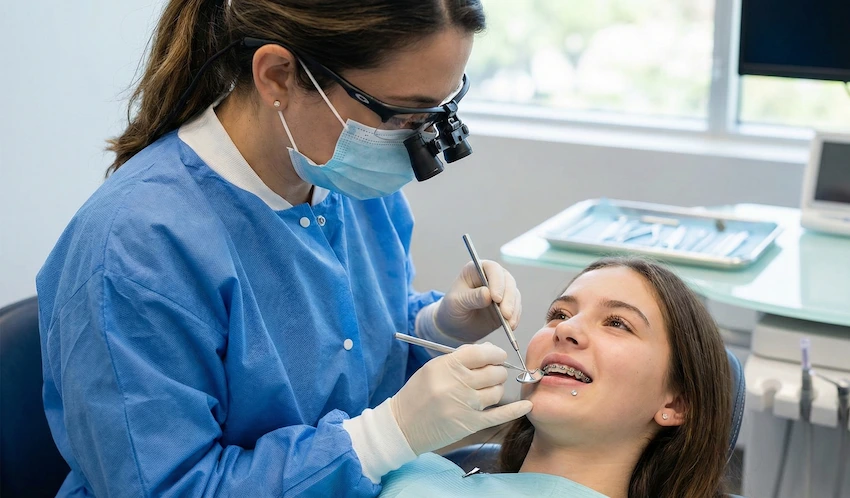
To know why mixing gems and brackets is not advisable, we have to unveil the secrets of orthodontics.
You can compare your braces to a railway track which is highly calibrated to guide a train. To push and pull your teeth to the correct positions, each wire, bracket, and rubber band is perfectly and precisely tensioned. Putting dental jewelry on the same tooth or even on the neighboring one is very much like a boulder being thrown onto that track. It disturbs the delicate equilibrium.
We would list the results we found when our patients combined the two:
First of all, they are a haven for the plaque. Braces are already known for impounding the food particles. The part of your enamel under a bracket is quite similar to skin under a cast; it definitely requires more care to stay clean. Then, by attaching a raised gem you are making yet another microscopic ledge where the bacteria and food particles can hide, thus in effect greatly increasing your chances of getting “white spot lesions” (these are spots of permanent enamel decalcification) and cavities.
- Bracket Interference: For their operation orthodontic wires require a clear path to slide through the brackets. A wrongly placed gem may block a wire, knock a bracket off, or hinder the orthodontist in tightening your braces.
- Bonding Conflicts: Both braces and dental gems involve etching needing an acidic surface to which they can properly adhere. When a tooth is etched several times in different places at once its enamel loses some of its strength.
But Let’s Look Closer: The Clear Aligner Loophole
What if your choice of orthodontic treatment is through clear aligners such as Invisalign?
Here, Coşkun Yıldız, Professor, points out that although you can take your aligners out, these are made custom so that they fit perfectly against your teeth without any gaps. Consequently, if you put a gem on your tooth, your aligner won’t fit over it. Moreover, pressing the plastic tray on the gem will result in the aligner being misshapen, thus the whole plan of your treatment will be wrecked. Conversely, if you try to attach a gem to the removable plastic tray with some adhesive, it will unavoidably be a toxic glue that is not suitable for use inside the mouth and at the same time the gem will hardly stay on the flexible plastic for long.
Dental Jewelry vs. Orthodontics: A Clinical Comparison
We have listed the interaction of dental jewelry with various stages of orthodontic treatment for better risk visualization.
| Treatment Phase | Jewelry Viability | Plaque & Decay Risk | Impact on Alignment |
| Active Braces | Highly discouraged | Severe | May interfere with wires and brackets |
| Clear Aligners | Not possible | Moderate | Prevents the aligner from fitting properly |
| Post-Treatment (Retainer) | Conditionally safe | Low to moderate | Requires a newly molded retainer |
| Fully Completed | Safe and ideal | Low (with good hygiene) | No impact |
Timing is Everything: Advice from Dentist Polen Akkılıç
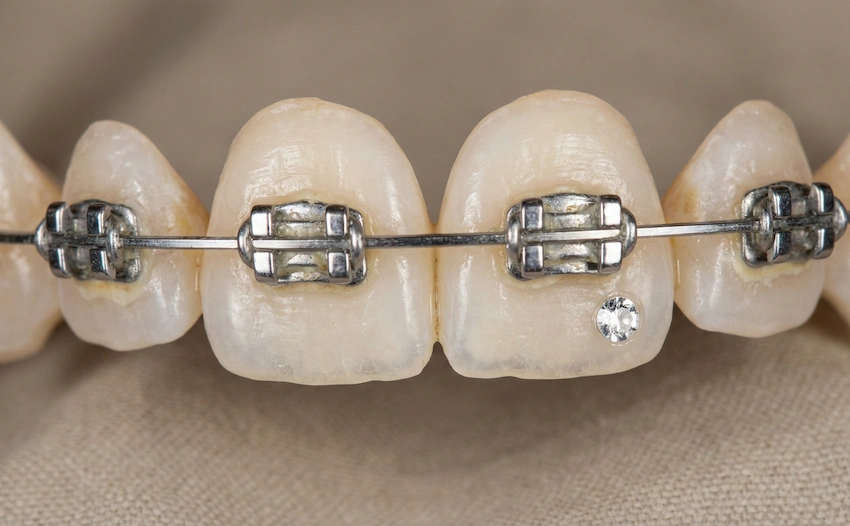
Patience is the main secret of success of the great results. Tooth gems should be considered as the icing on the cake after finishing the orthodontic treatment, according to Dentist Polen Akkılıç and her team.
After the removal of the braces, the enamel is polished by the professionals, the bite is perfectly aligned, and the teeth are like a blank canvas. At this time the application of dental jewelry should be considered the best time. Not only will the bond be stronger and the aesthetic cleaner but you also won’t have to worry about interrupting years of expensive orthodontic work.
Keep in mind that if you put a gem right after your braces are removed, a clear plastic retainer will be necessary to maintain the alignment. In any case, the orthodontist will have to take the impression or do a digital scan after the gem is applied, so the retainer can be made with a little pocket for accommodating the jewelry.
Frequently Asked Questions (FAQ)
Honestly, even if you want to put a gem on a back tooth which sounds like a great idea because the gem will be very far from the bracket, we as your doctors still don’t recommend it. Braces change how you chew and brush even if you are not aware of it. Keeping perfect oral hygiene is barely possible when you have wires; thus adding a gem anywhere in the mouth right now is only the risk of getting decay that you don’t need.
The gem on its own doesn’t stain the tooth; however, the bacteria that grow on the gem definitely will do so. If plaque is allowed to settle around the gem and the brackets, then after everything has been removed, you may notice some permanent white or brown squares on your teeth.
Please don’t do that. Eyelash glue, nail glue, and superglue are very toxic and thus none of them should ever be put in your mouth. Besides the fact that they can chemically burn the gums, they also cause permanent damage to the surface of teeth and orthodontic hardware.
In case you are having a fixed wire retainer adhered to the back of your teeth, then there is absolutely no problem with putting a gem on the front of your teeth. So, this is a combination that is totally safe.
In fact, it is possible to do it on the same day! After the brackets have been removed and the orthodontist has brushed away the remaining glue by polishing, your teeth are ready and waiting. However, inform your dental team about your plans so that they can make your removable night-time retainer to fit over the gem.
- Proffit, W. R., Fields, H. W., & Sarver, D. M. (2018). Contemporary Orthodontics (6th ed.). Elsevier.
- Zachrisson, B. U., & Arthun, J. (2004). Enamel surface appearance after various debonding techniques. American Journal of Orthodontics and Dentofacial Orthopedics, 125(2), 154-162.
- Buonocore, M. G. (1955). A simple method of increasing the adhesion of acrylic filling materials to enamel surfaces. Journal of Dental Research, 34(6), 849-853.
- Gorelick, L., Geiger, A. M., & Gwinnett, A. J. (1982). Incidence of white spot formation after bonding and banding. American Journal of Orthodontics, 81(2), 93-98.
- Al-Mulla, A., Kharsa, S. A., & Kjellberg, H. (2010). Caries risk profiles in orthodontic patients at follow-up using Cariogram. Angle Orthodontist, 80(3), 432-438.

