


Technically yes, but it permanently damages the veneer and is highly discouraged.
While a great smile potentially opens doors, I highly doubt that it is only your teeth that make the lasting impressions. According to the web, tooth gem or teeth gem is the trend in cosmetic dentistry or dental fashion nowadays. People are increasingly decorating their teeth with tiny diamonds, Swarovski crystals, or gold charms. These tiny pieces of jewels or ornaments can turn your basic smile into a unique and beautiful piece of art.
But it’s a totally different story when we talk about bonding to the natural teeth and ceramic veneers. Attaching a diamond to a natural tooth is one thing; however, trying to bond that same diamond to the very smooth surface of a ceramic veneer will be a very different challenge. If you recently went to Turkey for a full smile makeover, then it would be quite scary to think about changing it completely, right?
The main question is: Is it really possible to decorate dental veneers or zirconia crowns with diamond gems?
Below is our clinical observation, explanation of dental technology, and rationale for requiring expert care of your new ceramic teeth.
The Science of the Sparkle: Natural Enamel vs. Ceramic Veneers
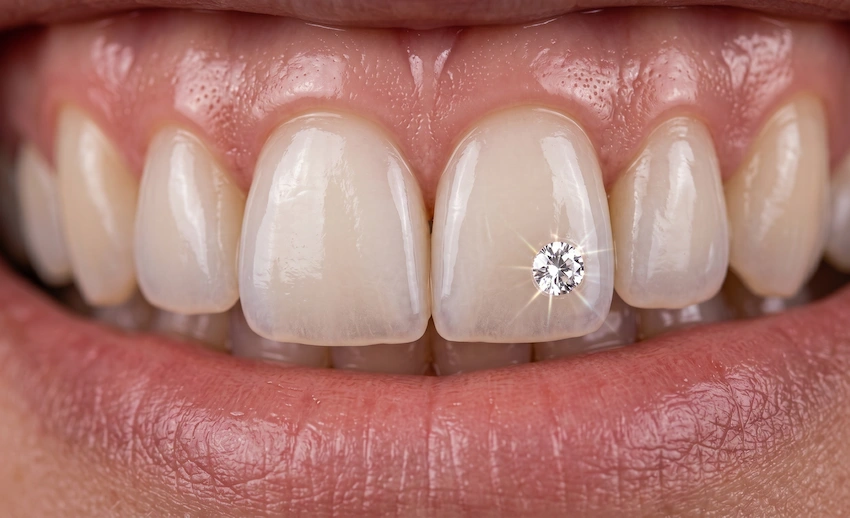
Understanding why it’s difficult to bond a gem to a veneer first necessitates examining the tooth surface.
Imagine your natural tooth as a tiny honeycomb. A dentist first puts a mild gel on the tooth to slightly enlarge the pores. After that, the dental adhesive goes down deeply into this honeycomb. In the end, a light hardens the adhesive and so tightly fixes the gem. The method is really very effective.
Porcelain veneers and zirconia crowns lack this honeycomb structure. They are manufactured to be entirely smooth and perfect.
At Lema Dental Clinic, according to our expertise, we work with high-end ceramic materials daily. These ceramics are baked in extremely hot ovens. They are given a shine resembling glass on their exterior to shield them against discoloration. If you imagine a natural tooth as a rough brick wall, then zirconia would be a smooth, non-stick pan. Usual dental adhesives completely slip off.
The Risks of Putting Tooth Gems on Porcelain Veneers
Polen Akkılıç and her team put in a great deal of effort to make every veneer flawless. Essentially, they design the veneers to beautifully reflect light. When you try to paste something on these well-finished artificial teeth, troubles begin.
In order for a gem to adhere to porcelain, the dentist is required to sacrifice that perfectly smooth protective glaze. Ordinary tooth gel simply won’t suffice. The dentist is compelled to resort to a strong acid along with special chemical drops. This method is the only one that can really get the glue to work with the ceramic.
Yıldız, the professor, always emphasizes that this operation results in the production of fragile points. “By taking away the glossy glaze for the placement of a gem,” he states, “you are actually leaving a tiny door open. That spot only gets covered with plaque and stains; in fact, it’s much faster than the rest of the tooth.”
Comparing Dental Bonding Surfaces
We prepared this chart simply to demonstrate how different kinds of teeth respond to cosmetic tooth gems:
| Surface Type | Bonding Difficulty | Chemicals Needed | Risk to Tooth | Gem Lifespan |
| Natural Enamel | Low | Mild Acid Gel | Very Low | Months to years |
| Porcelain Veneer | High | Harsh Acid + Primer | Medium (Ruins glaze) | Short; falls off easily |
| Zirconia Crown | Very High | Special Primers | High (Can crack) | Very short |
The Clinical Reality: Should You Add a Gem to Your New Smile?
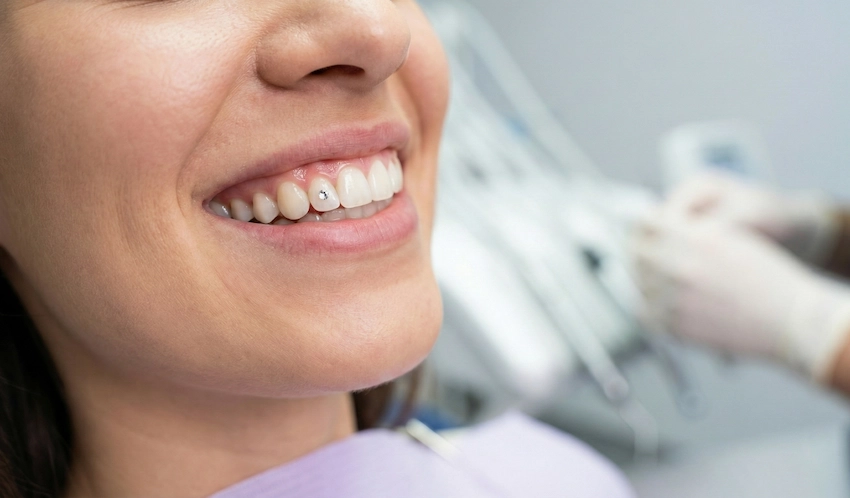
A well-trained cosmetic dentist can, in fact, stick a gem to a dental veneer or crown. We have the equipment for that.
Nonetheless, we should not automatically assume that just because we can do it, it’s okay to do it.
People come to Lema Dental Clinic in Turkey for a good reason. They want to get a smile that not only looks good but also lasts and is healthy. Putting a gem on new veneers undoes that work. If the gem comes off—which it often does with smooth ceramics—you have a rough, dull patch on your perfect tooth. We end up polishing it very thoroughly to restore the shine.
Using tooth gem kits at home by yourself is even worse. The glue in these kits is similar to a cheap superglue. Making the mistake of using these kits on your crowns can cause permanent staining. It is even possible for the ceramic layer to get fractured.
Frequently Asked Questions (FAQs)
It won’t necessarily break the crown, but smearing the original surface is a sure thing. The outer layer of the crown has to be compromised for the gem to adhere. Later on, if you decide to remove the gem, that patch remains dull forever.
Yes, it’s possible. But actually, it is really hard. We would have to precisely take off the cementing material without scratching the porcelain underneath. Also, it will be a bit time-consuming and requires a very steady hand.
On natural teeth, a gem can be retained for years. On porcelain or zirconia I, the lifespan may only be a few weeks. Eating and chewing can easily break the weak connection between the glue and the slick ceramic.
Yes, generally that’s the case. If someone damages your new teeth by scratching them to add jewelry, it completely ruins the work we have guaranteed. We always advise our patients to love the smiles we have created for them and to keep them as-is.
Absolutely not, please don’t. These kits are not dental-grade. You can permanently stain the veneers or injure the gums. Also, you may end up with hardened dark glue on the teeth that is very difficult to remove.
- Blatz, M. B., Sadan, A., & Kern, M. (2003). Resin-ceramic bonding: a review of the literature. The Journal of Prosthetic Dentistry, 89(3), 268-274.
- Özcan, M., & Bernasconi, M. (2015). Adhesion to zirconia used for dental restorations: a systematic review and meta-analysis. The Journal of Adhesive Dentistry, 17(1), 7-26.
- Peumans, M., Van Meerbeek, B., Lambrechts, P., & Vanherle, G. (2000). Porcelain veneers: a review of the literature. Journal of Dentistry, 28(3), 163-177.
- Shen, C., Rawls, H. R., & Esquivel-Upshaw, J. F. (2021). Phillips’ Science of Dental Materials (13th ed.). Elsevier.
- Tzanakakis, E. G., Tzoutzas, I. G., & Koidis, P. T. (2006). Is there a potential for mutual adhesion between different restorative materials? Journal of Esthetic and Restorative Dentistry, 18(4), 216-231.

