


Never pop a dental abscess; it can spread infection.
I guess that the pain caused by a dental abscess is the worst one can have. To a first approximation, that is what people think and try to get rid of the pain as soon as they can. You’ve heard of people wanting to “pop” it like a pimple, for instance. But, absolutely no question, do not try to popa dental abscess yourself. At Lema Dental Clinic in Turkey, we have seen how this quick-and-easy solution can, in fact, be very risky.
Knowing What We’re Up Against: What is a Dental Abscess?
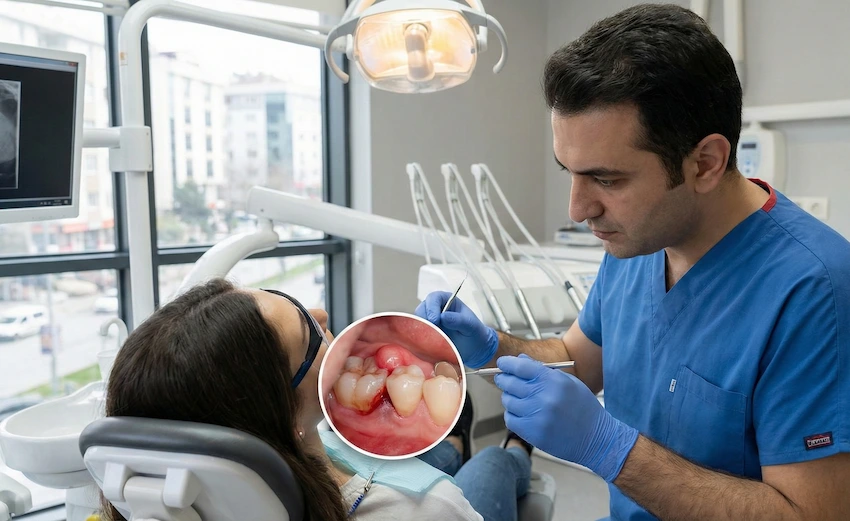
A dental abscess should not be equated with a “pimple” in the mouth only. A dental abscess is in fact a severely localized infection with a concentration of pus, which is produced by bacteria. Such an infection may arise as a result of bacterial invasion following the deep caries, periodontitis, or a cracked tooth. Your body isolates the infection by producing pus, but this “wall” may fall apart and the bacteria will spread if the infection is not treated. It is a frequent remark by Prof. Dr. Coşkun Yıldız that his patients do not realize that such an infection can be so aggressive. “In fact, the bacteria responsible for the abscess do not want to be trapped in one spot. They are on the move,” he said.
Opening an Abscess: Quite a Foolish Thing to Do
We are very often wrong in our assumption that the best thing to do is to relieve the pressure, which brings us far more discomfort than anything else. Only digging or puncturing an abscess through a needle or a sharp object poses the greatest dangers:
- Spreading the Infection: Popping an abscess carries the highest risk of this. Without knowing it, one may force bacteria deeper inside their tissues, blood vessels, or even bone. The problem is that once bacteria enter the bloodstream, the victim may develop sepsis, a systemic infection (that can be fatal).
- Making Pain Worse: Besides the fact that you will be just a very short moment relieving the symptom, with the irritation of the adjacent tissues, you will soon again experience inflammation and pain at an acute level and this time it will probably be worse.
- Partial Drainage: At home, a complete and sterile drainage of an abscess is virtually impossible. The most probable outcome is that you leave behind bacteria that cause further infection but this time it will be more aggressive.
- Damaging the Surrounding Tissues: Here you cannot even imagine the extent of damage that can be done. You can destroy the delicate gum tissue, misalign teeth, or even damage the nerves in the mouth which in the near future will be really troublesome for you.
- Introducing new bacteria into the wound is the same as allowing the invasion of pathogenic bacteria. The mouth, your hands or the tools that you may use are non-sterile and hence bacteria causing infections are naturally found on these surfaces and will enter the wound. By doing this, you will make the infection worse.
The Right Solution: See a Dentist in Turkey
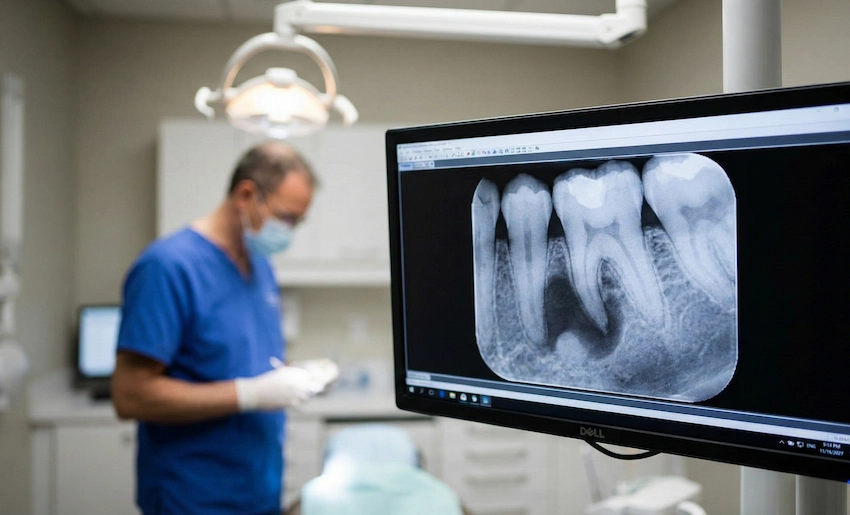
If you suspect a dental abscess, don’t waste your time and money on remedies that only act as a placebo; instead, go directly to a dental professional. You can find reliable dental professionals at Lema Dental Clinic, like Dentist Polen Akkılıç, with extensive experience in both the diagnosis and treatment of dental abscesses. We understand the urgency of the situation, and we are capable of providing you with the care you specifically need.
These are the basic steps involved in professional treatment:
- Diagnosis: A dentist first performs a thorough examination which might include X-rays to figure out the exact abscess location, the cause of infection as well as the extent to which the infection has spread.
- Drainage: A dentist will clean the pus gently and sterilely. This will relieve the pressure and pain instantly. To do this, a small cut in the gum or drilling into the infected tooth might be necessary.
- Root canal therapy: If a dental abscess happens to be due to an infected tooth, a root canal treatment will be performed to remove the infected pulp.
- Extraction: This option will be employed when the tooth is so heavily damaged that it is beyond saving.
- Treatment of Gum Disease: A periodontal abscess (from gum disease) necessitates deep cleaning (scaling and root planing) or other kinds of gum therapy.
- Antibiotics and other medications: For cases of bacterial and fungal infections, drugs are required, especially if the condition is severe or the patient has a compromised immune system.
Comparing the two scenarios (delayed vs immediate treatment) from the perspective of patient experience:
| Characteristics | Self-Performing (Dangerous) | Professional Care at Lema Dental Clinic (Safe & Effective) |
| Immediate Relief | Temporary; pain quickly returns | Immediate and complete relief after abscess drainage |
| Infection Spread | High risk of bacterial spread to the jaw or bloodstream | Controlled sterile drainage minimizes the spread |
| Complications | Risk of sepsis, osteomyelitis, tissue damage, and reinfection | Minimal risk with proper clinical management |
| Source Treatment | Root cause remains untreated | Cause identified and eliminated (caries, periodontal infection) |
| Sterility | Non-sterile; high reinfection risk | Fully sterile dental operatory environment |
| Long-term Outcome | Recurrent infection and possible tooth loss | Tooth preservation and long-term infection control |
FAQs
Dr. Polen Akkılıç explains that a dental abscess can cause a very painful toothache and a very sensitive tooth. Besides, the soft tissue around the tooth can become red and pus can be formed. If you notice these symptoms, don’t disregard your condition; if you can, see a professional dentist right away.
Prof. Dr. Coşkun Yıldız pointed out that a dental abscess is a very dangerous condition and if the treatment is delayed, it will only make the infection spread not only locally but also throughout the body. Therefore, if there is even a minimal doubt about a dental abscess, the first thing that should be done is to go to the dentist without any hesitation.
Dr. Polen Akkılıç said, “Antibiotics can play a major role in reducing the symptoms and making the bacterial infection unable to enter the bloodstream. However, most of the time, antibiotics will not help as the dental abscess will still be there. The first step is that the infected area has to be rinsed out and then the tooth or the gum has to be treated properly. You may think of antibiotics as a measure to prevent the water from flooding, but the broken dam still needs to be fixed.”
Prof. Dr. Coşkun Yıldız points out that a dental abscess without treatment for a long time eventually results in very serious complications such as bone resorption, cyst formation, spreading of infection from the tooth to the sinuses or jaw, and even a life-threatening condition of sepsis. Hence, fast intervention must be carried out on the abscess in these cases.
Dr. Polen Akkılıç explained that in the case of a toothache, one might take nonsteroidal anti-inflammatory drugs (NSAIDs) such as ibuprofen or if one is sensitive to acetaminophen, use mouth rinses with warm salt water, and avoid eating very hot or cold foods for short-term relief of a severely painful tooth. However, she emphasizes that these are just temporary solutions and the actual source of the infection should be treated as soon as possible for a permanent solution.
- Darby, M. L., & Walsh, M. M. (2014). Dental Hygiene: Theory and Practice (4th ed.). Elsevier Saunders.
- Hargreaves, K. M., Cohen, S., & Berman, L. H. (2016). Cohen’s Pathways of the Pulp (11th ed.). Mosby.
- Newman, M. G., Takei, H. H., Klokkevold, F. R., & Carranza, F. A. (2019). Carranza’s Clinical Periodontology (13th ed.). Elsevier.
- Peters, O. A., & Arias, A. (2020). Contemporary Endodontics: A Clinical Guide (2nd ed.). Springer.
- Poveda Roda, R., Bagan, J. V., Sanchis, J. M., & Bagan, L. (2007). Odontogenic infections: complications. Medical Oral Pathology Oral Surgery Buccal Journal, 12(4), E313-E319.

