


A broken dental flipper cannot be safely fixed and needs professional repair or replacement.
This usually occurs right when you least expect it. You hear a sudden “click” while eating or maybe you drop it on the bathroom floor and suddenly your temporary smile is in two parts. If you are a dental flipper wearer, you understand it is always a tightrope walk between aesthetics and convenience.
The panic might be quite intense. You try to figure out whether a bit of household glue might be able to fix it or if you will have to live with the gap for at least a week. At Lema Dental Clinic, Turkey, we assist patients daily who have been temporarily relying on dental appliances for their smile and are now making the step to permanent ones. The truth is a flipper can in most cases still be fixed but the “how” and “why” are more important than the “can.”
Dentistry “Spare Tire” with Dental Flipper
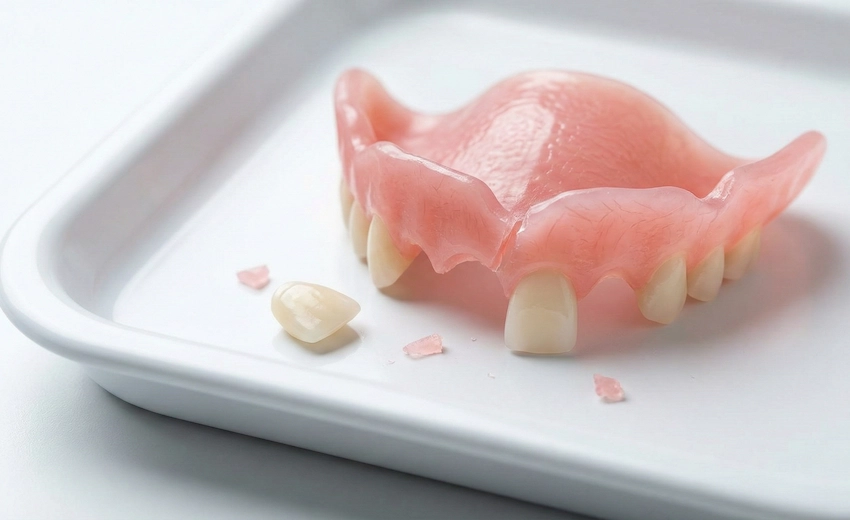
The dental flipper can be compared to the spare tire in your car. It serves to help you make the journey from point A (tooth loss) to point B (implant or permanent bridge), but it is not meant to be a high-performance or durable long-term solution. Mainly composed of acrylic resin, it is a hard material that doesn’t have the metal framework from inside that some more permanent partial dentures have.
Here at Lema Dental Clinic, we point out that the very features that make flippers such good choices—thin and lightweight—are also the reasons they will break down. The simple truth is they are brittle. When breaking they do not bend, but rather they break into pieces.
A Possible Repair? The Answer
The question stays the same: can it be repaired? Professor Doctor Coşkun Yıldız emphasizes the effect of the break on the answer that should only be established after seeing the flipper.
- Two pieces completely separated: If the acrylic plate breaks cleanly into two pieces without any fibers sticking out, the technician can often join both pieces again by using the so-called “cold-cure” acrylic.
- The tooth fell out: Having a prosthetic tooth not attached to the resin base, in this case, of the pink-colored material, is a very easy-to-repair situation for a dentist.
- “Spider-Web” Fracture: The flipper is broken into many small pieces, or it is so damaged that it appears crushed. In this case, the flipper cannot be properly repaired, and the current condition of the flipper is comparable to a shattered light bulb.
Why It Is Risky to Fix It Yourself?
One might be inclined to take off the cap of a bottle of Super Glue. Please reconsider your decision to use any obviously toxic glues. The ones you can get at a hardware store have no compatibility with the human body and among other things, they might have the potential to cause your gums to suffer chemical burns.
Mechanical damage risk can be more closely examined too. For example, if the pieces are misaligned to the extent of even only a fraction of a millimeter, the flipper cannot be placed properly in the mouth. As a result, the pressure will be exerted at certain points only. The analogy of a minute pebble that you just can’t get rid of even though it keeps bothering you fits perfectly here because it is only after several days that the effect of some pressure spots specifically created by the displaced lining of your gums which happens due to slight misalignment finally causes ulcers and not only that but there might be a possibility of the rest of your teeth being also shifted.
Comparing Your Path Forward
When a flipper breaks, you are at a crossroads. Here is how the options weigh up in a clinical setting:
| Feature | Professional Lab Repair | DIY Adhesive Fix | New Permanent Implant |
| Safety | High (Biocompatible) | Low (Toxic/Irritant) | Highest |
| Fit Accuracy | Retained | Usually Lost | Perfect Integration |
| Durability | Moderate | Very Low | Lifetime Expectancy |
| Cost | Low | Very Low | Higher Initial Investment |
| Timeframe | 24–48 Hours | 10 Minutes | Requires Surgery/Healing |
The Lema Perspective: Moving Toward Permanence
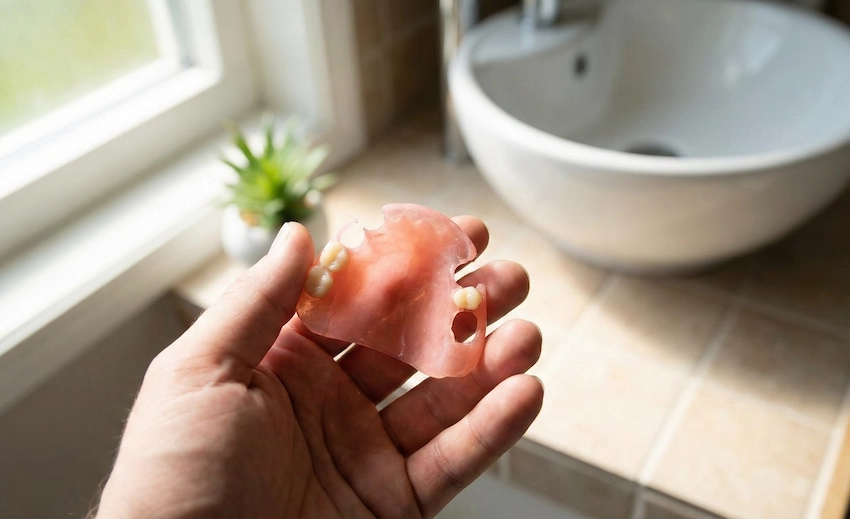
At our clinic in Istanbul, Dentist Polen Akkılıç and her team treat the breaking of a flipper as a “check-engine light” for your oral health. While we can facilitate repairs, we often use this moment to discuss the shift toward permanent restorations.
A flipper is a placeholder, but it does nothing to prevent bone resorption. Just as a building’s foundation weakens if the soil isn’t supported, your jawbone begins to shrink when a tooth root is missing. This is why we specialize in advanced dental implants. In Turkey, we provide world-class implantology that replaces the root, not just the crown, ensuring your smile doesn’t rely on a fragile piece of acrylic.
Frequently Asked Questions (FAQ)
“We certainly wouldn’t advise it. A tiny crack can harbor germs and is a clear indication that the piece is going to break soon. It may break while you are swallowing, which will then be a choking hazard. Let us fix it before it is beyond repair.” — Dentist Polen Akkılıç.
Generally, if you bring it to us in the morning, our lab partners can have it stabilized for the next-day pick-up. We don’t want our patients to lose their beautiful tooth-smiles, so we rush the cases
If the job is done well, the line is hardly noticeable. We carry the color of your previous base in the acrylic that we use for the replacement. However, the fixed section will always be less durable than a brand new piece.
Repairing a flipper costs a fraction of a flipper that is brand new. Nevertheless, if the flipper is worn out and the fit is already loose, buying a new one—or getting a permanent implant—instead is a wiser way of saving money in the long run.
“Carefully wash them with cold water and put them in a sturdy container. Do not attempt to ‘test-fit’ them back too many times as you can break the fragile edges, which might prevent a professional repair from being possible.” — Professor Doctor Coşkun Yıldız.
- Anusavice, K. J., Shen, C., & Rawls, H. R. (2012). Phillips’ Science of Dental Materials. Elsevier Health Sciences.
- Zarb, G. A., Hobkirk, J., Eckert, S., & Jacob, R. (2013). Boucher’s Prosthodontic Treatment for Edentulous Patients. Mosby.
- Phoenix, R. D., Cagna, D. R., & DeFreest, C. F. (2008). Stewart’s Clinical Removable Partial Prosthodontics. Quintessence Publishing.
- Rickman, L. J., Padipatvuthikul, P., & Satterthwaite, J. D. (2012). Contemporary polymers in dentistry: 1. Clinical applications. Dental Update, 39(2), 109-123.
- Stansbury, J. W. (2000). Curing dental resins and composites by photopolymerization. Journal of Esthetic and Restorative Dentistry, 12(6), 300-308.

