


Yes, receding gums can cause tooth loss by weakening tooth support.
Can Receding Gums Lead To Tooth Loss?
It starts very subtly. For instance, you may notice a slight “notch” at your gum line or find your morning coffee to be a little more acidic than usual. A lot of our patients at Lema Dental Clinic initially take these changes as aging.
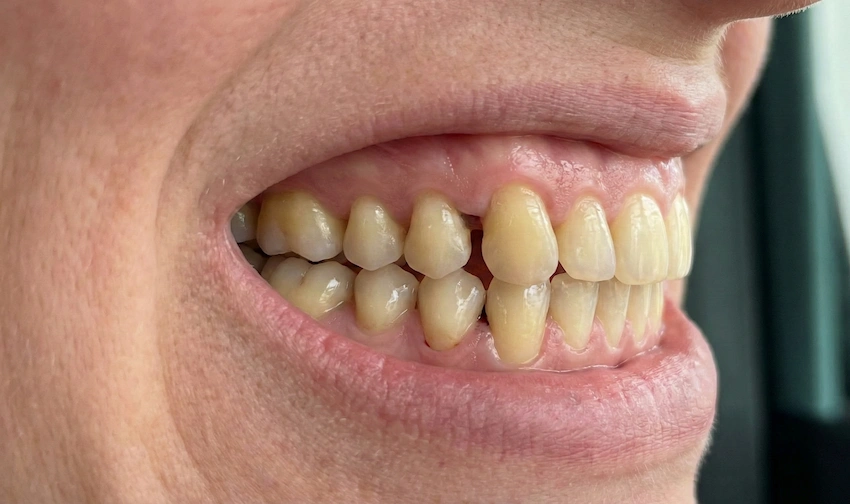
However, receding gums are not simply an ugly problem; they indicate that your mouth is truly at risk. Without treatment, no doubt receding gums will—indeed, they often do—result in tooth loss.
The Foundation of Your Smile: Why Gums Matter
Consider your teeth as a tall building. The shiny enamel which you can observe is the lovely outer architecture, while the gums and the bone below are the foundation and the earth that hold everything together. When gums recede, the “soil” will be eroded.
Professor Doctor Coşkun Yıldız often advises his patients that the gums are similar to a protective wall.When this wall is destroyed, a thin cementum (the coating of the root) is exposed and becomes vulnerable. Enamel and cementum differ in that the latter is soft and has pores. Cementum has not been exposed to mouth acids and bacteria, so it was not designed to withstand them either.
Why the Recession Starts?
From our clinical practice in Turkey, we have encountered different triggers that lead to the appearance of this condition. It is not always the case that the patient takes poor care of their mouth. On the contrary, sometimes overzealous brushing can result in “scrubbing” the tissue off. Moreover, the following are some other factors:
- Periodontal Disease: It is the main reason when bacteria damage the fibers of attachment.
- Genetics: A few people are simply born with a thinner layer of gums.
- Grinding (Bruxism): The overly powerful forces can make gum tissue detach.
- Misalignment: Crooked teeth can produce uneven bone and gum pressures.
The Slippery Slope to Tooth Loss
How precisely does a receding gum line come to mean a missing tooth? It is a gradual process. As the tissue gets detached, “pockets” appear between the tooth and the gum line. These pockets serve as shelters for plaque.
Dentist Polen Akkılıç and her team clarify that after bacteria find their way into these deep pockets, they start to break down the alveolar bone. When the bone is lost, the tooth loses its firm hold. It goes mobile—what we refer to as “wobbly”—and at last, the body can no longer support it.
Here is a breakdown of how the process typically unfolds:
| Stage of Recession | Clinical Observation | Risk of Tooth Loss |
| Mild | 1-2 mm of recession; slight sensitivity. | Low, if treated immediately. |
| Moderate | 3-4 mm of recession; visible root exposure. | Moderate; bone loss is likely beginning. |
| Severe | 5+ mm of recession; tooth mobility (loosening). | High; extraction may be necessary. |
| Advanced | Loss of attachment; abscesses and pain. | Critical; imminent tooth loss. |
Solutions at Lema Dental Clinic
The question remains: can you stop it? Absolutely. At our clinic in Turkey, we don’t just look at the teeth; we look at the entire biological system.
If the recession is caught early, Dentist Polen Akkılıç might recommend deep scaling and root planing to clear out those bacterial pockets. For more advanced cases, Professor Doctor Coşkun Yıldız specializes in regenerative procedures. This might involve “pinhole” surgery or gum grafting, where we essentially “re-soil” the foundation to cover the exposed roots and stabilize the tooth.
Managing the Risks
One shouldn’t think of a clinic just as a place to get surgeries. We stand as a hub for a holistic approach to Oral Health. Say, the key to tooth preservation is treating your gums just like silk—being gentle, using the right tools, and having regular professional check-ups.
Frequently Asked Questions (FAQ)
Indeed, gum tissues that get physically pulled away or lost won’t actually grow back like your fingernails. Nonetheless, better brushing will prevent the recession from worsening. Actually, if you want to bring back the gum line, you will require some clinical intervention.
Definitely not. The removal of a tooth might be considered only as a last resort. If there is still some bone left, the tooth can be saved by grafting and maintaining the periodontal health.
Your gum is like your coat in winter. When it is pulled back, the “nerves” of the tooth are exposed to the cold. A millimeter of recession is enough to expose the tubules that lead directly to the tooth’s nerve.
Sure, but first and foremost the main thing is to treat the gum disease. Prof. Dr. Coşkun Yıldız explains that the metaphorical “soil” needs to be healthy and disease-free if the “seed” (implant) is to be planted and grow successfully. We often attempt to guarantee the success of the implant even after years by performing implant preparations such as gum and bone grafts even before the actual implantation.
Most patients go back to their regular activities within 1-2 days although you will be restricted to a soft diet for approximately 2 weeks while the “new” tissue gets familiar with your smile.
- American Academy of Periodontology. (2023). Gum Disease Information and Prevention.
- Löe, H., & Anerud, A. (2018). The Natural History of Periodontal Disease in Man. Journal of Clinical Periodontology.
- Pini Prato, G. (2010). The Role of the Attached Gingiva in Maintaining Periodontal Health. International Journal of Periodontics & Restorative Dentistry.
- Zucchelli, G., & Mounssif, I. (2015). Periodontal plastic surgery. Periodontology 2000.
- Newman, M. G., Takei, H., Klokkevold, P. R., & Carranza, F. A. (2018). Carranza’s Clinical Periodontology.

