Autoimmune disorders can not only cause problems for your joints or organs but can also endanger your dental health. The early symptoms of the diseases of teeth that can be of autoimmune origin can be the beginning of changes in their color, texture, and the way they feel in your mouth. In fact, autoimmune diseases can cause many symptoms in your body if you don’t get timely help. Your immune system’s aggressive behavior can be displayed not only in the illness symptoms like inflammation and fatigue, but also in the health of your teeth and gums.
Here, we will investigate what role autoimmune diseases play in the weakening of tooth enamel, what symptoms to be aware of, and what actions might help you in protecting your teeth the most, in particular, if you have considered getting a Hollywood Smile with renowned professionals like the dentist at Lema Dental Clinic in Istanbul.
What Is Tooth Enamel and Why Is It Important?
Enamel for the teeth is like the armor protecting the knights; it is the outer layer that is hard and covers the teeth and shields them from all the harmful things, causing them in the oral cavity. The teeth are the only bones in your body that can do this, and they make the enamel even harder than bone tissue. But the problem is that as soon as it gets taken away from that very spot, it is lost forever. That is why maintaining its strength and health is not less than a must. It’s not only about looks for the person who missеs the enamel – it’s about pain and sensitivity that can turn into a variety of other dental issues, not to mention, the teeth can hit the stage of decay with a higher degree of probability. If the situation is added with the autoimmune diseases that are affecting the enamel, those damages could become permanent for the person.
How Autoimmune Diseases Can Weaken Enamel
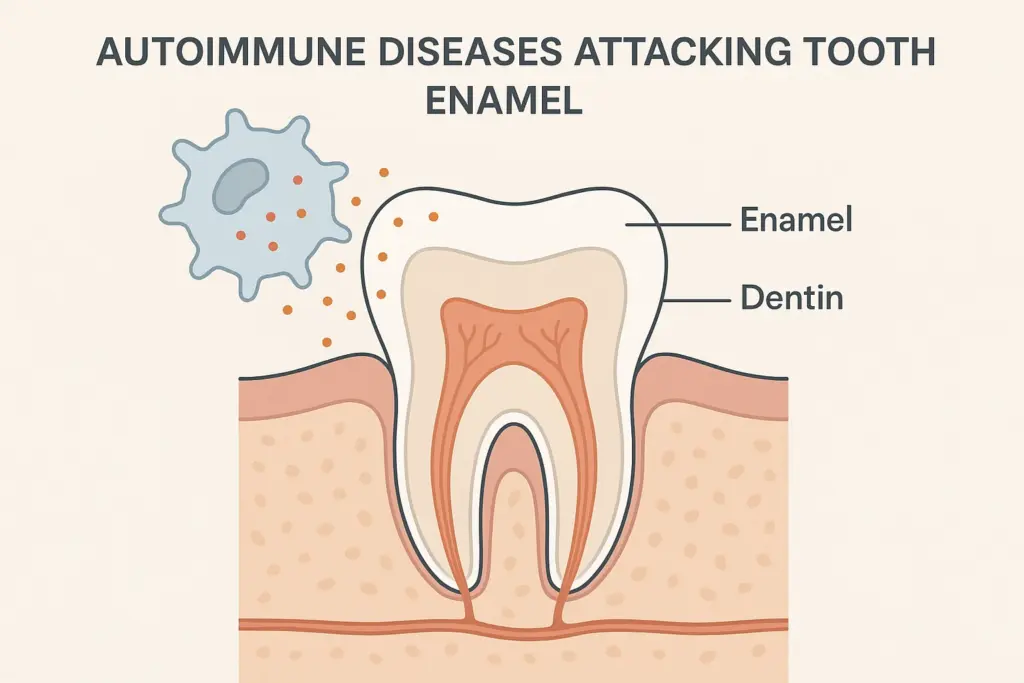
The lost enamel on the teeth is an example of the many health-related problems that are a result of the mistaken identity of autoimmune diseases. That is when your own organism attacks the organs and systems instead of foreign bodies, as it should be. Such cases can be seen in autoimmune diseases that influence the mucous membranes, joints, muscles, and so forth. And if your gums, tongue, or lips become the targets, you may, in particular, remember during the day, bad breath, and swollen/tender gums. The patient is then confronted with the likelihood of also losing the greatest part of the tooth enamel.
For instance, certain autoimmune conditions may be the reason why your mouth is dry and your body produces less saliva. Loss of saliva, a potent flushing agent, washing away acids and food particles that can harm the enamel, equals the deterioration of the enamel. A specific group of diseases can also activate a pathway to inflammation, and thus, calcium and phosphate will not protect your teeth as they should do originally.
Common Autoimmune Conditions That Affect Oral Health

Limited to just a few, the following diseases are the most common ones that severely interfere with the health of your mouth:
Celiac Disease: The condition that comes out in response to the gluten trigger can precipitate enamel defects, i.e., teeth that are pitted, stained, or grooved. Often, children’s tooth enamel damage is one of the first signs of celiac disease.
Lupus Disease: Unlike the effects of lupus on the skin and joints only, the presence of ulcers, a dry mouth syndrome, and a disturbed microbial flora in the mouth due to the lupus disease can be additional precipitating factors, which then lead to brittle enamel and thus the risk of cavities is increased.
Sjögren’s Syndrome: The severe symptoms of Sjögren’s, such as dry eyes and the mouth, will in one instant have the saliva level at almost zero, and hence there will be no protection of the enamel. Thus, already a destroyed enamel indicates the upcoming destruction of the tooth, and hence, the dental health of the person is at high risk.
Rheumatoid Arthritis: The excessive inflammation that is generated by RA is transmissible into your mouth’s acid-dependent condition, hence, that can contribute to poor hygiene, and then the erosion of enamel follows, which eventually may result in enamel erosion risk.
How to Identify Immune Disorder-Related Enamel Erosion?
Is your enamel still resilient? Some autoimmune conditions might lead to you having the following signs, so learn about them and keep yourself informed about your health, by the time the doctor can not be reached:
- More pain and discomfort when you drink or eat cold, hot, or sweet food, turn liquids, and problems with food are common.
- Teeth that are translucent or thin at the edges.
- Rough or chalky tooth surface.
- Visible pits, grooves, or stains on the teeth of children with celiac disease – this is especially common for kids with the disease.
- Despite good brushing habits, cavities still appear quite often, and decay is inevitable.
- Fluoride toothpaste or rinse: Offers enamel protection and repairs weak locations.
- Keep your energy and saliva flowing: A lot of water and sugar-free gum can act as the source of extra saliva and thus moisture, which can help you with your problem of a dry mouth, while mouth sprays can trigger saliva release too.
- Acidic products can be avoided, and likely the intake rather goes for basic ones; this means you can drink orange juice and cola, provided they are not too sour or too fizzy.
- Attend regular dental checks: Enamel can be saved if the dentist detects certain preliminary signs of enamel loss.
- Healthy choices include eating foods such as spinach, cheese, and yogurt, because of their high calcium content and the large amount of phosphorus they contain.
FAQ: Autoimmune Diseases That Affect Tooth Enamel
Yes! Many autoimmune diseases cause dry mouth, inflammation, or nutrient deficiencies that lead to enamel erosion over time.
Celiac disease can cause enamel to develop with defects—think grooves, discoloration, and weak spots—especially in children.
Definitely. Lupus can trigger dry mouth and ulcers that compromise enamel and overall oral health.
Tooth sensitivity, surface roughness, cavities, and visible pitting are common signs of autoimmune-related enamel damage.
Use fluoride, stay hydrated, limit acidic foods, and visit your dentist regularly for early enamel protection and care.