


Bonding is quicker and reversible, while porcelain veneers last longer and resist stains better.
This is a typical scene at our Lema Dental Clinic in Turkey. After treatment the patient is sitting back, the smile is shown to them through the mirror, and then the question is asked that pretty much sums up cosmetic dentistry: “Is it enough just to fix the cracks with bonding, or should I get veneers?“
It is a theme that keeps coming up. Yes, both techniques can be used to alter the appearance of a smile, but at the core, they are different implements for different jobs. Let me illustrate: Composite bonding is like an artist directly applying paint onto the canvas, covering the flaws layer by layer. Porcelain veneers are more like putting a custom marble outer layer on a house—new in structure, extremely good quality, and permanently changing the architecture of the smile.
To start deciding we have presented here the five key aspects that we normally talk about during consultation at our clinic in Istanbul.
1. Materials: Resin vs. Glass-Ceramic
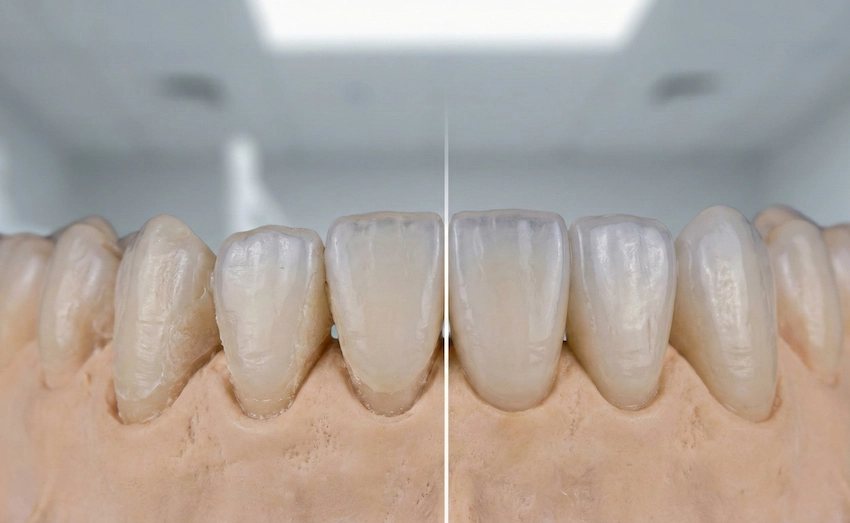
The main distinguishing factor is the composition of chemicals. Composite bonding material refers to a medical-grade resin, which is essentially a plastic-based substance that we can form directly onto your teeth. It is very versatile and soft enough to be sculpted manually.
Nevertheless, porcelain veneers are just thin sheets of medical-grade ceramic of medical grade. In fact, Dentist Polen Akkılıç and her team when creating a veneer, are not only reshaping a tooth, but also fabricating a prosthetic that possesses light-reflecting characteristics similar to enamel.
The Reality: Resin is porous. It will gradually behave like natural teeth—it can get stained just like teeth after drinking coffee, wine, or smoking. Porcelain is basically glass. It is stain-proof. You may drink espresso every day for ten years, and a porcelain veneer will look as shiny as the first day we cemented it.
2. The Steps: Chairside Artistry vs. Lab Precision
Bonding is an “additive” technique. We lightly scratch the surface of your tooth and shape the resin during one single visit. It is almost an instant reward. You come with a fractured tooth and leave with the tooth restored.
Veneers are a completely different story in that they involve longer preparation and the use of a laboratory.
- Step 1: We prepare the teeth, sometimes removing a paper-thin layer of enamel (about 0.5mm) to ensure the veneers don’t look bulky.
- Step 2: We take digital impressions.
- Step 3: Our lab technicians hand-craft each veneer.
At Lema Dental Clinic, the process is controlled, and the results are very predictable. Professor Doctor Coşkun Yıldız sometimes points out that while bonding strongly depends on the dentist’s skill at that moment, veneers depend on thorough planning. This means the fitting is so precise that it prevents any bacterial infiltration.
3. Durability: 5-Year Deal vs. 15-Year Plan
A lot of the time this is the one that determines our international patients coming to Turkey for a trip.
Composite bonding is very good, but only for a short time. The substance is softer and if you grind your teeth, it can be chipped or worn down very easily. Normally, bonding can stay nice-looking for 5 to 7 years if it is taken care of properly before it needs to be done again or re-polished.
Porcelain veneers represent a long-term commitment/cost. They are subjected to a very high heating temperature until they become quite hard. With proper maintenance, they can definitely last 15 to 20 years or even more. They do not just get over with in a day; they remain perfect until the time naturally comes when gums and teeth start to show signs of aging and changes.
4. Look: Lightness and “Pop.”
Here is what we observe in the clinic:
Bonding is beautiful but at times can give the impression of being “flat” or not translucent perfectly due to the fact that the enamel in-depth reflecting feature of light is not present.
Whereas porcelain has what is called “translucency.” This means that inside the veneer light penetrates, then it is interrupted by the tooth structure underneath, and finally, the light is seen again at the surface. The result is a natural kind of 3D effect and life that the human brain associates with a real tooth. When Dentist Polen Akkılıç creates a Hollywood Smile, she makes the most of this property so that the teeth appear extremely white but not overdone or ‘chalky’.
5. The Price Comparison
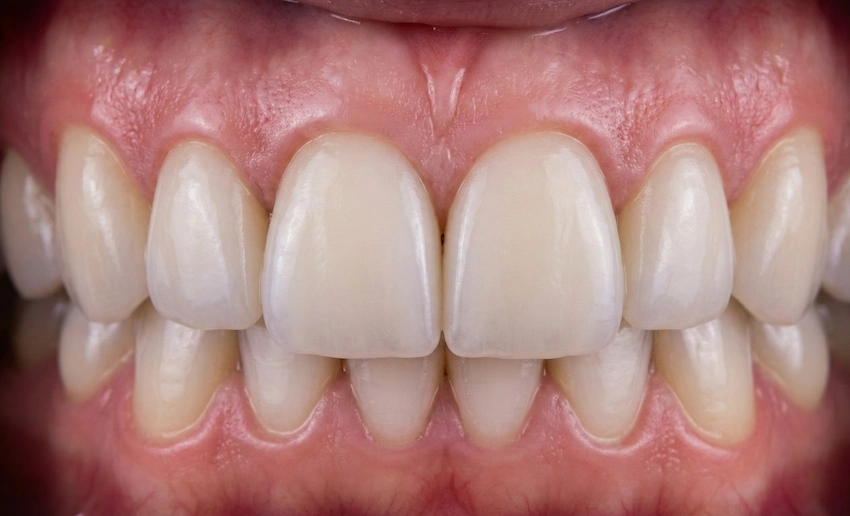
Let’s be honest. Initially, bonding is much cheaper. The main reason for this is that the procedure doesn’t involve a laboratory step, which drives the cost really down. It is an ideal option for quick repairs—like a single chipped tooth or a small gap.
Because the veneer price covers the laboratory work, high-grade ceramic material, and the permanency of the solution, it is more expensive. A good number of our patients conclude that veneers are worth it as the length of their lifetime is three times that of bonding; hence, when calculated yearly, the ‘cost per year’ evens out.
| Feature | Composite Bonding | Porcelain Veneers |
| Material | Resin (Plastic-based) | Porcelain (Glass-ceramic) |
| Stain Resistance | Low (Can stain over time) | High (Impervious to stains) |
| Lifespan | 5–7 Years | 15–20+ Years |
| Reversibility | Yes (Usually reversible) | No (Enamel is often prepped) |
| Best For | Minor chips, small gaps | Full smile makeovers, severe discoloration |
| Visits Needed | 1 Visit | 2–3 Visits (over a few days) |
FAQ: Your Questions, Answered by the Clinic
Absolutely not as much as you may have imagined. When the teeth preparation part is going on, a local anesthetic is given to the area. As a result, you will not feel any discomfort. With the temporary veneers, you may feel some cold sensitivity but that is nothing serious and it will disappear fast. Firstly, your pain-free comfort is our main concern.
The response is not straightforward. Bleaching gels only interact with natural enamel. If your bonding gets stained from coffee or smoking, whitening will not help; in fact, we will have to polish or replace the layer. Hence, we mostly advise veneers to smokers and heavy coffee drinkers.
Only in case such a veneer was installed without much care. ‘A fake look’ usually means that the teeth are too opaque, too large without a natural contour, or they have one monotonous color. To obtain a natural visual effect, we use color and texture variations close to the gum line, and the result of the veneers is a kind of beauty that the human eye cannot recognize as artificial. We intend to make people say ‘You look great!’ rather than ‘Nice veneers!
Definitely. Normally, the bonding is a cosmetic procedure when it is done to recover non-destructive injuries; for example, it is used in the case of a chipped front tooth. On the other hand, it is crucially important to identify a shade that matches the natural tooth perfectly and then concealing the transition can be a skill that only highly skilled professionals can possess.
Bottom line, excellence and accessibility. Here in Turkey and especially at Lema Dental Clinic, we bring European and American porcelain top materials to you just as the ones in London and New York. On the other hand, since the costs of operation are different, we can afford to offer our services at a price level which is very much more accessible without compromising the quality of the treatment and the sterile, state-of-the-art environment.
- Magne, P., & Belser, U. (2022). Bonded Porcelain Restorations in the Anterior Dentition: A Biomimetic Approach. Quintessence Publishing.
- Peumans, M., Van Meerbeek, B., Lambrechts, P., & Vanherle, G. (2000). Porcelain veneers: a review of the literature. Journal of Dentistry, 28(3), 163-177.
- Dietschi, D., & Devigus, A. (2011). Prefabricated composite veneers: historical review, indications and clinical application. European Journal of Esthetic Dentistry, 6(2), 178-187.
- Gurel, G. (2003). The Science and Art of Porcelain Laminate Veneers. Quintessence Publishing.
- Layton, D. M., & Walton, T. R. (2013). An up to 16-year prospective study of 304 porcelain veneers. International Journal of Prosthodontics, 26(4), 336-343.

