


Get a painless, drill-free diamond smile using safe surface bonding.
An Improved Way to Shine
Decorating teeth with jewels is not a new thing. However, the jewelry of the past meant, in a way, killing the tooth, since the dentist was forced to drill very deep holes to place the gem, which caused permanent damage. The consumer was in a dilemma of choosing between a pleasing look and healthy oral health.
However, if we look at it, it was a complete change. You can have your diamond smile without drills, shots, or pain at all. According to our clinical experience at Lema Dental Clinic in Turkey, there has been a drastic shift in the desire of desire in patients. These days, people want to sport real, genuine diamonds for their teeth, but at the same time, they will insist on the preservation of their natural teeth.
The Wonders of Surface Bonding

Is it really possible to stick a precious stone to a tooth without drilling a hole?
It is often Professor Dr. Coşkun Yıldız‘s point that true luxury in dentistry just means the body is respected. Use the analogy of a tooth’s enamel as a strongly built and very smooth brick wall; the diamond is not added by damaging the wall and smashing a hole into it.
In fact, what we do is to apply a mild, medical-grade gel that temporarily opens tiny, invisible pores on the surface of the tooth. It is just like when one lightly sands a very smooth wall so that the paint to be applied will stick better. We do not destroy the tooth. It is the diamond that gets a very firm and durable hold that we provide.
Dentist Polen Akkılıç and her team use a safe, special dental glue. This is the exact material that braces are made with. We press the diamond into the tooth with a curing light, and the bond is strongly tight; meanwhile, the original tooth remains perfectly safe beneath.
Old Drilling Way vs. New Surface Bonding
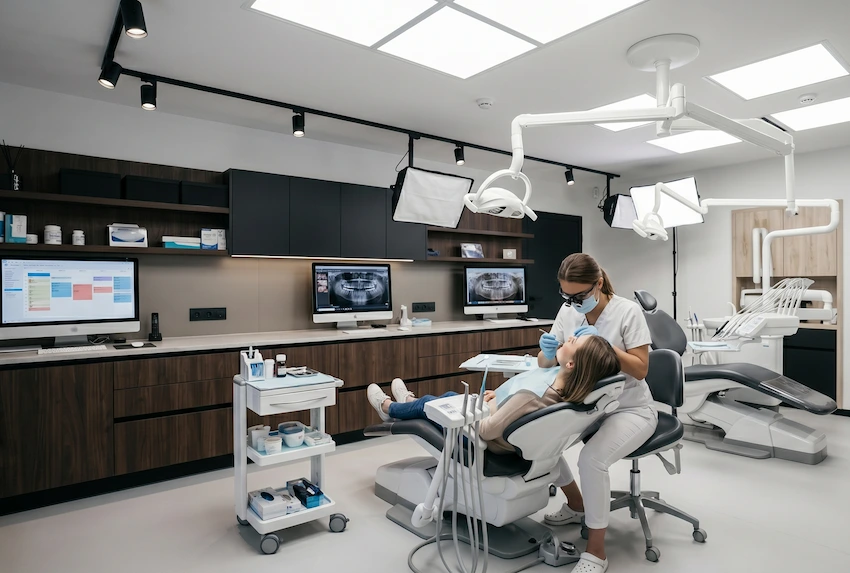
We do see the following when we look at the clinic, comparing the old way of doing things with our new and safer methods:
| Treatment Feature | The Old Drilling Method | Lema Surface Bonding (Modern) |
| Tooth Damage | High. It involves permanent drilling of the tooth. | None. We only get the surface ready. |
| Pain Level | Medium. Requires numbing shots. | Completely painless. No shots or other numbing agents are needed. |
| Can You Undo It? | No. The hole is permanent. | Yes. 100% reversible. |
| Time in Chair | Up to 60 min. | 15-20 min. |
| Future Risks | The tooth is weakened. There is a risk of a split. | Your tooth is completely safe. |
FAQs
Simply put, no. We do not drill your tooth at any time. We simply apply a very thin layer of protective dental glue on the surface. The underlying tooth is perfectly healthy and well- protected beneath the diamond.
Not even a bit. You will not be given a drill, and you will not be injected. The experience will be completely similar to a teeth cleaning session. Fast, easy, and pain-free!
It can be there for a very long time. All that is required is a very thorough tooth brushing and not biting straight into very hard substances such as ice or hard candy. Usually, the dental glue can cope with all the normal consumption of food and chewing.
Without a single doubt, yes. Most of all, this procedure is fully reversible. If the diamond is no longer wanted, we simply and gently remove the glue by polishing. The tooth is the same as it was before.
You will be given first-rate service along with an excellent trip. Our dental teams are very experienced in handling cosmetic dentistry cases as they do thousands every single year. The purchase of a diamond is not just the matter here. The fee is paid for experts of the highest level who will make your smile shine without damaging your health.
- Albers, H. F. (2002). Tooth-Colored Restoratives: Principles and Techniques (9th ed.). BC Decker.
- Buonocore, M. G. (1955). A simple method of increasing the adhesion of acrylic filling materials to enamel surfaces. Journal of Dental Research, 34(6), 849-853.
- Heymann, H. O., Swift, E. J., & Ritter, A. V. (2013). Sturdevant’s Art and Science of Operative Dentistry (6th ed.). Elsevier Mosby.
- Marshall, S. J., Bayne, S. C., Baier, R., Tomsia, A. P., & Marshall, G. W. (2010). A review of adhesion science. Dental Materials, 26(2), 11-16.
- Peumans, M., Kanumilli, P., De Munck, J., Van Landuyt, K., Lambrechts, P., & Van Meerbeek, B. (2005). Clinical effectiveness of contemporary adhesives: A systematic review of current clinical trials. Dental Materials, 21(9), 864-881.

