


Stress-Free First Dental Visit
The stress related to the first dental appointment is usually more significant for the parent than for the child. This is what we observe every day in the corridors of Lema Dental Clinic, Turkey. One lady tightly holding her little boy’s hand, her eyes looking around for any signs of a mood outburst, while the kid is simply fascinated with the bright lights.
Professor Doctor Coşkun Yıldız constantly points out that children’s mouths can be compared to blueprints of new buildings. If the foundation is carefully laid with love and positive reinforcement, the form will stay beautiful for years to come. It is not only about locating cavities; it is about creating a “dental home” where your kid becomes comfortable, understood, and even thrilled.
The “First Tooth, First Birthday” Rule
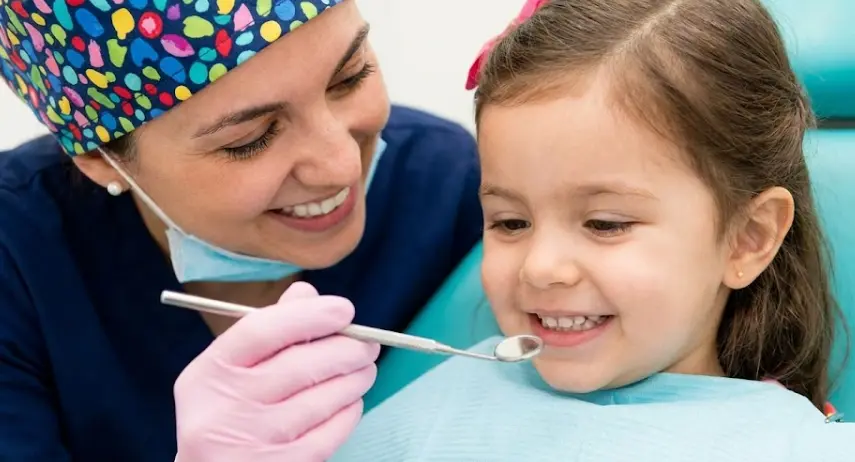
I guess the question is: when is the right time? Clinical guidelines are very clear; however, quite a lot of parents wait until a problem becomes evident. Our clinic promotes the “First Tooth, First Birthday” rule. Whether you notice that first tooth is just breaking through the gum, or the first birthday candle on the cake is about to be lit, it’s time to visit us.
It is not necessary to do complicated procedures when you start early. Imagine meeting and getting to know the local dentist. Dentist Polen Akkılıç and her team base their work on getting the child used to the environment during the first few visits. It’s not only the enamel that we check; we also observe growth of the jaw and habits of the mouth that could affect speech or dental alignment in the future.
Why the First Visit is a Psychological Milestone
The reality is that a dental phobia is very rarely “born” – it is a behavior that is learned. For example, if a child is taken to the dentist only when they are in pain, they will always associate the clinic with pain. If you take them along when they are healthy, you are giving them the idea that the dentist is a friend who makes them strong, not a stranger who comes and “fixes them.”
Let me first tell you what a really effective technique is and then we can discuss why it works. We made an eye-opening discovery regarding the effectiveness of the “tell-show-do” methodology during our clinical experience at Lema Dental Clinic. Initially, we inform the child about the different phases of the treatment, then we demonstrate the instrument by using their fingernail or a stuffed animal, and finally, we carry out the treatment. Thus, the fearful medical mystery to a predictable, controllable game for the child.
Preparing Your Little One at Home
Here is what we see in the clinic: the children who thrive during their first visit are those whose parents have turned oral hygiene into a story.
- Role-play the Visit: Use a toothbrush and a flashlight at home. Count your child’s teeth out loud. Let them “check” your teeth too.
- Watch Your Language: Avoid words like “pain,” “shot,” or “drill.” Even saying “it won’t hurt” can plant the seed of fear. Instead, talk about “sparkling” or “counting” teeth.
- The Power of Timing: Schedule the appointment when your child is most rested. A nap-deprived toddler is a recipe for a difficult session, regardless of how gentle the dentist is.
Comparison: Traditional vs. Lema Pediatric Approach
| Feature | Traditional Dental Approach | Lema Dental Clinic (Turkey) |
| Atmosphere | Clinical, sterile, and intimidating. | Warm, welcoming, and child-centric. |
| Initial Interaction | Focus immediately on the oral exam. | Focus on rapport building and “meet and greet.” |
| Communication | Technical explanations to parents. | “Tell-Show-Do” technique adapted for kids. |
| Focus | Corrective (fixing problems). | Preventive (building lifelong habits). |
| Environment | Adult-focused tools and chairs. | Specialized pediatric equipment and distractors. |
What to Expect During the Visit
At the clinic, the whole process is planned to cause the least possible discomfort to the child. Sometimes, for tiny little babies, we just do “knee-to-knee” examination. The child is going to be on your lap, face to face with you and when the child leans back, the dentist is the one who will have the child in his lap. What is more, the child can always see your face, which is like a safety net, figuratively speaking.
The dentist Polen Akkılıç emphasizes that a visit to the dentist is equally important for the parents as for the child. We emphasize the necessity of good eating habits, discuss the effect of a pacifier or thumb-sucking, and show the right way of fluoride application. The dental chair should not be considered as a place for the judge but as a place of power for the health of your family.
FAQ: What Should You Know About Your Child’s First Dental Visit?
Please don’t worry. In our clinical experience, crying is a very normal response to a new environment. We are trained to work through it with patience. We never rush a child, and we find that most little ones calm down once they realize nothing ‘scary’ is happening.
Absolutely. A ‘comfort object’ like a teddy bear or a favorite blanket acts like an emotional anchor. It gives the child something familiar to hold onto while they explore the new sights and sounds of the clinic.
“We love the idea of a reward, but we suggest a non-food treat. Perhaps a trip to the park or a new sticker. This reinforces the idea that the dental visit is a positive event without associating ‘good behavior’ with sugar!
Standard practice is every six months. This allows Professor Doctor Coşkun Yıldız and the team to catch any developmental shifts early. Consistency is the best cure for anxiety.
At Lema Dental Clinic in Turkey, we combine world-class technology with a deep cultural emphasis on hospitality and family. We treat our young patients as if they were our own, ensuring the highest medical standards in a nurturing environment.
- American Academy of Pediatric Dentistry. (2022). Periodicity of Examination, Preventive Dental Services, Anticipatory Guidance/Counseling, and Oral Treatment for Children.
- American Dental Association. (2023). Your Child’s First Visit to the Dentist: What to Expect.
- Casamassimo, P. S., & Nowak, A. J. (2019). Pediatric Dentistry: Infancy Through Adolescence. Elsevier Health Sciences.
- Savage, M. F., et al. (2004). Early preventive dental visits: effects on subsequent utilization and costs. Pediatrics, 114(4), e418-e423.
- Yousef, M. K., & Al-Zahrani, M. S. (2017). The impact of early childhood dental visits on future oral health-related quality of life. Journal of International Society of Preventive & Community Dentistry.

