


Nerve damage or dental trauma
Your smile can be imagined as a perfectly choreographed dance with every performer in perfect harmony. Suddenly, if one tooth changes its color and turns into a dull grey, yellow, or even deep purple, it is like a dancer who has missed a cue and hence, unconsciously draws the audience’s eyes.
In addition, at Lema Dental Clinic, based on our clinical experience, we rarely come across a situation where a dark single tooth is a surface stain caused by coffee or red wine. Although those habits may cause the whole “crowd” to yellow, a dark single tooth is usually a very personal matter, a revelation of the inner secret of the tooth’s structure.
This Is More Than Only a Cosmetic Issue
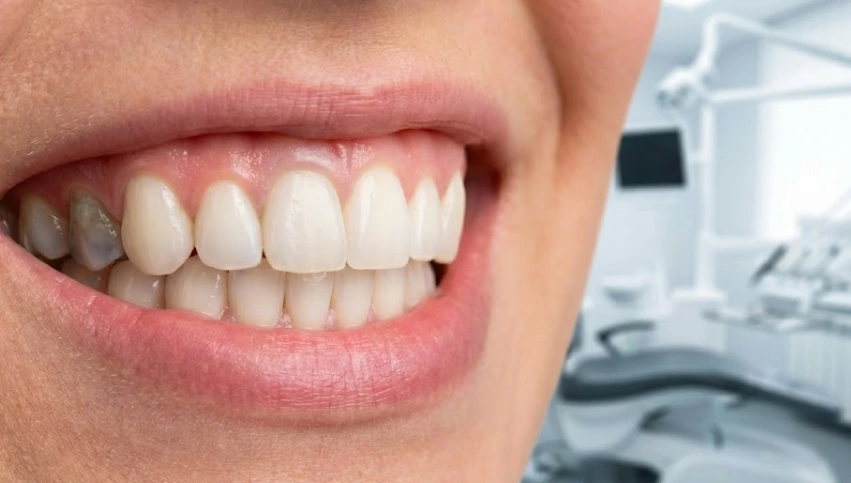
It turns out that teeth, just like any other organs of our body, are actually alive. Just beneath that tough exterior, the white enamel coating is the pulp, a marvel of hidden wonders made up of nerves and blood vessels. To help one wrap one’s mind around such a complicated system, Professor Doctor Coşkun Yıldız uses the analogy of the brain to the human body: the darkening of the tooth is when the body goes on “strike” and “shuts down”. This means the tooth has become a “power outage” situation either through an old injury or a failing root canal. This change of shade is thus an indication of going through an internal situation.
Dark teeth can be caused by aging. Chlorhexidine-based mouthwashes are also known to cause these discolorations. However, discoloration caused by pulp necrosis is the most discussed of all due to the profound nature of this condition.
Figure 1: An example of chlorhexidine mouthwash which causes staining of teeth. Is discoloration a sign of a “dead” tooth? Well, it really depends on the circumstances. Most dark teeth have a story to tell with some being “dead” while some still “alive”.
1. Dental Trauma (The “Bruised” Tooth)
What if you accidentally hit your road in a fall or got injured while playing? Even if the tooth did not break immediately, the blood vessels inside can be ruptured. This is actually the formation of an internal bruise. And like a bruise on the skin, the iron in the blood can enter the dentin tubules through the blood vessel breakdown and give the color purple.
2. Calcific Metamorphosis
In some cases, a tooth may not die but if it’s a traumatic case, it may be a reaction to the “armoring” of itself. The tooth continues to produce secondary dentin that is very dense and in large amounts. That is what we call calcific metamorphosis. Since the internal space in the tooth is probably occupied by thick dentin that is yellowish, the tooth loses its transparency and looks quite different, darker and more opaque than the neighboring teeth, however, it is not necessarily dead.
3. The Aftermath of Old Root Canals
Old materials that were used to fill root canals could have been problematic as they may leak over time and discolor a tooth from the inside. Besides that, if pulp tissue was not completely removed from the “horns” of the pulp chamber, the organic matter can become dark just like when a leaf turns brown after being left in a book.
Comparing the Causes and Solutions
When you visit us in Turkey, Dentist Polen Akkılıç and her team perform a comprehensive “dental detective” investigation to determine the exact cause before recommending a fix.
| Cause | What’s Happening? | Primary Treatment | Typical Timeline |
| Pulpal Necrosis | The “nerve” has died, usually from trauma. | Root Canal + Internal Bleaching | 1 – 2 Visits |
| Calcific Metamorphosis | Excessive dentin buildup (The tooth is “clogged”). | Porcelain Veneer or Crown | 3 – 5 Days |
| Internal Resorption | The body is “eating” the tooth from inside. | Specialized Root Canal | Immediate |
| Old Root Canal Stain | Staining from old filling materials. | Internal Bleaching or E-Max Crown | 1 – 3 Visits |
How We Restore Harmony at Lema Dental Clinic
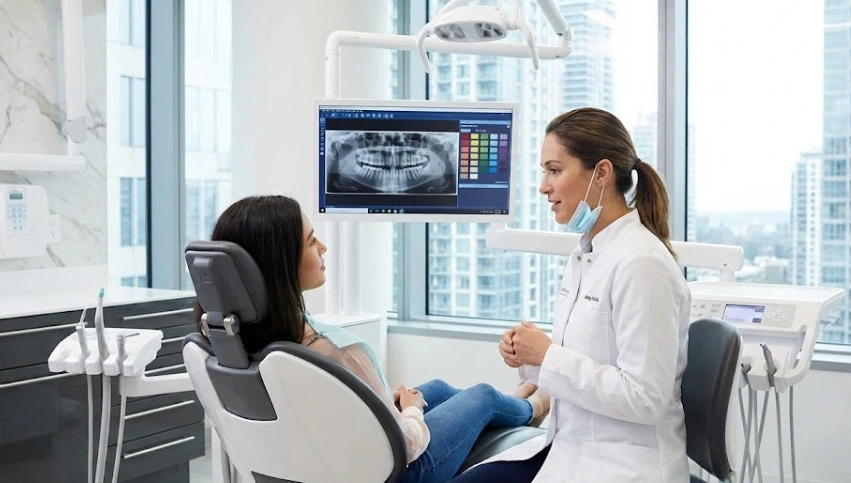
The question remains: how do we fix it? We don’t believe in “one size fits all” solutions.
- Internal Bleaching: This is a specialized technique where we place a whitening agent inside the tooth for a few days. It works from the inside out, like cleaning a stained glass lamp from the interior.
- The Art of Masking: In cases where the tooth is severely darkened, bleaching might not be enough. This is where the artistry of Dentist Polen Akkılıç and her team shines. We use ultra-thin E-Max veneers or Zirconium crowns to mask the dark stump.
Matching a single front tooth is one of the hardest tasks in dentistry. It requires a deep understanding of light, opacity, and layering. Here in our clinic in Turkey, we use advanced digital shade matching to ensure your new restoration doesn’t just look “white,” but looks like it belongs to you.
A Note on Professional Care
In fact, leaving a dark tooth untreated may be the cause of infections or abscesses that are even more agonizing (and costly) than a mere cosmetic treatment. Your tooth is essentially communicating to you by changing color that the inside is no longer healthy.
FAQ: Understanding Your Darkened Tooth
Not necessarily. If the tooth is darkening due to calcific metamorphosis and there is no infection, we might leave the nerve alone and simply cover the tooth with a veneer for aesthetics. However, if the pulp is necrotic (dead), a root canal is vital to prevent an abscess.
Unfortunately, no. Over-the-counter strips only work on external stains on the enamel. Since the darkness of a single tooth comes from the inside, external whitening will only make your other teeth whiter, making the dark tooth stand out even more.
Modern dentistry in our clinic focuses on absolute comfort. Whether we are performing internal bleaching or preparing a crown, we use advanced local anesthesia. Most patients describe the sensation as no different from a standard filling.
It can last for many years, but the tooth may eventually begin to ‘revert’ slightly. This is why many of our patients choose a permanent porcelain restoration, like a veneer, for a lifelong color match.
At Lema Dental Clinic, we combine world-class expertise with technologies that are often more accessible here than in many Western countries. You receive premium materials—like E-Max and Zirconia—and the care of specialists like Professor Doctor Coşkun Yıldız at a fraction of the cost.
- Abbott, P., & Levy, G. (2011). The diagnosis and management of tooth discolouration. International Dental Journal.
- Dietschi, D. (2006). Non-vital bleaching: biochemical considerations and clinical procedures. European Journal of Esthetic Dentistry.
- Manojlovic, A., et al. (2015). The effect of different bleaching agents on the color and translucency of dental tissues. Journal of Endodontics.
- Watts, A., & Addy, M. (2001). Tooth discolouration and staining: a review of the literature. British Dental Journal.
- Yıldız, C. (2023). Advanced Prosthodontics in Aesthetic Zone Management. Istanbul University Press.

