


Dry dentures help adhesive stick better and create a stronger hold.
As usual, you apply a small amount of cream, a pink line perhaps, on your denture, insert it into your mouth, and wonder why it is so difficult to keep in place. So frustrating, indeed.
Moisture can often be the cause of the issue.
Using paste on a denture that has never dried is quite pointless. It would be the same as trying to get one of two parts of a sign glued properly by just pressing them onto the side of a car that had been very recently washed.
It turns out that denture cements generally require a brief drying period to allow the paste to really stick in the denture. The process of laying down a foundation is the perfect analogy. The ground has to be fairly dry; otherwise the mixture will slide easily off!
We often see at Lema Dental Clinic in Istanbul, Turkey, how a little detail can make life much more comfortable. Professor Doctor Coşkun Yıldız sometimes reminds his audience about the fact that dental care can never solely rely on the initial treatment; home care habits also play an immense role.
How Adhesive Works
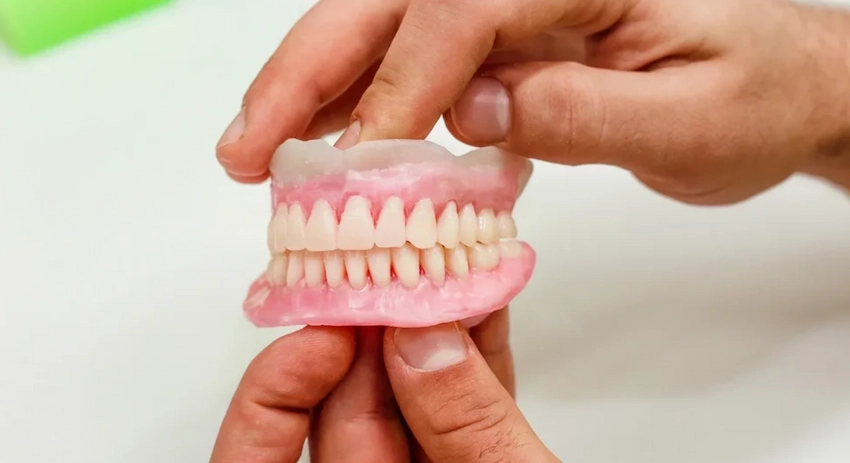
So, to figure out the role of dryness, let’s first study the fundamentals.
Denture paste is made up of several bonding agents. These substances start to swell when they meet saliva, thus turning sticky and making a very tight connection between your jaw ridge and the plastic base.
You may find yourself in a situation where the denture has already been wet before you apply the paste, which could be an issue because the polymer might be water-soluble. This kind of situation would allow the adhesive to form a lubricating film rather than bond the jawbone to the base of the denture.
Dentist Polen Akkılıç and her team have patients regularly showing them the small things they do, for example, just not letting the acrylic part of the denture get too wet to maintain a dry base.
- Exhausting Hydration: An overly wet resin model can suddenly cause an adhesive bond to become weak or even fail if this is allowed to happen without immediate cleanup.
- Nonhomogeneous application: Should one of the surfaces be slightly damp, some areas of the putty could flow down due to the lack of support; others might hang onto spots and thus create zones of increased pressure.
- Halfway point: The prosthetic base must not be dirty and must be dry to a maximum level, then patted dry to allow the putty to stick better to the prosthesis than to its ownbacking.
Step-by-Step Application Guide
For a solid hold every morning, carry out these simple activities:
- Clean deeply: Scrub off all the old stuff and wash the appliance thoroughly to make sure it is clean.
- Dry up: Dry the fitting surface inside the denture with either a brand-new tissue or a lint-free cloth.
- Paste the denture: Put dots of adhesive only where necessary; don’t paste edges.
- Press: Hold the upper part firmly into position for a few seconds.
Comparing Application Methods
| Application Method | Initial Bond Strength | Risk of Denture Slippage | Residue & Cleanliness |
| Application of adhesive on a wet denture | Poor (water dissolves polymers extremely fast) | High (adhesive layer is prone to moving) | Very messy (excess adhesive material around the denture edges) |
| Drying your dentures before use | Best (the surface is dried and therefore the denture is not getting saturated while the paste is applied on it) | Lowest (no issues of movement the whole day) | Cleaner (no surplus) |
Go Beyond the Paste: Dental Implants in Turkey
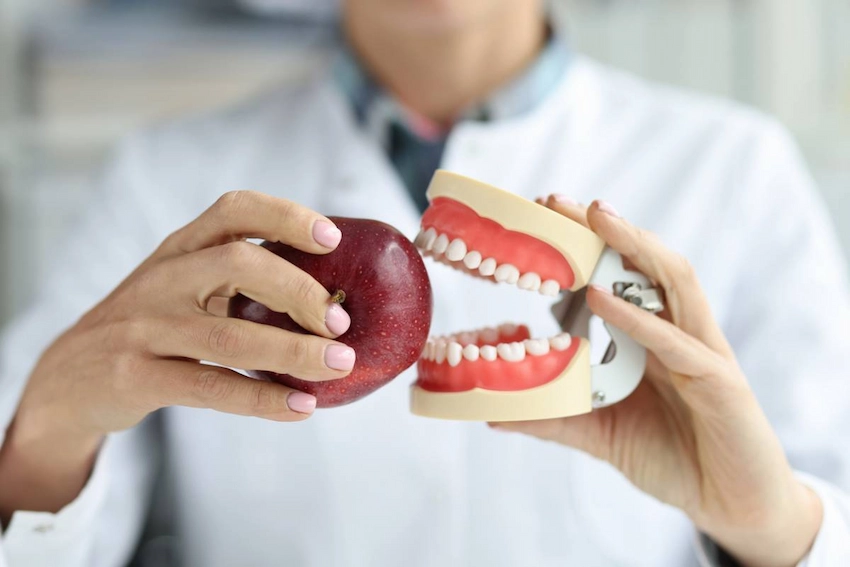
For many individuals, the daily struggle with denture glue and the mess it involves is a good reason to consider a more permanent and stable solution. A growing number of international patients travel to Turkey to get a lasting, fixed dental treatment.
Thanks largely to developments in the field, procedures such as All-on-4 or All-on-6 enable you to enjoy a natural-looking smile with the comfort of a regular mouth from the very beginning.
FAQs
Should your gums be totally dry when you put in your dentures?
Absolutely not; your mouth and gums should be naturally moisturized by saliva because your mouth has just eaten, talked, and been smiling,g and the denture adhesive requires saliva to activate. You only want the denture to be dry where it touches your teeth, not the denture itself.
Why does the adhesive ooze around my mouth if I dry my denture?
The problem is that usually, you’re not putting on enough of them, only a little bit, and in fact, a few little pea-sized drops would be fine,e and once the dry denture is pressed into your mouth, the adhesive will evenly spread out without coming out the edges.
Are paper towels a good choice for drying my dentures?
Of course! You can dry your dentures with a paper towel or a clean cloth that does not leave a fiber. Only don’t use something fuzzy that may leave tiny fibers stuck on an acrylic base.
Why does my adhesive give up before lunchtime?
If your glue fails by noon, it may be caused by a lot of saliva, an old layer left on the mouth’s surface, or that the denture is loose from your changing jawbone.
How often do I have to remove old adhesive completely?
All the old adhesive should be washed off at least once in the day, preferably each night before going to bed. Leaving the old buildups may shift the way your denture fits into the area it covers and promote bacterial growth as well.
Academic References
- Anusavice, K. J., Shen, C., & Rawls, H. R. (2013). Phillips’ Science of Dental Materials (12th ed.). Elsevier.
- Feine, J. S., et al. (2018). The McGill consensus on overdentures and subsequent Toronto updates. International Journal of Prosthodontics, 31(1), 55–62.
- Grasso, J. E. (2019). Dentures and adhesives: Clinical efficacy and patient management. Journal of Prosthetic Dentistry, 121(2), 203–209.
- Kapur, K. K. (2020). The role of denture adhesives in improving masticatory performance and retention. Journal of Prosthodontics, 29(4), 312–318.
- Zarb, G. A., & Hobkirk, J. A. (2020). Prosthodontic Treatment for Edentulous Patients: Complete Dentures and Implant-Supported Prostheses (13th ed.). Elsevier.

