


Quad Zygoma implants provide an instant, graft-free smile anchored in the cheekbone.
A lot of patients tell us the very same sad story when they come to our clinic: they have lost a lot of bone in their upper jaw. Other dentists had told them that standard implants were not an option. They were advised that they need years of painful bone grafting. And they were left feeling hopeless and as if they had run out of options.
Actually, getting standard implants in a weak jawbone is as good as trying to build a big, heavy bridge on a dock of wet sand. If the base is not solid, the implants will just fail. However, modern dentistry has come up with new ways. For patients with very severe bone loss, the Quad Zygoma system is a real savior.
At Lema Dental Clinic in Turkey, we have seen how this surgery changes people’s lives in only a few days. However, first of all, let’s talk about what exactly this procedure is and the reasons why it might be your breakthrough.
What is a Zygomatic Implant?
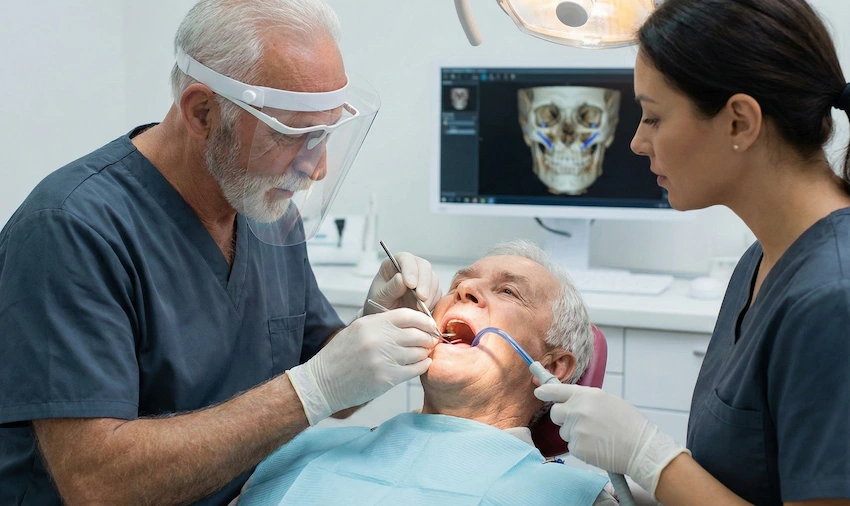
Actually, we need to understand what zygomatic implants are before proceeding to the “Quad” system.
Traditional dental implants are inserted directly into your jawbone. When the bone shrinks after teeth have been missing or dentures have been worn for a long time, then the standard implants have nothing to hold on to. A zygomatic implant totally avoids this old, disappearing jawbone.
These very long titanium posts do not really go into the bone inside the mouth but are instead fixed directly into the cheekbone (i.e., the zygoma).
As Professor Doctor Coşkun Yıldız has explained several times, the cheekbone is extremely hard. Unlike the jawbone, it does not shrink. So getting an implant here is like going through the loose dirt to drill a house all the way down into a very solid rock. Also, the stability is instant.
The “Quad” Factor
The usual zygomatic implant operation consists of two long implants in the back and two normally-sized implants in the front.
But let’s get down to the bare bones of the matter – literally – complete bone loss in the front of your jaw is what?
The solution is exactly what the Quad Zygoma technique does. The surgeons implant four zygomatic implants in the mouth in total. We do two on the left side and two on the right side. So, the entire new set of teeth is secured in the cheekbones.
Main Advantages for the Patient:
- Absolutely no Bone Grafts: The weak jawbone is numbered among the forgotten parts of the body.
- No Sinus Lifts: You are spared from years of additional surgeries.
- Immediate Teeth: You leave the clinic with a fixed and nice smile.
The Surgical Reality: What to Expect

One more thing is that the surgery is difficult for the patient, which is the question that remains.
Surgeons doing this type of surgery must have very high skills, be very precise, and have a deep knowledge of human facial anatomy.
In a nutshell, the way these operations are run in the clinic is that the dentist and the team do their best to make the patients feel at home and make their experience pleasant and easy. If you are given deep sedation or general anesthesia, you will be sleeping.
Thanks to the fact that the zygoma gives great support, it is possible for the implant recipient to have a fixed prosthesis within 48 hours of implant placement. This is the usual practice.
You can really do almost a complete makeover in Turkey. The time when you board the plane to come home with a permanent, nice smile is just a few planes after you arrive in the country with either failing teeth or no teeth at all
Quad Zygoma vs. Standard Implants (Severe Bone Loss Cases)
| Feature | Standard Implants (with Grafts) | Quad Zygoma Implants |
| Total Treatment Time | 9 to 18 months | 3 to 5 days |
| Number of Surgeries | Multiple surgeries | Just one surgery |
| Bone Grafting? | Yes, extensive grafts are needed | No grafting needed |
| Immediate Teeth? | Very rare | Yes (Immediate Loading) |
| Anchor Point | Weak jawbone | Solid cheekbone |
Frequently Asked Questions
Not at all. We place the implants from inside your mouth. They run safely alongside your sinus cavity. You will see no changes to your outer face. In fact, the new teeth will support your lips and cheeks, often making you look years younger.
You might think a big surgery causes massive pain. However, zygomatic implant recovery is usually very mild. Most of our patients report only mild swelling and bruising. It feels similar to having your wisdom teeth removed. We also provide clear instructions and medications to manage any discomfort.
Yes. We carefully guide the implants around or gently through the sinus lining. Advanced 3D scans allow our surgeons to map the exact, safe path before your surgery even begins.
With an experienced team implanting them, the survival rate of zygomatic implants is 96% after 10 years of use. Obviously, they need to be brushed and looked after like real teeth. They are designed to be a permanent solution for life.
Quad Zygoma is a highly complex procedure. A regular local dentist usually cannot perform it safely. Our clinic in Turkey combines top-tier surgical skills with beautiful dental design. We do this complex work safely, quickly, and with stunning results.
- Aparicio, C., Polido, W. D., & Zarrinkelk, H. M. (2014). Zygomatic implants: The anatomy-guided approach. Quintessence Publishing.
- Bedrossian, E., & Sullivan, R. M. (2011). Preliminary results of the use of the zygomatic implant concept for the rehabilitation of the severely resorbed maxilla: A clinical report. The International Journal of Oral & Maxillofacial Implants, 26(4), 863-868.
- Brånemark, P. I., Gröndahl, K., Worthington, P. (2004). Osseointegration and autogenous onlay bone grafts: Reconstruction of the edentulous maxilla. Quintessence Publishing.
- Chana, H., Smith, G., & Howell, P. (2018). The use of quad zygomatic implants in the severely atrophic maxilla: A retrospective clinical study. Journal of Cranio-Maxillofacial Surgery, 46(7), 1121-1127.
- Malevez, C., Abarca, M., Durdu, F., & Daelemans, P. (2004). Clinical outcome of 103 consecutive zygomatic implants: a 6-48 months follow-up study. Clinical Oral Implants Research, 15(1), 18-22.

