


Wait One to Two Hours
You have just gotten up from the dental chair at Lema Dental Clinic after your dental extraction. There is still the effect of anesthesia that makes your cheek to feel as if it is an uninvited heavy guest, and a piece of gauze is tightly fixed in the corner of your mouth. Your first thought—after the adrenaline wears off—is usually: ‘When can I finally eat?
The question is easy, but the answer is the main part of your healing. Based on our clinical experience in Istanbul, the first 24 hours is not only about waiting, but it is also about protecting the biological “scaffold” that your body is making to heal your jaw.
The Golden Window: The First 1 to 2 Hours
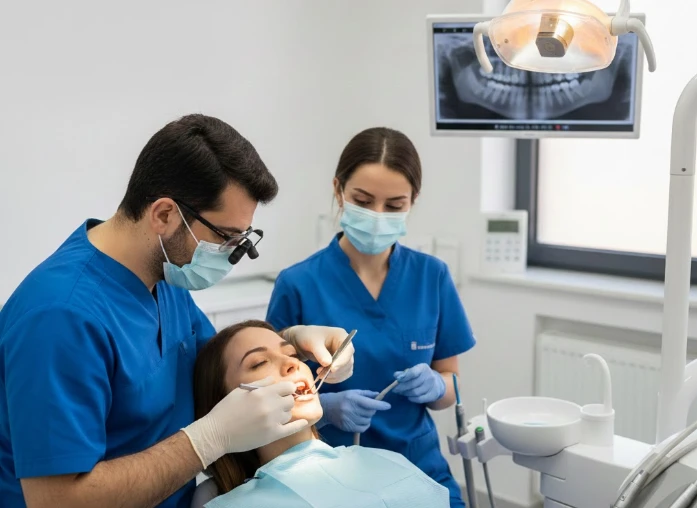
We have one immediate rule for our patients, which is very simple: Do not eat anything until the effect of local anesthesia is completely gone. What is the point of waiting? When your mouth is numb, you lose the “proprioceptive” feedback—this is the brain’s ability to know the exact position of the tongue and cheeks. If you try to chew now, you may bite yourself quite badly and not even realize it. Typically, Dentist Polen Akkılıç and her team recommend that the initial piece of gauze be left for at least 30 to 45 minutes so that the crucial blood clot can be formed.
The Blood Clot: Your Biological Band-Aid
Imagine the dental extraction site as a building site. The formation of the blood clot is like draping the area with a “protective tarp” while the bone and tissue are being restored underneath. If the tarp gets blown away—which results in a painful condition called dry socket—the nerves and bone become exposed to the environment. This explains the reason why we tell patients not to use a straw. The suction of a straw is the same as a vacuum cleaner that tries to pull the tarp off the site.
What to Eat and When: A Timeline
The question remains: what should actually be on your plate? Professor Doctor Coşkun Yıldız often notes that nutrition is a tool for healing, but the texture is the key.
The Recovery Menu at a Glance
| Timeframe | Recommended Foods | Foods to Strictly Avoid |
| 0–6 Hours | Apple sauce, lukewarm broth, yogurt. | Anything hot, spicy, or requiring a straw. |
| 6–24 Hours | Mashed potatoes, smoothies (spoon-fed), hummus. | Rice, seeds, or small grains that can get trapped. |
| Day 2–3 | Scrambled eggs, soft pasta, pancakes. | Crunchy toast, chips, or chewy meats. |
| Day 7+ | Gradual return to a normal diet. | Very hard nuts or popcorn (near the site). |
The “No-Fly Zone” for Food
But let’s take a look at the real reasons behind why we have to stay away from certain foods. It’s not only about keeping comfortable.
- Heat is the Enemy: Hot coffee or soup can melt the blood clot before it has had a chance to become firm. Imagine it like pouring hot water on a freshly made wax seal.
- The Danger of Small Grains: We’ve seen countless patients who ate quinoa or sesame seeds too soon. These little “intruders” may get into the extraction socket, causing irritation or even infection.
- Spice and Acidity: Tomatoes and chili peppers may be quite tasty, but when you have an open surgical wound, these substances will basically irritate you and cause unnecessary stinging and inflammation.
Why Quality Care in Turkey Matters
Going for your procedure at Lema Dental Clinic, you will be combining top-notch surgical precision with thorough post-operative care. Our dental surgery philosophy in Turkey goes beyond the extraction and focuses on the patient’s overall recovery. No matter if it’s a single tooth extraction or the removal of a complex wisdom tooth, the staff makes sure that you get out of the clinic not only knowing the first meal after the surgery but also your entire recovery process.
Post-Extraction Recovery: Your Most Pressing Questions Answered
The reality is, you can, but it must be iced or room temperature. Heat promotes blood flow, which can cause the extraction site to start bleeding again. Wait at least 24 to 48 hours before returning to your steaming morning brew.
In the clinic, we suggest “side-loading” your chewing for at least 3 to 5 days. Keep the food on the opposite side of the extraction to minimize the risk of food debris entering the socket.
Yes, but with a caveat! Plain vanilla or chocolate is great because the cold helps with swelling (like an ice pack for the inside of your mouth). However, avoid anything with nuts, chocolate chips, or sprinkles.
Don’t panic. If the site isn’t throbbing with intense pain and you don’t see heavy bleeding, you likely didn’t dislodge the clot. However, if you feel a dull, radiating pain 2 days later, call us immediately—it might be a dry socket.
Usually, by the end of the first week, the tissue has closed enough to handle more “mechanical” chewing. Professor Doctor Coşkun Yıldız recommends “listening to your body”—if it hurts to chew, you aren’t ready yet.
- Arakelova, S., & Petrova, M. (2021). Post-Extraction Protocols and Alveolar Ridge Preservation. Journal of Clinical Dentistry.
- Mamoun, J. (2018). Dry socket: Etiology, diagnosis, and clinical treatment. Journal of the American Dental Association.
- Suda, T., et al. (2020). Nutritional impact on maxillofacial wound healing. International Journal of Oral and Maxillofacial Surgery.
- Yıldız, C. (2023). Advanced Surgical Techniques in Modern Implantology. Istanbul Medical Press.
- Akkılıç, P. (2022). Patient Recovery Pathways in Outpatient Oral Surgery. Turkish Dental Review.

