


The Hidden Risks of Ignoring a Missing Tooth
Sometimes when patients visit Lema Dental Clinic in Turkey, they indicate a missing tooth in the back of their mouth and say, “I have a tooth missing for five years now, but since it didn’t hurt, I thought it wasn’t a priority.”
This is one of the many misunderstandings. Most people see a tooth loss as a minor cosmetic problem – a “gap in the fence.” However, from our clinical experience, a missing tooth is like a missing brick in the foundation of a skyscraper. The whole structural integrity of your face depends on that one “brick.”
By neglecting a missing tooth for years, you are not only simply living with a gap; you are letting your oral health slowly deteriorate like a collapsed building in slow-motion.
The Bone Melt: Why Your Jaw Shrinks
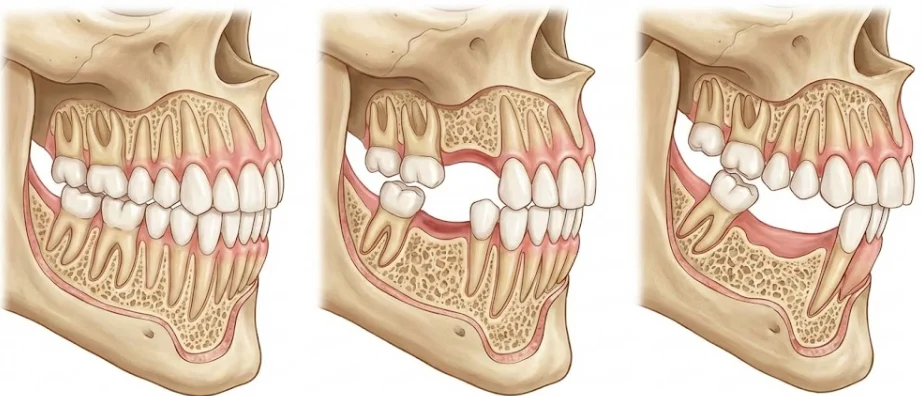
The most invisible and devastating effect is the one that occurs secretly. Your jawbone needs regular stimulation to stay dense and healthy. You can compare your jawbone to a muscle: if you don’t exercise it, you lose it.
Professor Doctor Coşkun Yıldız is used to telling our patients that every time you chew, the tooth root sends a signal to the bone for continuous regeneration. When the tooth is missing, that signal ceases. Just in the first year, the bone width on that spot can drop by 25%.
If you wait five or ten years, the bone “melts” so much that there is not enough of it left to fix a dental implant. That is the point where we have to carry out sinus lifts or bone grafts—very complicated surgeries that, with a little luck, we could have avoided if the intervention had been made earlier.
The Domino Effect: When Teeth Start Traveling
They are not like nails hammered into a board; teeth in the jaw are held in a delicate, pressurized balance. They draw support from each other. When a tooth is extracted, the neighbors lose their “bookend.
Your remaining teeth will start to wander inevitably into the gap left by the extracted tooth. The consequences, of course, go beyond mere aesthetics. It results in:
- Malocclusion: Your bite doesn’t line up anymore, which is why you may have cracked teeth or worn-down enamel.
- Hygiene Traps: Teeth leaning create tight angles that are hardly reachable with your toothbrush and floss thus, decay and gum disease set in the teeth that were once healthy.
- Super-eruption: The tooth on the other side of the gap will keep “growing” out of its socket because nothing is there to stop it.
Facial Collapse and the “Sagging” Effect
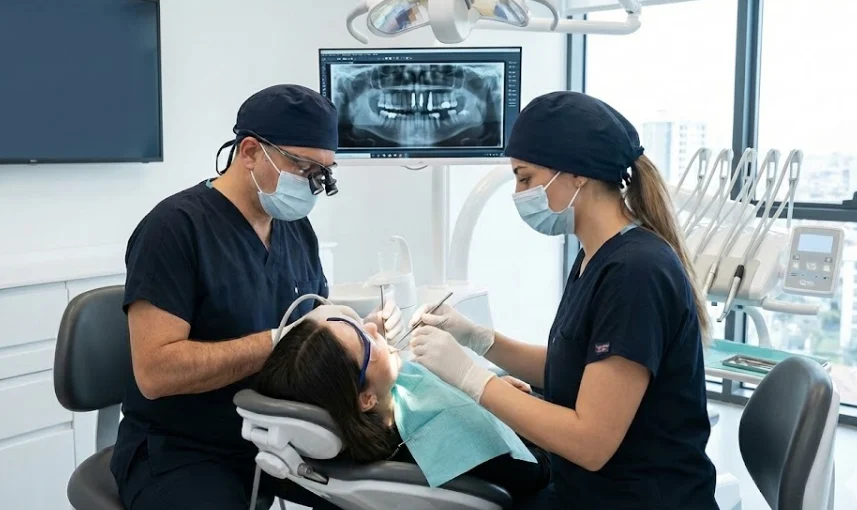
Many patients visit Dentist Polen Akkılıç and her team because they feel they are aging prematurely. They notice their lips look thinner or their cheeks are starting to hollow out.
This isn’t just about skin elasticity; it’s about the structural support of the jaw. As the bone resorbs, the distance between your chin and your nose actually shrinks. It’s like a tent where the center pole has been shortened—the fabric (your skin) begins to sag and fold. By replacing a missing tooth, we aren’t just fixing a smile; we are performing a non-surgical “lift” by restoring the bone’s volume.
The Cost of Waiting vs. Acting
In the clinic, we see that the financial and physical cost of waiting grows exponentially every year.
| Time Since Loss | Bone Condition | Typical Treatment | Estimated Complexity |
| 0 – 6 Months | Healthy / Stable | Single Dental Implant | Low |
| 1 – 3 Years | Moderate Recession | Implant + Minor Graft | Medium |
| 5+ Years | Severe Resorption | Sinus Lift / Major Bone Graft | High |
| 10+ Years | Bone Atrophy | Zygomatic Implants or Full Reconstruction | Very High |
Why the World Travels to Turkey for Restoration
While the risks of waiting are high, the solution doesn’t have to be out of reach. At Lema Dental Clinic in Turkey, we specialize in “rescue cases”—patients who have waited years and were told elsewhere that they didn’t have enough bone for implants.
Using advanced 3D imaging and the expertise of Professor Doctor Coşkun Yıldız, we can often reconstruct the foundation and place implants in a single trip. The combination of world-class technology and the specialized skill of our surgeons allows us to reverse years of neglect in a matter of days.
FAQ: Direct Insights from Lema Dental Clinic
The short answer is no. Even if you’ve waited 20 years and have significant bone loss, modern techniques like bone grafting or zygomatic implants can restore your smile. However, the sooner we act, the simpler the journey is for you.
Unfortunately, no. A bridge sits on top of the gums. It replaces the ‘look’ of the tooth but doesn’t replace the root. Only a dental implant can provide the stimulation needed to stop the bone from melting away.
The question remains: how well are you chewing? When you lose a molar, you stop grinding food effectively. This forces your stomach to work harder, which can lead to bloating and poor nutrient absorption. Your teeth are the first step in your digestive system.
Here in Turkey, and specifically at Lema, we combine high-volume clinical experience with the world’s best implant brands (like Straumann or Nobel Biocare). You get the same—or better—clinical outcomes than in the UK or USA, but at a fraction of the cost.
Not at all. We use advanced local anesthesia and sedation. While a bone graft adds a step to the healing process, the actual sensation during the procedure is no different than a standard filling.”
- Branemark, P. I. (1983). Osseointegration and its clinical outcomes. Clinical Oral Implants Research.
- Misch, C. E. (2007). Contemporary Implant Dentistry. Elsevier Health Sciences.
- Schropp, L., Wenzel, A., Kostopoulos, L., & Karring, T. (2003). Bone healing and soft tissue contour changes following single-tooth extraction: A clinical and radiographic 12-month prospective study. International Journal of Periodontics & Restorative Dentistry.
- Tan, W. L., Wong, T. L., & Lang, N. P. (2012). A systematic review of post-extractional alveolar bone resorption in humans. Clinical Oral Implants Research.
- Yıldız, C. (2022). Advanced Bone Augmentation Techniques in Atrophic Jaws: A Clinical Perspective. Journal of Oral Maxillofacial Surgery and Research.

