


High success rate.
Dental implants have been a subject of the most exhaustive research and offer one of the most predictable treatments in modern dentistry. In recent times, Turkey has ascended as a primary global hub for implant dentistry, hence, patients are often confronted with a very specific and significant question: What is the dental implant success rate in Turkey?
To cut it short, success rates in Turkey are markedly high and on a par with, or perhaps even exceeding, international standards of dental implant treatment when it is conducted in qualified clinics adhering to evidence-based protocols.
Here is a detailed, clinically precise, and layman-friendly article elucidating the notion of success rates of dental implants in Turkey. It dissects how success is determined, what scientific evidence yields, why Turkey is excelling in this domain, and to what extent various factors influence the results in the long run most strongly.
How Is Dental Implant Success Defined?

Clinical dentistry describes implant “success” not just as the implant staying in the bone. Besides the implant staying in the bone, a successful dental implant has to satisfy biologic, functional, and patient-centered criteria as well.
We say a dental implant is successful if it:
- Has achieved stable osseointegration with the jawbone
- Does not exhibit any recurring pain, infection, or inflammation
- Has healthy gum and bone tissues around it
- Is capable of supporting normal chewing, speech, and aesthetics
- Has no mobility and remains functioning without mechanical failure
Success rates are usually assessed at 1, 5, and 10+ years, thus, clinicians can evaluate the early recovery and durability over time.
Global Dental Implant Success Rates: The Scientific Baseline
Several large-scale clinical studies still provide consistent evidence across Europe, North America, and Asia that modern dental implants have very high success rates.
- One-year success rates: frequently over 97-98%
- Five-year success rates: usually 95-96%
- Ten-year survival rates: often 90-95% in healthy patients
These figures refer to implants placed after a proper diagnosis, using a sterile surgical technique and carrying out suitable prosthetic planning. Turkey adheres to the same scientific concepts and clinical standards which were a basis of these studies.
What Success Rate Is Reported for Dental Implants in Turkey?
Tightly regulated implant clinics in Turkey present implant success rates that are almost at par with the global data.
- Typically, five-year success rates of 95% or more are reported
- With adequate care, ten-year survival rates over 90% are attainable
- Early failure rates stay low when patient selection and surgical planning are carried out correctly
These achievements are not limited to Turkey only; still, through a great combination of clinical expertise, technology, and well-organized workflows, Turkey is able to deliver excellent results almost continuously.
Reasons for High Dental Implant Success Rates in Turkey
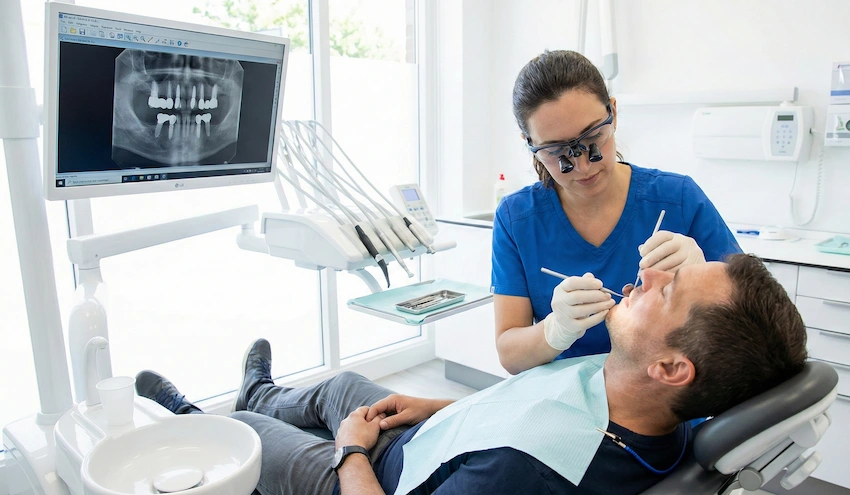
There are numerous local and systemic factors that help dental implant surgeries in Turkey to be very successful.
Advanced Diagnostic Tools
Nowadays, almost all dental clinics use 3D (cone-beam computed tomography) for assessing the bone quality, nerve location, and sinus cavity anatomy before the surgery. Apart from lowering the risk of the operation, this also raises the precision of implant placement.
Experienced Implant Dentists
Almost every university in Turkey graduates dental students who have undergone training in implantology. As a result, Turkey is endowed with a fairly large number of implant specialists. Some of these dentists are trained abroad and follow European clinical guidelines.
Evidence-Based Surgical Protocols
Biological principles during implant surgery are strictly adhered to, including atraumatic surgery, controlled drilling protocols, and soft tissue management.
High-Quality Implant Systems
By and large, clinics utilize world-renowned dental implant brands that are compliant with medical device regulations with regard to surface technology, material strength, and longevity.
Structured Follow-Up and Maintenance
Professional follow-up, patient education, and monitoring of oral hygiene over time are all closely related to high survival implant rates.
Early vs Long-Term Implant Success in Turkey
Early Success (First 3-6 Months)
Early success depends on steady healing and osseointegration. In Turkey, early implant failure rates are low when risk factors such as smoking or uncontrolled systemic disease are managed.
Long-Term Success (5-10+ Years)
The bigger impact on long-term success is exerted by maintenance and oral hygiene rather than surgery only. Implant-supported patients who attend regular dental hygiene appointments and adhere to protocols will be maintaining their stability for many years to come.
What Factors Can Affect Implant Success?
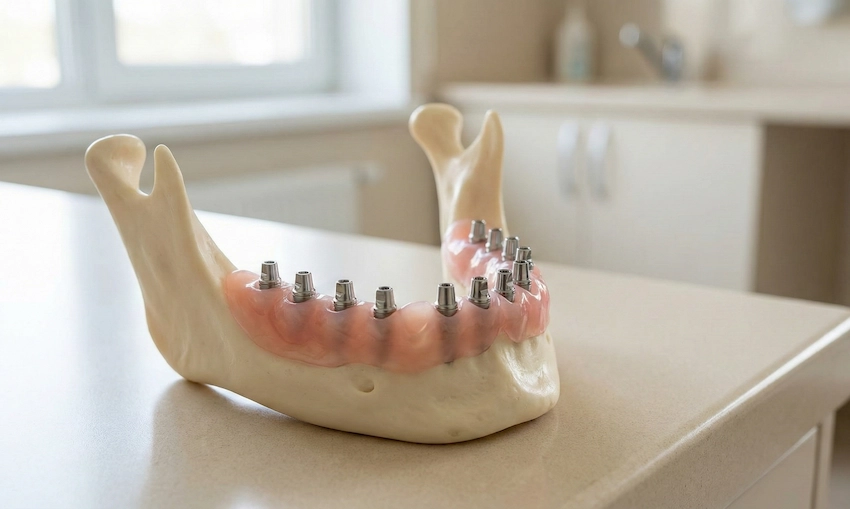
Even in countries with very high average success rates, there are a number of personal and clinical factors that ultimately determine the treatment outcome.
Patient-Related Factors
- Oral hygiene habits and compliance
- Cigarette smoking and nicotine exposure
- General health problems (e.g., diabetes and osteoporosis)
- Bone density and jaw anatomy
Treatment-Related Factors
- Accuracy of implant placement
- Primary stability at surgery
- Prosthetic design and bite force distribution
- Quality of temporary and final restorations
Maintenance Factors
- Professional cleanings
- Early detection of peri-implant inflammation
- Long-term monitoring of bone levels
When properly controlled, these factors can still achieve high success rates.
Implant Success in Complex Cases
Some complex cases Turkey is often preferred for include:
- Dental implants for the whole mouth
- Full set implants: All-on-4 and All-on-6
- Dental implant treatments combined with bone graft or sinus lift
- New dental implants after previous implant failure
Clinical evidence indicates that despite the complicated nature of the cases, the success rates remain high if the treatment has been properly planned and implemented.
Dental Implants vs Other Tooth Replacement Options
| Treatment Option | Long-Term Success | Bone Preservation | Stability |
|---|---|---|---|
| Dental Implants | Very high (90–95%+) | Yes | Fixed |
| Fixed Bridges | High | No | Fixed |
| Removable Dentures | Moderate | No | Removable |
Dental implants remain the most predictable option for preserving bone and restoring natural function.
The Role of Clinic Standards in Success
Clinics such as, Lema Dental Clinic, which is a patient safety oriented one, gradually it came to implant protocols that include thorough diagnostics, very carefully controlled surgical procedures and regular patient monitoring over the long term in the case of that clinic. Such tactical systems are very significant in risk reduction and in the achievement of high implant survival rates.
What Success Means for Patients
For patients, implant success is far more than just a number. It means:
- Being able to eat comfortably without movement or pain
- Speaking clearly and confidently
- Maintaining the structure of the face and the health of the jawbone
- Not having to go through dental procedures repeatedly
- Achieving long-term oral stability
High success rates go hand in hand with the enhanced quality of life.
Conclusion: Are Dental Implants in Turquie Reliable?
Dental implant success rates in Turkey are high, predictable, and consistent with the global scientific data when a treatment is performed by qualified clinics using evidence-based protocols. Achieving success rates of over 95% at 5 years and survival rates post 90% at the long term is both possible and well documented.
Finally, with accurate diagnosis, meticulous surgery, and sustained maintenance, dental implants in Turkey will most probably be one of the tooth replacement solutions with the highest reliability available today.
Albrektsson, T., & Johansson, C. (2001). Osteoinduction, osteoconduction and osseointegration. European Spine Journal, 10(Suppl 2), S96–S101.
Buser, D., Sennerby, L., & De Bruyn, H. (2017). Modern implant dentistry based on osseointegration: 50 years of progress. Journal of Dental Research, 96(1), 7–21.
Moraschini, V., Poubel, L. A., Ferreira, V. F., & Barboza, E. D. S. (2015). Evaluation of survival and success rates of dental implants reported in longitudinal studies with a follow-up period of at least 10 years: A systematic review. International Journal of Oral and Maxillofacial Surgery, 44(3), 377–388.
Frequently Asked Questions About Implant Success in Turkey
Highly ranked clinics in Turkey that placed implants properly, sticking to sterile protocols and evidence-based treatment planning, report a dental implant success rate of 95% or even higher at the five-year mark.
Yes, dental implant success rates in Turkey are at par with those reported in the U.S. and Europe. The results depend more on the dentist’s level of expertise, the quality of the implants, and the patient’s commitment to post-treatment care than on the geographic location.
With appropriate oral hygiene and constant professional follow-up, dental implants may last for several decades. As a rule, no medical treatment can be guaranteed for life.
Simply by being old, a patient won’t experience a considerable lowering of the success rates for dental implants. Factors such as overall health, bone quality, and hygiene habits greatly outweigh the importance of the patient’s age in years.
Most implant failures result from a lack of accurate diagnosis, uncontrolled surgical techniques, and neglect of post-operative care. If the patient is staying on top of their dental check-ups and getting peri-implant inflammation treated at the earliest, their long-term risk will be even lower.

