


First orthodontic checkup at age 7.
At 7 years old, a child is at a significant crossroad in the stages of development when it comes to their primary and permanent dentition. In clinical parlance, the Rule of 7 means that a child must have their very first full orthodontic evaluation no later than their seventh birthday. At this age, according to Prof. Dr. Coşkun Yıldız, the posterior occlusion is fixed, thus experts at Lema Dental Clinic can spot skeletal imbalances that later become difficult malocclusions.
Three Aspects of the Rule of 7
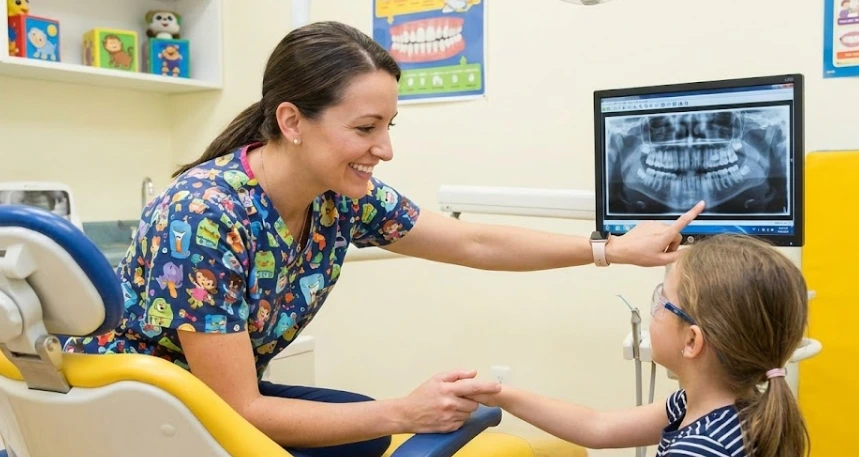
Using the Rule of 7, Lema Dental Clinic is able to kick off a treatment interrupted by braces through interceptive orthodontics, a preventive measure that diminishes the need for major surgical treatments later on. At a 7-year-old appointment, Dentist Polen Akkılıç and her Team in Turkey concentrate on only three clinical parameters:
- Eruption of the First Permanent Molars: Around the age of seven, the first permanent molars (six-year molars) should have come in, thus forming the posterior occlusion. This gives the dentist a chance to examine the jaw relationship (bite) and to locate any problems such as overbites, underbites or crossbites.
- The Presence of Permanent Incisors: When the first four permanent teeth arrive, it becomes possible to analyze whether there is any crowding or a gap in the dental arch. If a narrow dental arch is discovered early, a palatal expander might be prescribed to utilize the bone growth more efficiently during the bone’s plastic stage.
- Skeletal Growth Monitoring: 7-year-old children, unlike adults, are at a stage when their facial skeleton is rapidly growing. By locating the skeletal problem at the earliest stage, the doctors in Turkey can correct it by using functional appliances that stimulate proper bone growth, thereby obviating the need for surgical interventions later on.
Clinical Benefits of Early Checking in Turkey
Thanks to the modern technological base, the dental clinics in Turkey, like Lema Dental Clinic are equipped with low-radiation panoramic radiography and they thus have the capacity to perform a ‘deep dive’. It is vital for the Rule of 7 since it uncovers:
- Impacted Teeth: Recognizing those teeth that are covered or are going to grow in the wrong direction.
- Congenitally Missing Teeth: Strategizing for future restorations even before children become adults.
- Supernumerary Teeth: Spotting additional teeth that are likely to obstruct the eruption of the normal permanent ones.
Pediatric Developmental Milestones (The Rule of 7)
| Clinical Indicator | Observation at Age 7 | Potential Intervention |
| Molar Relationship | Establishment of the “Bite” | Space Maintainers |
| Incisor Alignment | Crowding or Protrusion | Interceptive Braces |
| Jaw Symmetry | Lateral or Vertical Growth | Palatal Expanders |
| Oral Habits | Thumb Sucking/Tongue Thrust | Habit Appliances |
FAQ: Professional Guidance on Pediatric Care
Not necessarily. Professor Doctor Coşkun Yıldız clarifies that for most children, the age-7 visit is a “screening.” Only about 15-20% of children require immediate interceptive treatment. The goal at Lema Dental Clinic is to monitor and choose the most effective time to intervene.
Waiting until age 12 or 13 means the jaw has largely finished its growth. Dentist Polen Akkılıç and her team emphasize that by age 7, we can utilize the child’s natural growth spurts to correct skeletal issues that would later require jaw surgery.
Yes. In Turkey, we utilize ultra-low-dose digital radiography specifically designed for pediatric patients. The diagnostic benefit of identifying an impacted canine or a skeletal cyst far outweighs the negligible radiation exposure.
The Rule of 7 is based on the average eruption timeline. However, even if many primary teeth remain, the skeletal evaluation is still vital. At Lema Dental Clinic, we adjust the monitoring cycle based on the child’s unique biological clock.
Absolutely. The Rule of 7 is the ideal time to address habits that deform the palate. Specialists in Turkey can provide gentle, fixed appliances that help the child break the habit while simultaneously correcting the dental arch.
- American Association of Orthodontists. (2021). Your Child’s First Orthodontic Checkup.
- Proffit, W. R., et al. (2018). Contemporary Orthodontics. Elsevier Health Sciences.
- Graber, L. W., et al. (2016). Orthodontics: Current Principles and Techniques.

