


A standard dental implant procedure typically takes between three to six months overall, primarily due to the natural bone healing process required for osseointegration.
Losing a tooth is not only about fixing your smile aesthetically, but more importantly, rebuilding the architectural structure of your mouth. When looking for permanent dental solutions at Lema Dental Clinic, patients usually ask us in simple terms: How long does the whole process actually take?
In reality, a dental implant is not a single-afternoon procedure. This is a highly accurate and multi-phase clinical process. Understanding the timeline is only possible by looking closely at the underlying processes that take place during the healing time of each phase.
To really understand the time required, you need to separate the time the surgery lasts from the time your body heals. Professor Doctor Coşkun Yıldız usually reminds his patients that the key support for an implant is not only the metal post, but also the living bone that grows around it. Therefore, trying to hurry this step is rarely the right idea when aiming for a result that lasts forever.
Description of the Timeline for Treatment
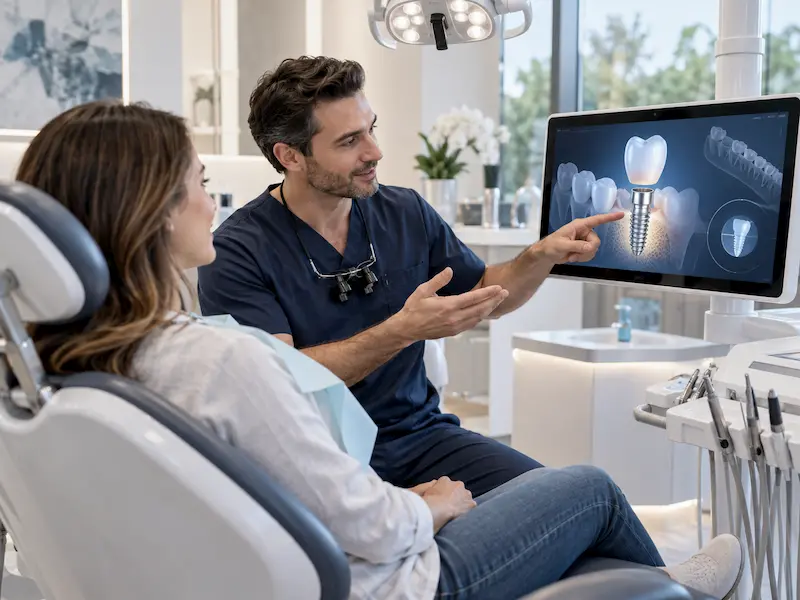
Given that every person’s oral cavity heals at a slightly different rate, the typical single-implant process is carried out through a series of organized, multi-step procedures:
- Initial Digital Consultation and Planning: Your first step involves taking high-resolution 3D volumetric scans. Dr. Polen Akkılıç and our surgical team determine your bone density and nerve paths. This ensures the dental insertion is not only rapid, but also minimally traumatic.
- Surgical Phase: Inserting the titanium implant into the gum is a fairly fast process. Putting in a single-tooth implant under local anesthesia usually takes under an hour. For international patients traveling to Turkey, this initial stay amounts to approximately 3 to 5 days.
- Bone Integration Time: This part of the schedule is the longest. Over the course of 3 to 6 months, the bone around the implant becomes so dense that the biometallic implant fuses with the jawbone.
- Placement of the Abutment and Final Crown: Once the bone tissue has merged with the titanium post, a small connector piece called an abutment is added. Then, after the surrounding gingiva heals, the permanent ceramic crown is firmly attached during a 5-to-7-day visit.
Why the Healing Phase Can’t Be Shortened
We often come across patients wondering why the permanent crown cannot be placed immediately after the titanium post is implanted. This boils down to the laws of physics and cellular behavior.
Initially, after a titanium post has been inserted into the mouth, it requires time for osseointegration to occur. This means living bone cells must migrate toward the metal surface and lock onto it. If these phases are skipped or excessive forces are applied too early, it will cause micro-motion of the post, leading to failure.
Based on our clinical practice, allowing the restoration period to align with natural development ensures the patient receives a replacement that looks, feels, and functions exactly like a natural tooth root. When shortcuts are attempted, structural issues frequently surface in the long run.
Managing Your Calendar: What International Patients Can Expect
Your stay at the clinic is a key factor in your planning, but it is not necessary for you to remain in the country for the full bone regeneration period.
The entire plan is divided into two distinct trips. The first trip is shorter—roughly 3 to 5 days—covering imaging, extractions, and surgery. The second trip takes place about 3 to 6 months later for designing, fitting, and seating your new ceramic restoration.
Frequently Asked Questions
1. Does the implant surgery itself take a long time?
No. For a single implant, the actual surgical procedure takes around 30 to 45 minutes. Even for multiple implants or full-arch restorations like All-on-4, the surgery is typically completed within a single morning session under specialized local anesthesia or sedation.
2. Can I get teeth immediately on the same day?
In specific cases where primary stability is exceptionally high, we can place a temporary aesthetic crown on the same day. However, this temporary tooth is kept intentionally out of heavy biting contact while the underlying bone heals in the background.
3. What happens if I do not have enough jawbone for an implant?
If your bone has shrunk due to missing the tooth for many years, we perform a minor bone grafting procedure. While this adds a few months to the initial healing timeline, it creates a solid, permanent foundation necessary for a successful implant.
4. Will I have a noticeable gap during the months of healing?
Never. We always provide comfortable, aesthetic temporary solutions—such as a lightweight retainer or a bonded bridge—so you can smile, speak, and socialize with total confidence while your permanent implant heals beneath the surface.
Academic References
- Albrektsson, T., Branemark, P. I., Hansson, H. A., & Lindstrom, J. (1981). Osseointegrated titanium implants: Requirements for ensuring a long-lasting, direct bone-to-implant anchorage in man. Acta Orthopaedica Scandinavica, 52(2), 155-170.
- Buser, D., Martin, W., & Belser, U. C. (2004). Optimizing aesthetic results of implants with immediate placement. Journal of Oral Maxillofacial Surgery, 62(9), 39-46.
- Gallucci, G. O., Hamilton, A., Zhou, W., Buser, D., & Chen, S. (2018). Implant placement and loading protocols in partially edentulous patients: A systematic review. Clinical Oral Implants Research, 29(S16), 106-134.
- Tarnow, D. P., Chu, S. J., & Salama, M. A. (2014). Flapless postextraction socket implant placement: The effects of bone grafting on facial marginal bone level. The International Journal of Periodontics & Restorative Dentistry, 34(3), 323-331

