


Tooth loss may seem like a purely cosmetic problem; however, it is a health issue that can affect your nutrition, speech, jawbone density, and even your overall self-esteem. For a long time, dentures and bridges have been the primary solutions that have treated the problem superficially by only replacing the visible part of the tooth without the root. That is when the dental implant came in as a revolutionary advancement. This in-depth guide will be the exploration of one of the biggest changes in the field of modern dentistry—dental implant surgical crown placement, which is identified by the dental code D6010. We will explore the science, the step-by-step procedure, the amazing advantages, and what you can actually expect if you decide to use this technology to bring back your smile.
Knowing the D6010 dental code: A lot more than just a number
In dentistry, dental procedural codes provide a clear and standard means of communication between dental offices and insurance companies. Code D6010 is the code that identifies a “surgical placement of an implant body: endosteal implant” the most. To put it simply, this code describes the first stage implantation of the titanium “screw” or “post” into the jawbone during a single-tooth dental implant process.
It is the point where everything is built upon it. It is very important to separate this from the next codes such as D6056 that refer to the custom abutment (the connector) and D6058 that refer to the crown (the artificial tooth). D6010 is the surgical procedure that makes the whole restoration possible. It is the point where science and biology come together, and a surgical artificial root is created that will serve as a permanent anchor in your jaw.
Dental implants are the future of tooth replacement
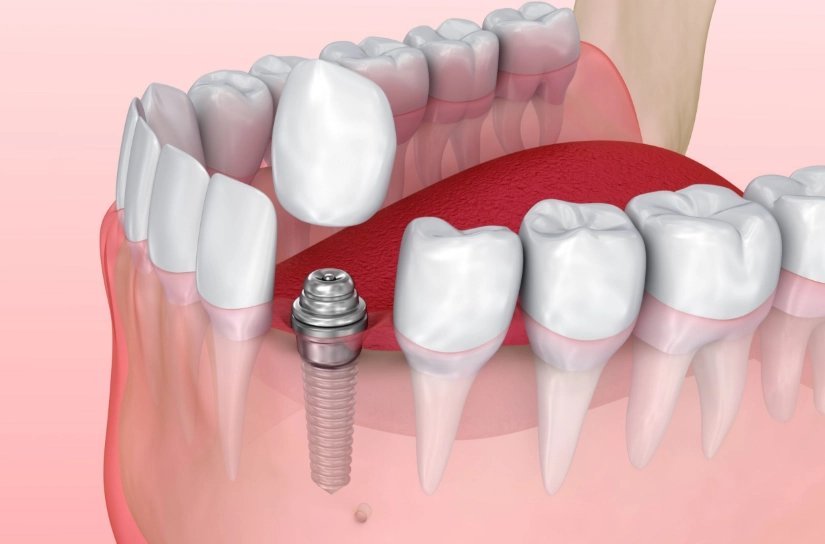
In the last couple of years, it has always been a fixed bridge that was considered the best treatment for a missing tooth. To make the bridge, the two healthy teeth that were next to the space had to be shaved so that the false tooth which was in the middle, could be supported on them. This way the problem is solved for some time, but it has significant disadvantages:
- Damaging Healthy Teeth: The permanent change of good teeth makes them weaker and more likely to get decay and infection in the long run.
- Bone Loss: When a tooth root is taken out, the jawbone where the tooth was doesn’t get stimulation from chewing. The body, in a process called resorption, starts to break down and reabsorb that bone, thus the area looks sunken after some time.
- Difficulty in Cleaning: Special floss threaders are needed to clean under a bridge, and the food and plaque that get trapped there can cause decay in the teeth that support the bridge.
Implants eliminate the problem of a dental bridge by introducing a biocompatible titanium post. Through this, they can provide the necessary stimulation to the jawbone to maintain its health. At the same time, they do not require the alteration of the neighboring teeth and operate as an independent unit.
The biological wonder: osseointegration, the base of success
Actually, the magic of a dental implant is not the metal or the ceramic but rather your body’s amazing healing ability and the acceptance of a foreign material. The process is called osseointegration, a name coined by Professor Per-Ingvar Brånemark, the Swedish orthopedist who made the groundbreaking discovery in the 1950s.
What are the exact procedures?
Titanium is a metal that is characterized by one very special property: it is osteoconductive. In a very simple way, one could say that bone cells (osteoblasts) will be directed to the implant’s surface, where they will be able to grow there in a very natural manner.
The implant post is placed in a socket (which has been very precisely drilled) in the jawbone, the body initiates the healing process. After a certain time, that may be anywhere from 3 to 6 months, the bone tissue is found to be in direct contact with the titanium implant surface (which is rough on a microscopic scale) without any soft tissue layer being intermediate.
The fusion that takes place biologically is the one that is very strong and stable—in fact, it is often stronger than the original periodontal ligament that held your natural tooth in place. This is what enables the implant to be machined to withstand the powerful forces of chewing, similar to a natural tooth.
Success in osseointegration is the primary factor that determines the long-term viability of a dental implant and will be achieved after the D6010 surgical procedure.
Examining the D6010 method in detail: From the initial consultation to the placement of the crown
The journey to a new tooth is certainly not a quick one; it requires a well-thought-out plan, an almost perfect execution, and patience during the recovery periods. Here is the detailed explanation of the whole process.
Stage 1: The comprehensive consultation and treatment planning
The first phase is probably the most important because it prepares the following stages. A successful outcome heavily depends on thorough diagnostics and honest communication.
- Medical and Dental History Review: Your dentist will conduct a complete review of your health. Diseases like diabetes (if uncontrolled), osteoporosis, and bad habits like smoking can impact healing and osseointegration significantly. Also, it is very important to tell the dentist everything about the medications and supplements that you take.
- Advanced 3D Imaging: Conventional X-ray images are good enough; however, Cone Beam Computed Tomography (CBCT) is the most reliable method for implant planning. This advanced 3D imaging gives the surgeon a very detailed view of the patient’s jawbone; this way, he can exactly determine its density, volume, and shape. Besides that, it provides the position of nerves and sinuses in relation to the place where the implant is to be fixed, thus the post can be installed securely and furthermost.
Stage 2: D6010 Surgery: The Day of Implant Placement
Here we are talking about the day when the surgery will be done. This is usually a simple local anesthesia procedure, but there are sedative options for nervous patients if it’s a single implant.
- Incision and Access: The oral surgeon or periodontist will make a small incision in the gum tissue exposing the bone under it.
- Precision Drilling: The surgeon will slowly and carefully go through the drilling stages with increasing sizes of the drills will create a small hole Then that he will widen it gradually to the prevailing diameter and depth noted in the pre-operative plan. This is done slowly and constantly with irrigation to cool the bone and prevent any damage that could lead to failure of osseointegration.
- Implant Placement: The implant post made of titanium and sterile, is thus inserted either by screwing or if gentle tapping is needed, then tapping lightly into the site already prepared. To ensure no tissue latches onto the implant during the period of healing, a final “healing cap” or “cover screw” is placed on top.
- Closure: After the gum tissue has been stitched back together, a “one-stage” implant protocol might be used in a case where a healing abutment is placed that slightly sticks out through the gum line, thus there is no need for a second surgery to expose the implant later.
The operation itself usually takes one to two hours. On the itinerary, post-instrumental pain is usually very well under control with over-the-counter pain relievers or a doctor-prescribed medication, and most patients can resume their usual activities the following day.
Stage 3: The Silent Work: Healing and Osseointegration
The most vital phase after the operation is only very little that this can be done by you. The healing period of 3-6 months is essential and cannot be compromised. During this time, you should eat soft food and refrain from putting any pressure on the implant site so as to allow the biological miracle of osseointegration that takes place silently and without disturbance. Your body is committed to the building of a lifelong partnership between the titanium implant and your jawbone.
Stage 4: The Restorative Phase: Abutment and Crown
After a dentist confirming Osseointegration through an X-ray, the final restorative phase comes next.
- The Abutment Insertion (if not already done): A two-stage intervention scenario requiring a minor second operation, if so. To gain access, the gum is incised to remove the healing cap and the permanent abutment is screwed into the implant.
- Impressions and Crown Fabrication: The general dentist or prosthodontist with the abutment on will take a very accurate digital scan or physical impression of the patient’s mouth.
- Putting the Final Crown: At the last appointment, the custom crown is put on to check for fit, bite, and visuals. When everyone is satisfied, the crown is permanently cemented onto the abutment.
Secured with the crown, your treatment is complete. You now have a fully working, visually pleasing replacement tooth that is biologically compatible with your body.
Practical Advantages: Reasons the Trip is Worth It

The time, money, and effort spent on a D6010 operation will bring back to the patient improved quality of life for a long time, which is quite a worthy investment.
- Unmatched Longevity and Value: Implants are generally more cost-effective over a lifetime if we will compare a bridge with an implant. A dental bridge may be replaced every 7-15 years depending on the situation and thus involves recurrent costs.
- Preservation of Facial Structure: Implants prevent bone resorption and thus maintain the natural structure not only of the jaw but of the whole face as well.
- Superior Oral Hygiene: An implant-supported crown can be taken care of in the same way as a natural tooth i.e., regular brushing and flossing.
- Restored Chewing Function and Nutrition: Various studies show that people with missing teeth or unstable dentures are often forced to consume only soft foods which are usually less nutritious. Implants allow you to have a healthy, varied diet as they restore nearly natural biting force.
- A Profound Boost in Confidence: The psychological impact is the thing that is most difficult to put into words. The feeling of normalcy and confidence regained when being able to smile, talk, and eat in public without the fear of being judged or feeling self-conscious is truly priceless.
Frequently Asked Questions About the D6010 Dental Code
The D6010 dental code refers to the procedure for placing a crown on a dental implant to restore a missing tooth’s appearance and function.
The implant placement takes about 1-2 hours, with the osseointegration phase taking 3-6 months for healing.
Most patients report minimal discomfort, as the procedure is done under local anesthesia, with pain manageable by over-the-counter medication afterward.
With proper care, implant-supported crowns can last 20 years or more, significantly longer than traditional bridges or dentures.
Yes, dental implants are generally safe, with a high success rate when performed by a skilled professional.
Crown materials typically include porcelain, ceramic, or zirconia, chosen for their strength and natural appearance.
Yes, if necessary, dental implants can be replaced, although they are designed to last a lifetime when cared for properly.

