


Bottle caries is early tooth decay in babies caused by sugary liquids in bottles.
What Is Bottle Caries? Protecting Your Child’s Smile
It is such a quiet heartbreak type of sorrow when in the clinic, you can witness a parent who is completely shocked and in disbelief that it is their toddler’s first teeth that are decaying. The first evidence is almost a barely visible white line,e right where the gums meet the teeth – virtually undetectable even to parents. However,t this is such a rapid development that the child can end up severely infected without proper dental care. This phenomenon is known as Early Childhood Caries (ECC), also referred to as bottle caries.
The truth of the matter is that a child’s baby or primary teeth are crucial since they set the foundation of the overall oral health in the future of the child. At Lema Dental Clinic, Istanbul, besides filling cavities, we also involve parents in the process of ensuring that these placeholder or temporary teeth are maintained in good condition until the permanent teeth are ready to take over.
Figuring out “Sugar Baths” through Science
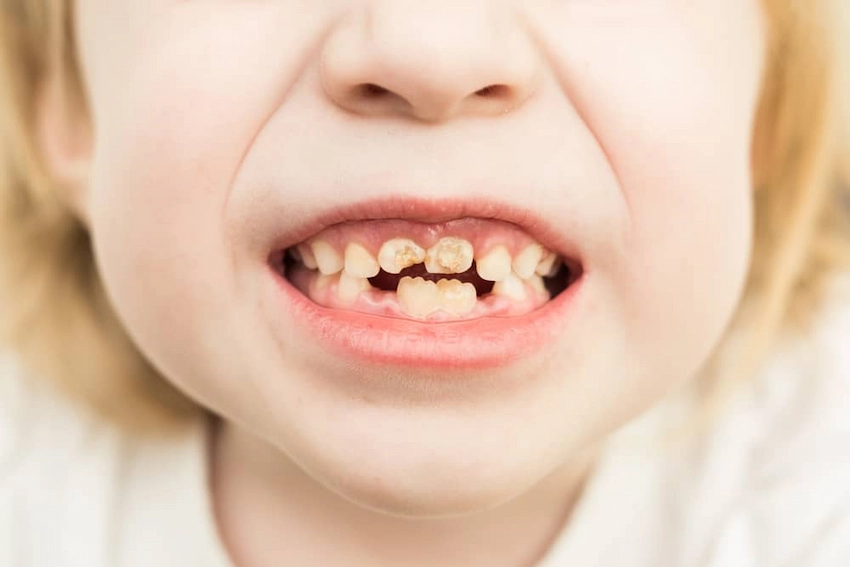
When kids drink milk, formula, or juice from a bottle just before they fall asleep, the liquid residue will continue to coat their teeth for a long time.
Now think about it, if a silver spoon is kept overnight in a bowl of vinegar, the protective layers no longer manage to withstand the constant chemical attack.
Professor Doctor Coşkun Yıldız keeps emphasizing that saliva, being the natural mouth protector, is getting a rest as its synthesis is considerably lowered. In the absence of sufficient saliva to remove the sugars, the bacteria present in the mouth, which is an infection source, will produce acids that will eat away at the enamel.
Importance of Baby Teeth
Parents frequently ask a question that goes something like this: “Why bother fixing baby teeth if they will be replaced anyway?” In fact, besides their main role as “GPS” for adult teeth, baby teeth also have a lot to do with the condition of the adult teeth that follow them. Thus, if the baby teeth decay and fall off prematurely before the adult teeth are ready to come out, the adult teeth can be misaligned, crowded, or in the worst case, not erupt at all.
Spotting the Danger: Not Just About Bottles

Naturally, bottle usage can’t be the sole cause of the problem, which can be inferred from the term itself. Dentist Polen Akkılıç and her team have discovered that several other lifestyle factors contribute to this situation:
- Using a pacifier: You might think that by dipping the baby’s pacifier in honey or sugar to comfort a crying infant, you’re really doing the right thing, but in reality, it is like you’re lowly spreading acid on their gums that is what is actually happening.
- Prolonged Breastfeeding: There is absolutely no doubt that breastfeeding is good and very healthy; however, if a baby is breastfed at night after the first teeth appear and there is no proper dental care, the harmful effects of the above scenario will be similar.
- Transmission of bacteria: In case you share the same spoon with your child or use your mouth to clean the pacifier, you are essentially transmitting the cavity-causing bacteria (Streptococcus mutans) from your mouth to your child’s.
Prevention vs. Intervention: A Comparison
The question still is: how are we going to handle this at various stages? Here is a summary of what we observe in the clinic and the solutions we employ for that.
| Stage of Caries | Visual Signs | Clinical Approach at Lema |
|---|---|---|
| Initial (Chalky) | Opaque white spots or lines near the gumline | Fluoride varnish & dietary adjustments |
| Moderate (Brown) | Light brown spots; enamel feels soft or “tacky” | Composite fillings or white restorations |
| Advanced (Severe) | Dark brown/black holes; possible abscess or swelling | Specialized crowns or gentle extractions |
| Maintenance | Healthy, pink gums and translucent white teeth | Professional cleanings every 6 months |
How We Treat Bottle Caries in Turkey
At Lema Dental Clinic we are really glad to see parents bringing their kids to us regularly not only for a check-up but also for treatment. It goes without saying, kids first of all should feel comfortable with our child-friendly fearless approach and secondly, with us, because we actually work very softly and lovingly.
An exception is a child under 3-years-old with very very severe decay. In such cases, to avoid frightening the child with the “dentist,” the treatment can be done under light sedation.
Still, prevention really matters and the question is still open. We should be talking about it anyway, right? A nd it’s not just theory, one piece of gauze is actually your best weapon against dental decay rather than a drill. What’s more, at least before the first tooth you can wipe a baby’s gums with a clean cloth dipped in water. And, it’s time for a dental check-up with the “dentist” when the first tooth is about to come (at around 6 months).
Frequently Asked Questions
Well, the truth is that it’s completely fine. Just in case a toddler actually insists on sleeping with a bottle, there is no reason why you shouldn’t give water at any time. Not only is git oing to be free from germs, but it will also help to keep the mouth hydrated.
You can ostart usinga fluoride toothpaste in dental home care straight from the eruption of the first tooth but only very little “smear” (about the size of a grain of rice). When your child turns about 3, you can initiate using a pea-sized amount.
Yes, teeth, especially the front ones are the very beginning stage of the development of speech. These teeth are essential for the making of sounds like “f,” “v,” and “th”. Missing or severely damaged teeth due to caries can cause speech problems or lisping.
Of course, Lema Dental Clinic is happy to help foreign patients and their kids. Generally, foreign parents bring their children to Turkey for dental treatments due to the high-quality medical care here and the presence of excellent doctors like Professor Doctor Coşkun Yıldız. Please tell us when you are going to be in Istanbul so that we can schedule your child’s treatment and take care of all the details.
Dr. Polen Akkılıç and her team are very skilled in using the “tell-show-do” approach with children. They are so good at dealing with kids that the dental chair can even turn into a “spaceship” and medical instruments into “magic wands” to be used for the kids’ trust.
- American Academy of Pediatric Dentistry. (2021). Policy on Early Childhood Caries (ECC): Classifications, Consequences, and Preventive Strategies. Reference Manual.
- Gussy, M. G., et al. (2006). Early childhood caries: Current evidence for aetiology and prevention. Journal of Paediatrics and Child Health.
- Moynihan, P., & Petersen, P. E. (2004). Diet, nutrition and the prevention of dental diseases. Public Health Nutrition.
- Tinanoff, N., & O’Sullivan, D. M. (1997). Early childhood caries: Overview and recent findings. Pediatric Dentistry.
- World Health Organization. (2017). Sugars and dental caries. WHO Technical Fact Sheet.

