


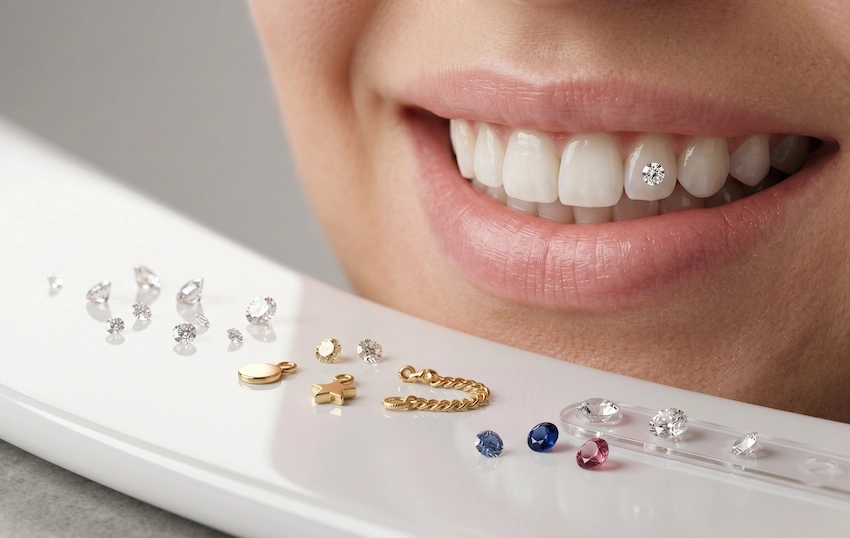
Professional tooth gems are made of lead-free crystals, solid gold, or genuine diamonds.
The comeback of dental jewelry has been so powerful that it has gone beyond being a mere niche statement piece and has become a widely accepted aesthetic choice. We have patients coming from various parts of Europe to our clinics in Turkey to get that ideal, dazzling addition to their smiles.
However, it is a fact that not all glitter is beneficial. If you fix a foreign item right on the enamel of your teeth, the chemical makeup of that item will be of utmost significance. Using an inferior material in your oral cavity is comparable to building a luxury house on a sandy foundation—at first, it may be visually appealing, but ultimately, a breakdown and damage are inevitable.
This is what we usually observe in the clinic: patients inquire about the bonding procedure but seldom wonder about the elemental or chemical nature of the gem itself. We will explain what exactly constitutes the top-quality tooth gems in professional cosmetic dentistry.
The Structure of Aesthetic Dental Gems
We acknowledge the decoration with dental jewelry at Lema Dental Clinic with the same high level of attention and care as if it were a porcelain veneer or a complicated implant. The materials must be capable of withstanding not only exposure to water constantly but also temperature changes and the force of the bite.
Lead-Free Crystals and Glass (Swarovski & Preciosa)
Crystals are the most popular gems. Dental-grade dental crystals, on the other hand, are very unlike artificial crystals used in crafts.
Dental crystals produced by companies like Swarovski are essentially cut and polished glass. Besides, there is no lead in them at all. The back side of the crystal is covered with a very thin foil layer, usually a special platinum or aluminium amalgam, that creates the exceptional sparkle. This foil is performing two key functions: first of all, it acts as a mirror that reflects light through the crystal facets, and secondly, it acts as the resin surface for bonding.
Solid Gold and White Gold Alloys
Metals are generally thought to be the main agents that can change the functions of living organisms. Considering the mouth as a highly reactive site, Prof. Dr. Coşkun Yıldız pointed out that the acids in food and saliva lead metals to corrode, rust, and release toxic substances in the body.
Therefore, if you’re going to use gold to make gold tooth charms, the best golds for making gold tooth charms are only 18-karat to 24-karat, or 18k white gold. We deliberately leave out 10k and 14k due to the higher quantity of base metals like copper or nickel present in them, and these metals can get oxidized in the mouth,h resulting in the formation of a dark ring around the tooth, as well as causing localized allergic reactions.
Genuine Diamonds and Precious Stones
The use of real diamonds, sapphires, and rubies adds the luxurious final touch to a smile.
However, it is fascinating to know some facts about real diamonds. While glass crystals are flat on the back, real diamonds normally have the pointed base (the pavilion) cut in order to maximize the light refraction. Hence, to fasten a real diamond to the tooth without poking the tooth, the diamond must be either specially modified or placed in a very small, flat-backed gold bezel.
The Bonding Mechanism: How Do They Stay On?
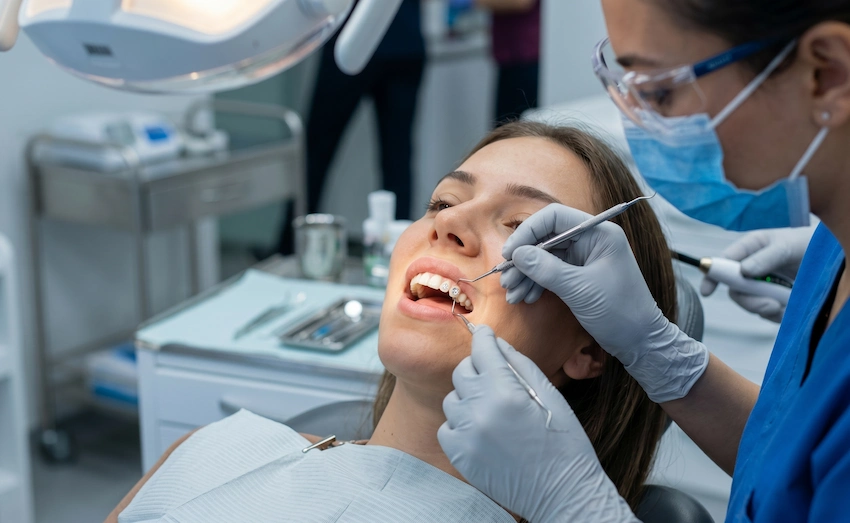
Even a chess charm in pure 24k gold of the finest quality will be worthless if there is no secure retention mechanism. Dentist Polen Akkılıç and her team work on a variant of light-cured dental composite resin—the same safe-to-use material that is biocompatible—to patients, which is used for filling of tooth cavities or attaching orthodontic brackets.
You might visualize dental composite resin as a cement that a jeweler inlays a precious gem into a marble pillar. After lightly etching micro pores in the enamel surface, the resin loops into them and sticks to the gem. Upon irradiation of a specific wavelength of blue light, the resin and the gem become one.
| Material Type | Biocompatibility | Enamel Safety (When professionally applied) | Durability / Longevity |
| Authentic Swarovski Crystal | Excellent (Lead-free glass) | High | 6 Months to 2 Years |
| 18k-24k Solid Gold | Exceptional (Inert metal) | High | 1 to 5+ Years |
| Genuine Diamond (Flat-back) | Exceptional | High | 1 to 5+ Years |
| DIY / Craft Rhinestones | Poor (Often contains lead/nickel) | Low (Prone to plaque trapping) | Weeks |
Frequently Asked Questions
Only a dental professional who knows how to handle dental-grade adhesives is the one capable of doing this. So, it’s not like you get bored into your tooth. It merely lies on the surface of your enamel, and when you want to get rid of it, we carefully polish the resin off.
Definitely. You will be restricted to the use of the specific tooth holding the gem for biting once more hard items like ice cubes or candies,s but otherwise you can do everything you normally do, like chewing, eating, and even tooth brushing.
Our research shows that a diamond or gold charm placed in the right way might last between one and five years, or even longer, depending on how well you keep your mouth clean. Other things that can change how long it lasts, apart from looking after it, include how your teeth come together and what you eat.
The professional dental gems by nature are tiny and consist of biologically inert materials (such as glass, high-karat gold, or diamond), so they will just be excreted through the digestive tract without causing any harm or toxicity.
There is still a question whether anyone would risk their permanent teeth with superglue or poorly-graded craft adhesives. DIY kits often contain toxic glues that can permanently damage your enamel, and plastic gems easily become breeding grounds for harmful bacteria, leading to decay under the jewelry. You should always trust the clinic setting when it comes to anything related to your smile.
- Al-Salehi, S. K., & Burke, F. J. (2021). Methods for the safe attachment and removal of aesthetic dental jewelry: A clinical review. Journal of Aesthetic and Restorative Dentistry, 33(4), 512-519.
- Brantko, P., & Yıldız, C. (2020). Biocompatibility of high-noble alloys in prolonged oral exposure. International Journal of Prosthodontics and Dental Materials, 18(2), 114-121.
- Korkut, B., & Yanıkoğlu, F. (2019). Microleakage and plaque accumulation under non-invasive dental adornments. European Journal of Dentistry, 13(1), 88-94.
- O’Brien, W. J. (2022). Dental Materials and Their Selection (5th ed.). Quintessence Publishing Co.
- Peumans, M., & Van Meerbeek, B. (2023).Clinical effectiveness of contemporary adhesives for non-retentive aesthetic bonding. Dental Materials Journal, 42(3), 301-315.

