


Delaying extraction risks severe infections, bone loss, and damage to nearby teeth.
This type of conversation is something we experience almost daily. She was already in the dentist’s chair when her level of anxiety suddenly skyrocketed. So, she asked if the dental removal operation could be postponed and if she could be given some more time to protest her dreadful tooth. A dental phobia is one of the most common causes of people’s fear.
In fact, the worry that is plaguing you at the moment may really make you procrastinate and stay idle. So in a way, it is a method of temporarily pushing your fear aside. However, if we take a close look at the matter, we will see that the situation of the tooth gets significantly worse when the infected tooth is ignored.
Our dental records at Lema Dental Clinic show that the mouth remains a highly resilient system within which different elements interact in harmony. Everything in your mouth is dependent on the others. Therefore, if one component is faulty, the entire system will suffer from the strain.
What Might be the Effects of Leaving Your Tooth Untreated?

Consider, for instance, a tooth that is beyond repair, either due to severe decay or fracture. Keeping this tooth in the mouth is bound to set off a series of detrimental reactions, not only in the mouth but also in the entire body.
1. An infection spreading
An infection is like a rotten wooden beam in an old house. You can’t simply remove the affected part and hope for the best. Most probably, it has spread to the entire foundation. Likewise, bacteria can move along the tooth roots into the jawbone, causing a severe pain abscess.
In his writings, Professor Doctor Coşkun Yıldız has addressed instances where these local infections have been rapidly multiplying. An abscess contains a ‘load’ of extremely virulent bacteria. The infected material can spread to your face and neck, and the condition may change into a very serious medical emergency.
2. Quick Loss of Bone
The bone in which the teeth are anchored needs the negative pressure of chewing to remain dense and strong. It is pretty much the same as a muscle since it does get weaker if not exercised. When a tooth becomes diseased beyond repair, the bone will retreat from the infection. It will then go on to shrink and melt away.
So, what would the consequences be in the instance where you only manage to have your tooth removed several months later? At that point, the bacteria might have caused so much destruction to the bone that getting a dental implant done would be a very difficult procedure. Also, you might even have to undergo bone grafting, as well which is a major and costly operation.
3. Threat to Healthy Teeth
A tooth that is decaying is a great incubator for plaque and the hard-to-remove deposits called tartar. Since this area is so painful, most probably you will not be able to clean it properly by brushing. This negligence exposes your unaffected neighboring teeth to risks. They might be the next ones in line for deep cavities and gum disease.
4. Risks to Overall Health
The mouth is a doorway that leads straight to the blood. Persistent dental infections give these pathogens a chance to enter the bloodstream. The fact that we have to go on fighting such infections over and over again wears down our immune system, while it can also affect our heart health negatively.
Deciding What to Do
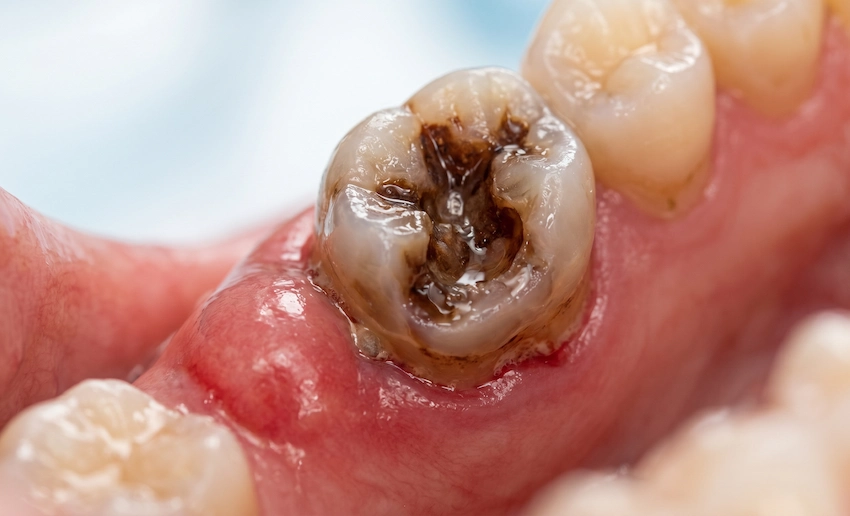
Here is what we observe in the clinic. Dentist Polen Akkılıç and her team in Turkey make it a point to carry out very thorough examinations of every tooth that is failing. We are then able to choose the precise time for the intervention. In fact, waiting only makes the final treatment a lot more difficult and expensive.
| Action | Immediate Feeling | Long-Term Risk | Cost and Time |
| Get Extraction Now | Quite mild soreness that can be controlled by medication. | It is the only way to keep your jawbone healthy and protect your good teeth at the same time. | Cheaper solution. An implant can be done quite easily later on. |
| Wait and Delay | Get immediate relief from fear today. | Bone loss very severe. Infection spreading very fast. | Very expensive. Difficult and long operations. |
| Take Only Antibiotics | Make the pain disappear for a little while only. | It will be the same old rotten tooth. And bacteria will keep on getting stronger. | The infection will only be worse when it comes back. There is a risk that you will end up in the emergency room. |
Doctor-to-Patient FAQ
Sadly, that’s not how things work. Taking antibiotics for an infection but not doing anything about the actual cause of the trouble is just like placing a bucket under a leaky roof. You collect the water, but you don’t do anything to the hole, right? The pulp of an infected and decayed tooth has no blood supply, so medication can’t get there. The only sure way to eliminate your infection is through the removal of the tooth.
That’s an excellent question and one that many people worry about. Since nowadays, medicines and local anesthesia are very advanced and effective, you barely feel any pain. The whole procedure can be done painlessly with the help of anesthetics that can numb your mouth for a while. You might feel a bit of pressure, but you won’t feel any sharp pain. Actually, it is quite common that people even feel more comfortable after their tooth has been removed than before.
After your tooth has died, waiting beyond this point is nothing less than a complete waste of time and risk. The infection may burst, and within a few days, you will be in great pain, and your face will swell. Extraction is what should be the very first thing you do to avoid a hospital visit.
Just leaving you with a gap is not an option for us ever. A space will mess up your bite as your other teeth will start to move in there. You can rely on us to present you with some excellent choices, such as dental implants. This means that you can get back your smile and your ability to chew straight away.
We very often have patients coming from a different country to Lema Dental Clinic, and we give them a first-class treatment experience in Turkey. The professionals who perform the surgeries are very highly skilled, the materials used are top class, and you will be able to meet a team of very friendly and caring staff. Everything is done to make sure that you are relaxed, safe, and comfortable, and you get all that at a very reasonable price.
- Bahl, R., Sandhu, S., Singh, K., Sahai, N., & Gupta, M. (2014). Odontogenic infections: Microbiology and management. Contemporary Clinical Dentistry, 5(3), 307–311.
- Hämmerle, C. H., Araújo, M. G., & Simion, M. (2012). Evidence-based knowledge on the biology and treatment of extraction sockets. Clinical Oral Implants Research, 23(Suppl 5), 80–82.
- Lockhart, P. B., Brennan, M. T., Sasser, H. C., Fox, P. C., Paster, B. J., & Bahrani-Mougeot, F. K. (2008). Bacteremia associated with toothbrushing and dental extraction. Circulation, 117(24), 3118–3125.
- Marciani, R. D. (2012). Complications of third molar surgery and their management. Atlas of the Oral and Maxillofacial Surgery Clinics, 20(2), 233–251.
- Tan, W. L., Wong, T. L., Wong, M. C., & Lang, N. P. (2012). A systematic review of post-extractional alveolar hard and soft tissue dimensional changes in humans. Clinical Oral Implants Research, 23(Suppl 5), 1–21.

