


Titanium is the workhorse; Zirconia is the supermodel.
Let’s be real for a second. Most dental blogs read like they were written by a robot trying to sell you a car. They list “Pros” and “Cons” and leave you more confused than when you started. At Lema Dental Clinic in Istanbul, we don’t do that. When you’re sitting in my chair, you don’t care about a “comparison list.” You care about whether that screw is going to stay in your head for the next three decades without causing an infection or snapping while you’re eating a steak.
The “metal-free” trend is everywhere right now. People hear “Zirconia” and think “Natural.” They hear “Titanium” and think “Cold Metal.” But biology doesn’t care about your aesthetic preferences. It cares about osseointegration.
The Old Guard: Why Titanium is Still the King
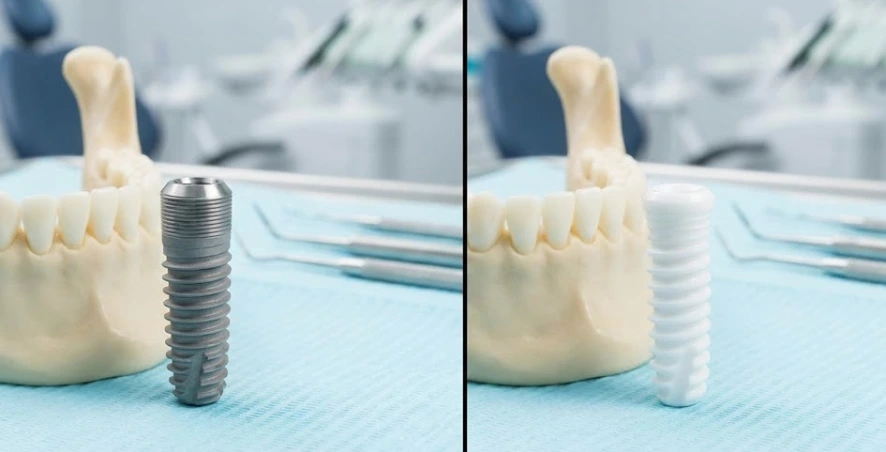
Titanium isn’t just “some metal.” It’s a biological miracle. Since the 1960s, we’ve known that human bone doesn’t just tolerate titanium—it literally falls in love with it. It fuses.
Professor Doctor Coşkun Yıldız often points out a simple fact: We have 50-year-old data on titanium. We know exactly how it behaves in a 70-year-old jaw versus a 30-year-old jaw.
- The Flex Factor: Titanium has a tensile strength of roughly 850 to 900 MPa, but more importantly, it has a slight “give.” It’s not brittle. If you trip and hit your face, or if you grind your teeth like a chainsaw at night, titanium absorbs that shock. It doesn’t snap.
- The “Grey” Myth: Yes, titanium is dark. But unless your dentist is inexperienced or your gums are paper-thin, you will never see it. At Lema Dental Clinic, we use specialized zirconia abutments on top of titanium screws. You get the strength of the metal underground and the beauty of the ceramic above ground. Best of both worlds.
The Aesthetic Challenger: Is Zirconia Actually Better?
Zirconia (zirconium dioxide) is a ceramic. It’s white. It’s “holistic.” And yes, it is beautiful.
But it’s also rigid. Very rigid. While its compressive strength is high (>1000 MPa), its fracture toughness is lower than that of titanium. Think of it like a diamond: incredibly hard to scratch, but if you hit it with a hammer at just the right angle, it shatters.
Dentist Polen Akkılıç and her team usually reserve Zirconia implants for very specific cases:
- The “Thin Tissue” Patient: If your gums are so thin we can see through them, Zirconia is a lifesaver. No shadows.
- True Metal Allergies: Rare? Yes (less than 0.6% of the population). But if you have a documented allergy to the trace metals in titanium alloys, Zirconia is your only safe harbor.
The Raw Truth: A Comparison That Actually Matters
| The Reality Check | Titanium (The Veteran) | Zirconia (The Newcomer) |
| History | Winner. 50+ years of clinical proof. | 15-20 years. Promising, but young. |
| Design | Two-piece. High flexibility for the surgeon. | Often one-piece. Harder to adjust the “angle.” |
| Healing | Fast. Bone loves it. | Slightly slower. Requires “zero-load” healing. |
| Plaque | Good. | Winner. Bacteria hate Zirconia. Gums stay pink. |
| Cost | More affordable in Turkey. | Premium pricing due to manufacturing. |
The “Clinical Hunch”: Why One-Piece Implants Scare Us
Here’s something the brochures won’t tell you. Most Zirconia implants are “one-piece.” This means the part that goes in the bone and the part that holds the tooth are one solid stick.
In the operating room at Lema Dental Clinic, this is stressful. If the implant is even one millimeter off-angle, we can’t fix it later with a custom abutment. You’re stuck with a crooked tooth. This is why we almost always recommend the two-piece Titanium system for complex full-mouth cases. It’s about precision. It’s about leaving room for human biology to be imperfect.
FAQ: Wisdom from the Lema Team
Not a chance,” laughs Professor Doctor Coşkun Yıldız. “It’s non-ferrous. You can walk through every airport in the world and have as many MRIs as you need. It’s a total non-issue.
Both are biocompatible,” explains Dentist Polen Akkılıç. “Your body won’t ‘reject’ either one if the surgery is done correctly. The ‘rejection’ people talk about is usually just a hidden infection or poor bone quality, not the material itself.
Wrong,” says the team. “In dentistry, ‘more expensive’ usually just means ‘harder to make in a factory.’ We choose the material based on your bone density and your bite force. If you’re a heavy chewer, we’re putting in Titanium. Period.
No. Both materials are incredibly resistant to the oral environment. The crown on top might stain if it’s cheap material, but the implant itself is buried. It stays as it is.
- Pjetursson, B. E., et al. (2018). Zirconia ceramic vs. titanium dental implants: A systematic review. Clinical Oral Implants Research.
- Osman, R. B., & Swain, M. V. (2015). A critical review of dental implant materials. Materials.
- Cionca, N., et al. (2017). Zirconia implants: An alternative to titanium? Clinical Oral Investigations.
- Siddiqi, A., et al. (2017). Titanium allergy: Could it affect dental implant integration? Journal of Oral Maxillofacial Surgery.

