


It depends on complexity and patient compliance.
When patients walk into Lema Dental Clinic here in Istanbul, they usually have one eye on the mirror and the other on the calendar. Whether it is an upcoming wedding or a career milestone, the question is always the same: “How quickly can we finish this?“
The reality is that your jawbone doesn’t have a stopwatch. It follows a biological process called bone remodeling. However, the tools we use to guide that process can significantly change the pace. In our clinical experience, the “speed winner” depends entirely on the architectural map of your mouth. Professor Doctor Coşkun Yıldız often notes that comparing the two is like comparing a powerful tractor to a high-speed GPS-guided sedan—both get you there, but they handle the terrain differently.
The Constant Force: Why Braces Stay in the Lead for Complexity
Think of traditional braces as the “heavy-duty engine” of orthodontics. They are fixed to your teeth 24/7, providing a relentless, steady pressure that never takes a lunch break.
For complex cases—such as severely rotated molars or significant bite realignments—braces are almost always the faster option. This is because they have a “handle” (the bracket) on every single tooth, allowing for three-dimensional control. Dentist Polen Akkılıç and her team often find that trying to fix a complex skeletal issue with aligners can actually take longer because the plastic trays lack the sheer mechanical leverage that metal or ceramic wires provide.
Digital Precision: When Clear Aligners Take the Shortcut
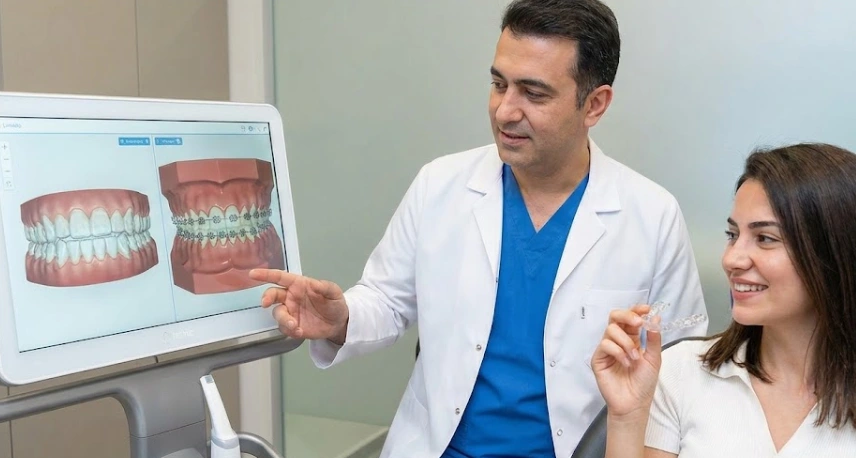
Clear aligners, like the systems we use at Lema Dental Clinic, are the “digital architects” of the dental world. In Turkey, we use high-resolution 3D scans to plan every micro-movement before you even wear your first tray.
The question remains: when do they win the race? For mild to moderate crowding or simple gaps, aligners can be a significantly faster alternative.
- No Wasted Movement: Every tray is programmed for a specific shift. There is no “trial and error” often found with manual wire tightening.
- Targeted Force: We can move specific teeth without disturbing others, which can shave months off a simple treatment plan.
The “Human Factor”: The Hidden Speed Bump
Here is what we see in the clinic every day: the fastest treatment is the one the patient actually follows. This is where the aligner “speed” often hits a wall. Since aligners are removable, their success depends entirely on your discipline.
If those trays spend four hours a day in a plastic case instead of your mouth, your treatment timeline will balloon. Braces, on the other hand, are “un-skip-able.” They are working while you sleep, eat, and speak, which provides a level of predictability that is hard to beat for a less disciplined wearer.
Speed Showdown: A Comparative Overview
| Condition | Faster Option in Turkey | Why? |
| Simple Gaps | Clear Aligners | Direct digital path with no manual wire adjustments. |
| Severe Crowding | Traditional Braces | Better torque control for cramped teeth. |
| Rotated Molars | Traditional Braces | Metal brackets provide the “grip” plastic cannot. |
| Patient Discipline | Traditional Braces | Fixed nature eliminates the risk of “forgetting” trays. |
| Predictability | Draw | Depends on biological response and clinical planning. |
FAQ: Clinical Insights from Lema Dental Clinic
It’s a common request,” says Professor Doctor Coşkun Yıldız. “Sometimes we use braces for the ‘heavy lifting’ in the first six months and then finish with aligners for the fine-tuning. This hybrid approach can be very efficient for patients visiting us in Turkey.
We occasionally use high-frequency vibration tools at Lema Dental Clinic. These can stimulate bone blood flow and potentially reduce treatment time by up to 20%, but they only work if the fundamental orthodontic pressure is consistent.
The reality is that speed has a safety limit. If teeth move too quickly, the roots can shorten (resorption). Dentist Polen Akkılıç and her team prioritize the health of the tooth over a fast deadline to ensure your smile lasts a lifetime.
Not necessarily. Because aligners require fewer emergency visits for “poked wires,” the laboratory costs and chair-time often balance out. At Lema Dental Clinic, we price based on complexity, not just the tool used.
Usually, this is due to “tracking” issues. If a tooth doesn’t move exactly as the computer predicted, we have to pause and order “refinement” trays. This is why regular check-ups in our Istanbul clinic are vital to keeping the race on track.
- Buschang, P. H., Ross, M., & Shaw, S. G. (2014). Comparative time efficiency of aligner therapy and conventional edgewise braces. The Angle Orthodontist, 84(3), 391-396.
- Ke, Y., Zhu, Y., & Zhu, M. (2019). A comparison of treatment effectiveness between clear aligner and fixed appliance therapies. BMC Oral Health, 19(1), 24.
- Gu, J., Tang, J. S., & Skulski, B. (2017). Evaluation of Invisalign treatment effectiveness and efficiency compared with conventional fixed appliances. American Journal of Orthodontics and Dentofacial Orthopedics.
- Misch, C. E. (2007). Contemporary Implant Dentistry. (Note: Contextualized for bone remodeling and biomechanical force). Elsevier Health Sciences.
- Tamer, İ., Öztaş, E., & Marşan, G. (2019). Orthodontic Treatment with Clear Aligners and The Scientific Reality Behind Their Marketing. Turkish Journal of Orthodontics.

