


Yes, laser teeth whitening is entirely safe for your enamel.
Sure, you want to have your teeth whitened. We understand you. But you also hesitate. You have heard scary stories of people’s teeth becoming as thin as paper or so sensitive that even a light breeze causes pain. Every day at Lema Dental Clinic, we bravely confront these fears. The most common question is? “Is there any chance the laser would melt my enamel?”
Let’s face it, a high-energy laser beam being pointed at your teeth is the last thing you want to hear as it sounds like a sci-fi movie where everything ends with an explosion. However, the reality and safety aspects of the situation are much less exciting. Enamel is the hardest substance in your body. It contains 96% mineral. Professor Doctor Coşkun Yıldız, who lectures in Istanbul, always tells the patients that your enamel is even stronger than your bones. So, it cannot just “melt away” when exposed to a dental light that is properly controlled.
The Smart-Key Analogy: How the Light Works
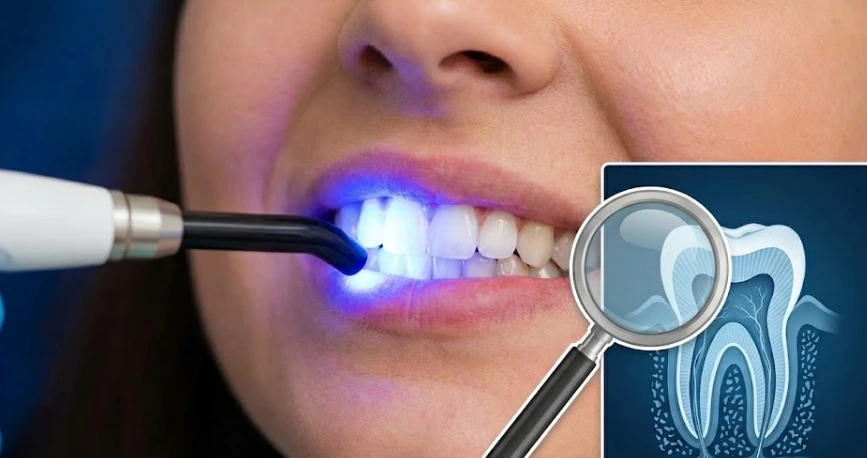
To understand the safety, you have to understand the “Lock and Key” mechanism. Think of the staining molecules trapped in your teeth as a locked door. The whitening gel we use is the locksmith. Now, on its own, the gel works slowly. The laser? That’s the smart-key.
It’s specifically tuned to a wavelength that only “vibrates” the pigment molecules. It doesn’t even see the enamel. It passes right through the mineral structure like a ghost through a wall, targeting only the dark debris. Dentist Polen Akkılıç and her team use these precise diode lasers because they don’t rely on raw heat. They rely on light-activated chemistry. No scraping. No sanding. No thinning.
The “Clinical Hunch”: Why Your Teeth Feel Weird
I’ve noticed a pattern in our Istanbul clinic: patients mistake “sensitivity” for “damage.” They aren’t the same thing.
If your teeth “zing” after a session, it isn’t because your enamel is gone. It’s because the tooth is momentarily thirsty. The whitening process temporarily dehydrates the tooth, making the internal nerve a bit “loud” for a day or two. At Lema Dental Clinic, we’ve perfected a rehydration protocol that calms that nerve almost instantly. Professor Doctor Coşkun Yıldız has found that using a high-tech desensitizer right after the laser session cuts complaints by nearly 90%. It’s a bit of a dental secret, but the “pain” isn’t the enamel screaming—it’s just a thirsty nerve.
Don’t Fall for the “Natural” Trap
Let’s face it: the concept of a super-powerful laser beam hitting your teeth is quite scary, right? That’s something you’d probably see in a sci-fi movie where things go boom. However, the reality is much less dramatic and, of course, much safer. Tooth enamel is the hardest material found in your body. It is made up of minerals by 96%.
Our doctor, Coşkun Yıldız, keeps reminding the people of Istanbul that their enamel is actually stronger than their bones. Enamel does not just “disappear” when exposed to a dental light that’s under control.
Whitening Safety: The Real Comparison
| Method | Enamel Impact | Speed | Control Level |
| Professional Laser (Lema) | Zero structural loss | 1 hour | Total (Clinician monitored) |
| Whitening Toothpastes | Low to Moderate (Abrasive) | Months | Low (User dependent) |
| Charcoal / DIY Scrubs | High (Mechanical wear) | Variable | Zero (Highly dangerous) |
| Drugstore Strips | Minimal | Weeks | Low (Often leaks onto gums) |
Expert Perspectives: 5 Direct Answers
It depends,” says Professor Doctor Coşkun Yıldız. “If your enamel is thin from acid erosion, we might steer you toward veneers. But if it’s just naturally translucent, the laser is actually the safest path because it avoids the friction of whitening pastes.
We don’t recommend it. Over-whitening can make teeth look ‘chalky.’ Dentist Polen Akkılıç and her team usually suggest a professional touch-up once every 18 to 24 months. Moderation is the soul of safety.
The laser won’t hurt your fillings, but it won’t whiten them either. They stay the same color. This is why we often plan whitening before we do a front-tooth filling or crown.
We generally wait until a patient is at least $18$. The “pulp” (the nerve center) of a child’s tooth is too large and sensitive for professional-grade gels. Safety first, vanity second.
The question remains a common fear. The answer is no. These aren’t UV tanning beds. The lasers used at Lema Dental Clinic are non-ionizing, meaning they don’t have the energy to damage DNA or cellular structures.
- Joiner, A. (2006). The bleaching of teeth: A review of the literature. Journal of Dentistry, 34(7), 412-419.
- Buchalla, W., & Attin, T. (2007). External bleaching therapy with activation by heat, light or laser—A systematic review. Dental Materials.
- Sulieman, M. (2005). An overview of tooth-bleaching techniques: Chemistry, safety and efficacy. Dental Update.
- Mondelli, R. F. L., et al. (2009). Comparative study of the dental whitening effectiveness with and without laser activation. Journal of Applied Oral Science.
- ADA Council on Scientific Affairs. (2010). Tooth Whitening/Bleaching: Treatment Considerations for Control of Color.

