


Veneers last longer, while bonding is for minor fixes.
Can You Really Skip the Braces?
Let’s face it—nobody wants to even imagine getting metal braces at 40+! Of course you want the result—the symmetry, the right alignment, the confidence—but I bet you don’t want to spend 18 months with wires or aligners.
Here at Lema Dental Clinic in Istanbul, based on clinical experience, we witness numerous international patients who make the same request: “Can’t you just cover the crookedness?”
The brief response is of course. It is sometimes referred to as “instant orthodontics”. However, the choice of the method—Composite Bonding or Porcelain Veneers—determines if a smile that is visually pleasing only for one year or that beautifully changes your face for decades is made possible.
The Quick Fix: Composite Bonding
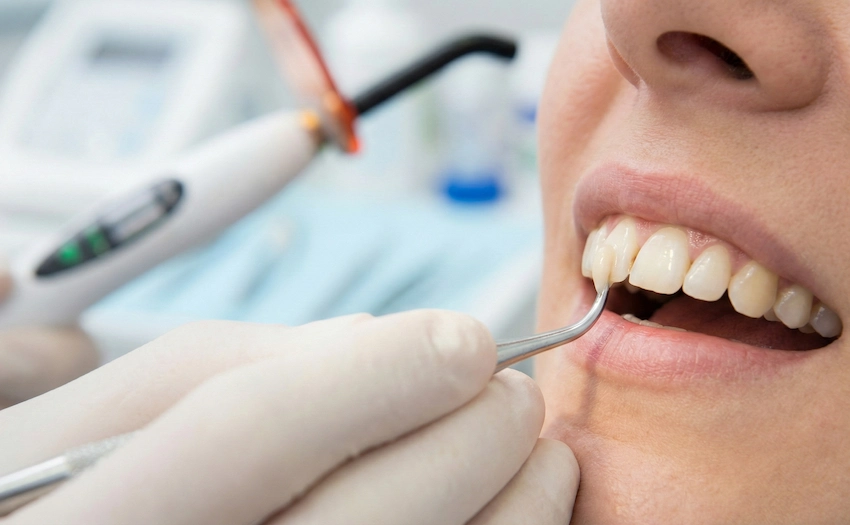
Think of dental bonding as an artist molding clay. The artist uses his hand to make the changes to the clay. In fact, a soft, tooth-colored resin is first applied to your tooth and then it is hand-shaped to fill the gaps, fix the chips, or make the teeth look as if they are well aligned. There is no doubt that this is a treatment that adds to the tooth.
Dentist Polen Akkılıç and her team often suggest the same to younger patients or people with very slight aesthetic issues.
Bonding (Clay) vs. Veneers: Straight Teeth No Braces?
Think of a brick with a chipped corner in the wall. Bonding is like patching that chip with mortar. The wall looks complete again but the quality and longevity of the patch are only comparable with the original brick if the mason is skillful. However, with time, that patch could get dirty or wear down quicker than the brick.
Advantages:
- No Waiting Time: You can have it done in just one session.
- Minimal Damage: We rarely have to touch your natural enamel.
- Cheap: In general, it is cheaper upfront than porcelain.
On the other hand:
Resin is a porous material. So, if you are a fan of red wine, espresso, or Turkish tea, bonding will definitely stain over time. Also, bonding lacks the property of natural teeth to “reflect light.” It may appear a little dull compared to enamel translucency.
The Gold Standard: Porcelain Veneers
If bonding is repairing a brick, then Porcelain Veneers is the equivalent of covering the entire building with a brand-new, architectural facade. These are thin, custom-made shells of medical-grade ceramic (typically E-max or Zirconia) that are placed on the front side of the teeth.
At Lema Dental Clinic, we run this as our signature. Patients typically seek the durability and aesthetics of porcelain when travelling from other countries to Turkey in search of a “Hollywood Smile”.
Why Professor Doctor Coşkun Yıldız Is a Fan of Porcelain
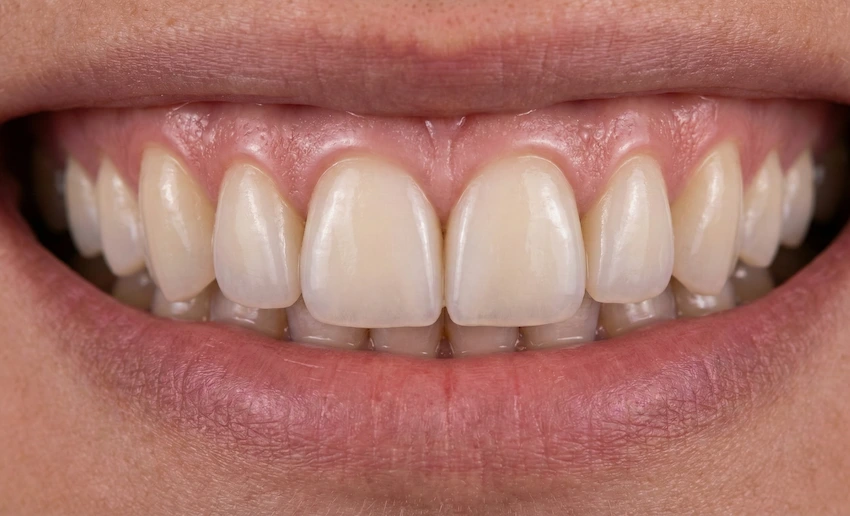
Professor Doctor Coşkun Yıldız often repeats the argument that bonding is entirely dependent on the skill and dexterity of the dentist in the moment as veneers are manufactured. They go through a digital designing phase, then a firing process in a kiln. This makes them extremely hard—the ones that are hardest in some cases surpass the hardness of natural tooth enamel.
Pros:
- Stain-resistant: Porcelain is just like glass; coffee cannot adhere to it.
- Power of correction: We can mask a much greater number of misalignments with veneers than with bonding. Basically, we can “rebuild” the arch.
- Lifetime: If used properly, the lifetime of such doubles the bonding time.
Cons:
Some preparation is needed. To avoid the veneer appearing too thick, we generally need to cut away a very thin layer of enamel (only about the thickness of a contact lens). It is a commitment, but the results are permanent.
Comparison: Which “Instant” Path is Yours?
We have observed the following in our practice when we compare the two major options for patients willing to give up braces.
| Feature | Composite Bonding | Porcelain Veneers (E-max / Laminate) |
| Primary Material | Composite resin (plastic–glass blend) | Medical-grade ceramic |
| Stain Resistance | Low (absorbs pigments over time) | High (resistant to most stains) |
| Durability | 3–7 years (prone to chipping) | 15–20+ years (highly durable) |
| Procedure Time | Single visit | Two visits (5–7 days in Turkey) |
| Best For | Minor chips, small gaps, and younger patients | Full smile makeovers, crowding, and color correction |
| Reversibility | Mostly reversible | Irreversible (enamel preparation required) |
The Decision: When to Choose What?
For instance, if your teeth resemble the zipper of a jacket that isn’t closed without any help, just applying veneers may not be effective enough. In such cases, braces before the veneers may be the solution.
In contrast, 90% of the people who pass through the door of our clinic in Istanbul can get the “straight” look immediately through veneers. With them, we can simultaneously change the shape and the angle of the teeth.
- Opt Bonding if: You have a single crooked tooth, or a minor gap and you want to keep the expenses down.
- Opt Veneers if: A Lema “Hollywood Smile” is what you want. If you are dreaming of that uniform, shiny, pretty row of teeth as in the commercials, resin bonding is simply incapable of producing that high-gloss finish.
FAQ: Answers from the Chair
If the veneers are well done, the answer will be no. We have a huge range of colors. Even though most of our international patients prefer the “Bleach White” effect, with porcelain layering the veneers can look totally natural with translucency at the biting edge. It’s your smile; we just help you design it.
We cannot compromise on your comfort. During the preparation phase, local anesthesia is employed so you won’t feel any pain. Polen Akkılıç is well known as a very gentle dentist. There are sedation techniques available for nervous patients.
Yes, however, try to be rational. Porcelain is a very hard material, but it is not indestructible. Under no circumstances should you use your teeth as tools ( absolutely no bottle opening! ), and it’s a good idea to get the habit of cutting hard fruits, say apples or pears, with a knife rather than biting into them. That way, the investment will be safe.
Your stay will usually be 5–7 days if you are getting an entire set of veneers. This period covers the time needed for your preparation, your custom teeth fabrication in the lab, and the sealing and polishing of the final product.
The advantage of bonding is that it can be repaired quite simply. There’s no need for you to worry as we always treat such cases with a minimum of fuss. You return; we put some new resin on, light cure it and polish it. Veneers hardly ever chip. But in case they are, the only option usually is to replace the entire veneer.
- Magne, P., & Belser, U. (2022). Bonded Porcelain Restorations in the Anterior Dentition: A Biomimetic Approach. Quintessence Publishing.
- Peumans, M., Van Meerbeek, B., Lambrechts, P., & Vanherle, G. (2000). Porcelain veneers: a review of the literature. Journal of Dentistry, 28(3), 163-177.
- Dietschi, D., & Devigus, A. (2011). Prefabricated composite veneers: historical review, indications and clinical application. European Journal of Esthetic Dentistry, 6(2), 178-187.
- Gurel, G. (2003). The Science and Art of Porcelain Laminate Veneers. Quintessence Publishing.
- Alghazzawi, T. F. (2016). Advancements in CAD/CAM technology: Options for practical implementation. Journal of Prosthodontic Research, 60(2), 72-84.

