


It is a manageable process similar to a heavy cold.
A situation you may have faced if the doctor informed you that you need dental implants in the upper jaw is a lack of sufficient bone. The solution is often a procedure that sounds admittedly intimidating—a sinus lift.
At Lema Dental Clinic here in Turkey, we find that the phrase “sinus lift” causes more anxiety than the actual procedure. Patients imagine an invasive, painful ordeal with a long, difficult recovery.
The reality is quite different. While it is oral surgery, modern techniques have made the recovery far more manageable than most anticipate. As clinical partners to world-renowned surgeons like Professor Doctor Coşkun Yıldız, we spend a lot of time demystifying this process. We want you to understand not just what happens, but how it feels afterward.
Think of your upper jawbone like the ceiling of your mouth. Just above that ceiling is an “attic space”—your maxillary sinus. When you lose teeth, the “floor” of that attic gets thinner. To place an implant safely, we need to gently raise the attic floor and reinforce it with new bone material. That is a sinus lift. It’s foundational work for your future smile.
The First 72 Hours: Navigating the Initial Healing
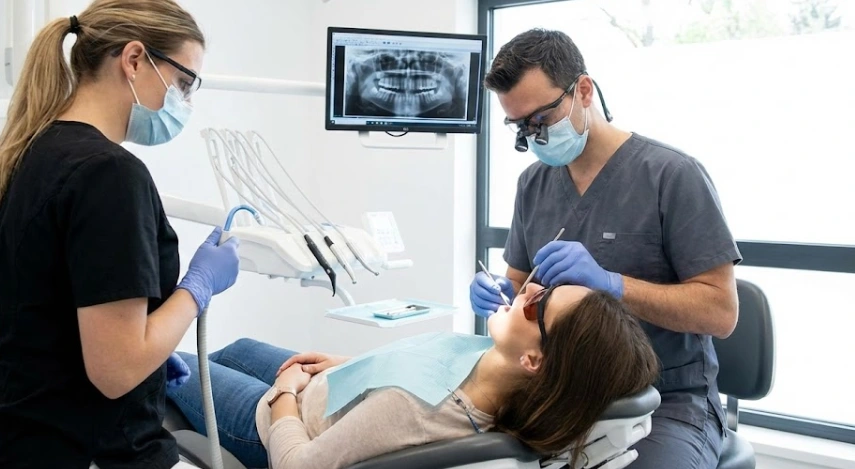
The surgery itself is painless due to the use of local anesthesia or sedation. The recovery time is counted from the moment the local anesthesia wears off.
Day 1-3 are crucial. This is the peak inflammatory phase. You won’t necessarily feel sharp pain—most of our patients describe it as a dull ache or pressure in the cheek and sinus area, similar to a heavy head cold.
Here is what we see in the clinic: Swelling is normal. It is not a complication; it is your body rushing healing factors to the site. The swelling may extend up to the lower eye area. Bruising can also occur, sometimes appearing a few days later.
Professor Doctor Coşkun Yıldız highlights a straightforward mantra for these first three days: Ice, rest, and elevation. Elevating your head with extra pillows allows the fluid to flow away from your face, thus greatly reducing the fullness feeling. Also, we give you strong anti-inflammatory drugs and painkillers to ensure your comfort.
The Golden Rules of the First Two Weeks

The swelling generally starts to go down quite quickly again from day four or five. You really will be back to the old you. But this is the “danger zone” in terms of compliance. You are feeling better, so you could be tempted to do too much too soon.
One of the key factors of a successful sinus lift is ensuring the protection of the delicate lining of your sinus cavity. Dentist Polen Akkılıç and her team always explain to their patients using the “eggshell analogy” – imagine the sinus membrane to be as delicate as the thin skin of a raw egg. We have lifted it and put bone under it. If you generate a lot of pressure, that skin will come off, and the whole thing will be a failure.
To protect that membrane during the first two weeks, you must adhere to strict pressure protocols:
- Do not blow your nose. Wipe gently if needed.
- Sneeze with your mouth open. This directs pressure out of your mouth, not up into your sinuses.
- Avoid drinking through a straw. The sucking motion creates a vacuum in the mouth.
- No heavy lifting or strenuous exercise. Raising your blood pressure can cause bleeding to restart.
Recovery Roadmap: Normal vs. Alert Signals
It helps to know what is part of the process and what requires attention.
| Timeline | Normal Experiences (What to Expect) | Alert Signals (Contact Lema Clinic) |
| Days 1-3 | Moderate swelling, bruising, minor oozing of blood, dull ache manageable with meds. | Active, bright red bleeding that won’t stop with pressure. Fever over 38°C (100.4°F). |
| Days 4-7 | Swelling peaks then subsides. Stitches may feel tight or itchy. | Sharp, throbbing pain not helped by medication. Increased swelling after Day 4. |
| Week 2 | Feeling generally well. Gum tissue looks pink and healing. | A sudden rush of salty fluid in the nose or mouth. Feeling bone particles in the mouth. |
The “Silent Phase”: Osseointegration (Months 3-6)
Typically, you will be scheduled for a revisit at Lema Dental Clinic for a follow-up and stitch removal about ten to fourteen days after the surgical intervention. At this stage, visually, your gums would have appeared almost completely healed.
However, from a microscopic point of view, this is the secret spot where most of the biological events that lead to healing occur and where the real magic happens. It is through the next several weeks that the gingiva heals, whereas the osseous graft incorporates and matures for a longer duration in months.
This is the stage where the implant integrates with the bone, and the implant becomes a stable fixture in your jaw. Essentially, the graft serves as a framework to which your own bone can eventually attach. Your body will gradually grow new blood vessels into the grafting material, break it down and replace it with living bone during a 4 to 9-month period.
Compare it to a construction site where concrete is being poured for a building’s foundation. At times, the surface may seem like it is done but in reality, it will need a few months to get hard from within before it can bear the weight of a house (or the dental implant).
You won’t experience any discomfort or pain coming from this area during the ‘resting’ period; thus, it is more or less like a normal life scenario. The only thing is that you have to be a little more patient to allow the foundation to get strong enough for us to finish your smile story here in Turkey.
From the Specialist’s Desk: Answers to Your Concerns
Honesty is key here: you will be sore. It is, after all, oral surgery. However, most patients report that the pain is far less than they feared and is easily managed with the prescription painkillers we provide. It’s rarely sharp pain; it’s more of a deep, throbbing ache that fades significantly after 48 hours.
This is a very common question for our international patients. We generally recommend waiting at least 3 to 5 days before flying. Cabin pressure changes can affect the sinuses. We need to ensure your initial healing is stable before you board a plane. We will clear you for travel during your follow-up appointment.
Not necessarily. Sometimes, a few tiny grains of the bone graft material escape from the incision site during the first few days. This feels like sand in your mouth. It’s usually nothing to worry about. However, if you feel a large amount of material, please contact us immediately.
For the first week, you are on a soft-food diet. Think yogurt, lukewarm soups, mashed potatoes, and scrambled eggs. Avoid anything hot, spicy, or crunchy, as this can irritate the incision site. You can gradually reintroduce firmer foods in the second week, but chew on the opposite side.
Every body heals differently. The timeline depends on the amount of bone we had to build and your own biology. A small lift might be ready for an implant in four months; a massive reconstruction might need nine. At Lema Dental Clinic, we don’t rush biology. We wait until the bone is clinically solid to ensure your implants last a lifetime.
- Chiapasco, M., & Casentini, P. (2018). Horizontal bone augmentation procedures in implant dentistry: prosthetically guided regeneration. Periodontology 2000, 77(1), 213–240.
- Testori, T., Drago, L., Wallace, S. S., Capelli, M., Galli, F., & Zuffetti, F. (2012). Prevention and treatment of postoperative infections after sinus elevation surgery: clinical consensus and recommendations. International journal of dentistry, 2012, 365809.
- Pjetursson, B. E., Tan, W. C., Zwahlen, M., & Lang, N. P. (2008). A systematic review of the success of sinus floor elevation and survival of implants inserted in combination with sinus floor elevation. Journal of clinical periodontology, 35(s8), 216-240.
- Starch-Jensen, T., Aludden, H., Hallman, M., Dahlin, C., & Jensen, S. S. (2018). A systematic review and meta-analysis of long-term studies (five or more years) assessing maxillary sinus floor augmentation. International journal of oral and maxillofacial surgery, 47(1), 103-116.
- Wallace, S. S., & Froum, S. J. (2003). Effect of maxillary sinus augmentation on the survival of endosseous dental implants. A systematic review. Annals of Periodontology, 8(1), 328-343.

