


Identifying root canal infection signs.
In the world of restorative dentistry, there is perhaps no phrase that triggers more unearned anxiety than “root canal.” However, for those of us in the operatory, a root canal is not the enemy—it is the ultimate rescue mission. It is the final barrier between keeping your natural anatomy and facing the irreversible path of extraction.
Our philosophy at Lema Dental Clinic, Turkey, is basically centered on preserving biology. Professor Doctor Coşkun Yıldız regularly reminds his patients that although implants nowadays are perfect pieces of engineering, nothing can really match the sensory experience and biomechanical balance of your own tooth. However, for a rescue to be successful, timing is everything.
The Anatomy of an Internal Siege
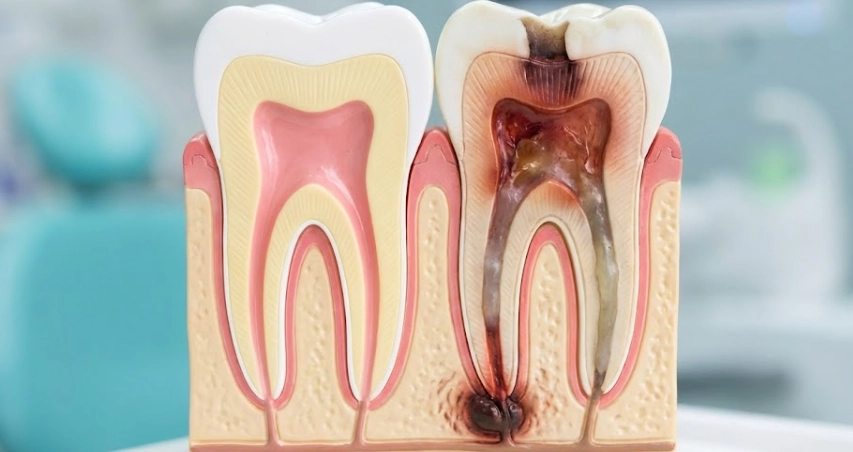
Signs of infection would be much easier to spot if you understand first the tooth’s “inner sanctum,” i.e. the pulp. The pulp is a sensitive area consisting of nerves, blood vessels, and connective tissue. When bacteria invade this section through a deep cavity or a hidden crack, the tooth’s internal pressure rises.
Imagine an infected tooth as a steam boiler that’s been over-pressurized and has no safety valve. The infection eventually extends down the root canals to the jawbone where it forms a pocket of pus called an abscess, thus the infection travels down the root canals to the jawbone.
Dentist Polen Akkılıç and her team point out that by the time you experience pain, the “siege” has been going on for quite some time already. These are the signs that we look for during clinical examinations in Istanbul.
4 Red Flags: Is Your Tooth Sending an SOS?
Symptoms are often so subtle that they barely give any warning until, in fact, one gets completely unbearable. However, let’s examine clinical markers indicating the loss of pulp vitality at a deeper level of the pulp.
- The “Lingering” Temperature Response: A tooth reacting to cold is a normal thing. However, a pain that beats for 30 seconds or even longer after the cold source is removed is not normal. This lingering pain is one of the hallmark signs of pulp infection that has gone irreversibly damaged.
- Spontaneous, Nocturnal Pain: If a dull, throbbing pain wakes you up in the middle of the night when you don’t expect it and during your sleep, and no alarm clock nor any other event is provoking the pain, then the infection is probably at its late stage.
- The “Pimple” on the Gums: Parulis or fistula is a small swelling of the gums,a “pimple” that you can see on your gums nearest. This is a main outlet for the infection inside the bone. If you have a taste of metal in your mouth or you suddenly experience a gush of liquid, the abscess is on its way to relieve its pressure.
- Discoloration of a Single Tooth: When a single tooth in that one of your teeth turns gray, dark yellow, or brownish in comparison to the rest of the teeth, it will likely be a sign that the internal blood supply has been completely cut off. The tooth is essentially “bruised” from the inside out.
Comparison: Root Canal Treatment vs. Tooth Extraction
In our experience at Lema Dental Clinic, patients often ask if it’s easier to just “pull it out.” Here is how the two paths compare:
| Feature | Root Canal (The Rescue) | Extraction & Implant (The Replacement) |
| Natural Anatomy | Preserved. | Lost. |
| Duration | Usually 1-2 visits. | 3-6 months (including healing). |
| Procedure | Minimally invasive; local anesthetic. | Surgical; involves bone healing. |
| Biting Force | 100% (Natural proprioception). | Approx. 80-90%. |
| Cost in Turkey | Lower long-term investment. | Higher (includes implant, abutment, & crown). |
The “Save the Tooth” Protocol in Turkey
When you visit us for a root canal in Turkey, the question remains: how do we ensure success? We utilize advanced endodontic technology that makes the procedure remarkably similar to getting a standard filling.
“The secret to a successful root canal is complete debridement,” explains Professor Doctor Coşkun Yıldız. “We don’t just ‘clean’ the canal; we use microscopic magnification and ultrasonic irrigation to ensure every microscopic pocket of bacteria is neutralized.”
Once the canals are sterile, they are sealed with a biocompatible material called gutta-percha. At Lema Dental Clinic, we almost always recommend following this with a high-strength porcelain crown to prevent the now-brittle tooth from fracturing under the pressure of chewing.
FAQ: Clinical Perspectives on Root Canal Therapy
The reality is the opposite,” says Dentist Polen Akkılıç. “A root canal stops the pain. With modern local anesthetics used at our clinic, you should feel nothing more than the sensation of pressure. The ‘painful root canal’ is a myth from a pre-modern era of dentistry.
The question remains one of systemic health. An untreated dental abscess doesn’t just stay in the tooth. Bacteria can enter the bloodstream, potentially leading to a serious condition called cellulitis or even affecting heart valves. The tooth will eventually lose all bone support and fall out on its own, but the damage to the jawbone can be extensive.
Yes,” warns Professor Doctor Coşkun Yıldız. “While the inside of the tooth is sealed, the outside is still natural enamel. You must brush and floss exactly like a normal tooth. If decay starts at the edge of the crown, the infection can return.
Think of it like a minor surgery. While the nerve inside the tooth is gone, the ligaments around the tooth are still very much alive and were likely inflamed by the infection. It takes a few days for the “bruised” feeling in the jawbone to settle down.
Unfortunately, no,” the team notes. “If the tooth is cracked vertically down into the root, or if there is not enough healthy structure left to support a crown, extraction may be the only safe option. This is why we emphasize coming to see us at the very first sign of sensitivity.
- Bender, I. B. (2000). Reversible and irreversible pulpitis: Diagnosis and treatment. Journal of Endodontics.
- Haapasalo, M., et al. (2011). Irrigants and intracanal medicaments in endodontics. Dental Clinics of North America.
- Siqueira, J. F., & Rôças, I. N. (2008). Clinical implications and microbiology of bacterial persistence after treatment. Journal of Endodontics.
- Torabinejad, M., & Walton, R. E. (2014). Endodontics: Principles and Practice. Elsevier Health Sciences.
- Zehnder, M. (2006). Root canal irrigants. Journal of Endodontics.

